Wholesale Handbags: How to Buy Handbags at Scale With Predictable Pricing, Assortments and Reorders
What does it cost to buy wholesale handbags at scale, and where does the money actually go? A wholesale handbag order is six costs stacked on top of one another - material, hardware, labour, tooling, packing and freight - and the unit price on a quotation is the sum of those six divided by the quantity, so the two variables that decide it are the specification and the run length. At MOQ 500 pcs per style / colourway the fixed costs dominate the number; at 2,000 pcs the same fixed costs are spread four times thinner and the material line takes over. Wholesale handbag pricing improves with run length because the fixed costs - the plating bath, the weaving minimum, the line changeover - are divided across more units. The rest of the arithmetic on a scaled programme is equally fixed: 6-10 working days to a first sample, 35-50 days of bulk production, inspection at AQL 2.5 under ISO 2859-1, and shipment FOB Xiamen. This page breaks the unit cost down line by line, shows what changes between 500 and 2,000 pieces, and sets out the assortment, freight and reorder arithmetic behind a first bulk order.
- The Unit Cost Stack: Six Lines Behind a Wholesale Price
- Price Tiers: What Changes Between 500 and 2,000 Pieces
- How to Read a Wholesale Price Break
- Assortment Planning: How Many Styles Before an Order Works
- Category Mix: Six Silhouettes and Their Sell-Through Behaviour
- Margin Math for Resellers
- Calculating a Healthy Landed Margin
- Freight, Duty and the Landed Cost Equation
- Lead Time and Reorder Timing
- Payment Terms and Trade Assurance
- Quality Grading and Defect Allowance
- What a Defect Allowance Should Cover
- Packaging That Survives the Channel
- Returns, Claims and Who Pays for What
- A First Order Plan That Does Not Get Stuck
What does it cost to buy wholesale handbags at scale, and where does the money actually go? A wholesale handbag order is six costs stacked on top of one another - material, hardware, labour, tooling, packing and freight - and the unit price on a quotation is the sum of those six divided by the quantity, so the two variables that decide it are the specification and the run length. At MOQ 500 pcs per style / colourway the fixed costs dominate the number; at 2,000 pcs the same fixed costs are spread four times thinner and the material line takes over. Wholesale handbag pricing improves with run length because the fixed costs - the plating bath, the weaving minimum, the line changeover - are divided across more units. The rest of the arithmetic on a scaled programme is equally fixed: 6-10 working days to a first sample, 35-50 days of bulk production, inspection at AQL 2.5 under ISO 2859-1, and shipment FOB Xiamen. This page breaks the unit cost down line by line, shows what changes between 500 and 2,000 pieces, and sets out the assortment, freight and reorder arithmetic behind a first bulk order.
Wholesale programme numbers
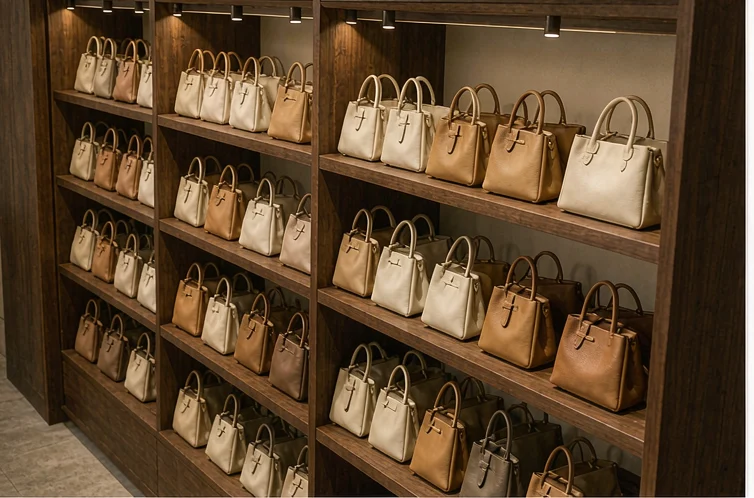
The Unit Cost Stack: Six Lines Behind a Wholesale Price
A wholesale quotation is not a number that a partner invents; it is a stack of six costs, five of which are set by the specification and one of which is set by the freight market. Buyers who learn to read the stack stop asking whether a price is good and start asking which line moved, which is the only question that produces an answer. The stack also explains the two things that confuse first-time bulk buyers: why a bag that looks simple can be expensive, and why doubling the quantity does not halve the price.
| Cost line | What sets it | How it behaves with volume | Typical share |
|---|---|---|---|
| Material | Leather grade and thickness, or coated fabric weight; hide or roll yield | Falls slowly - better nesting at volume, but the hide price is the market price | 35-50% |
| Hardware and trimming | Zipper gauge, plating specification, closure type, webbing | Falls sharply - the plating bath is priced per bath, not per piece | 10-20% |
| Labour and operations | Operation count: skiving, edge painting, reinforcement, lining | Falls a little - the operation count does not change with quantity | 15-25% |
| Tooling | Dies, moulds, embossing plates, digitised stitch files | Fixed - amortised, which is why it matters less above 1,000 pcs | 0-8% |
| Packing | Polybag, carton grade, barcode, hang tag, insert | Falls slowly - cartons are bought in lots | 3-7% |
| Freight and handling | Carton volume, mode, port pair, fuel and peak surcharges | Falls per unit with consolidation, rises with peak season | 5-15% |
Read that table twice and the two classic surprises disappear. A simple-looking tote in full-grain leather with an open top can cost more than a structured satchel in coated fabric, because the material line is two to three times larger and the operation count is not the dominant term. And doubling the quantity never halves the price, because three of the six lines - material, labour and packing - are essentially linear in units. Only hardware, tooling and freight consolidation reward volume strongly.
Price Tiers: What Changes Between 500 and 2,000 Pieces
The four tiers below describe what actually improves as a run grows. Everything that improves does so for one of three reasons: a lot size is finally filled efficiently, a fixed cost is amortised across more units, or the line runs long enough that the set-up is no longer a meaningful share of the day. Nothing improves because anyone is being more generous. The tier arithmetic is set out in full in wholesale pricing tiers at 500 versus 2,000 pieces.
| Tier | Quantity | What improves | Who it suits |
|---|---|---|---|
| Entry | 500 pcs per style / colourway | Full branding package at the baseline price | A first bulk order or a market test |
| Capsule | 500 pcs per colourway across 2-3 colourways | One shared material buy; labelling priced once | A boutique house assortment |
| Volume | 1,000-3,000 pcs per style | Better hide nesting, hardware price breaks, amortised tooling | An established e-commerce assortment |
| Seasonal programme | 5,000+ pcs across a season | Reserved capacity and a price held for the season | An importer or distributor |
How to Read a Wholesale Price Break
A price break is only meaningful if the specification is held constant across the tiers. Ask for all four quantities quoted against one tech pack, then check whether the material and hardware lines are identical between them. If they are not, the break is partly a substitution, and the buyer is being shown a cheaper bag rather than a cheaper price.
- Request every tier against the same specification, and confirm the material line is unchanged.
- Separate tooling from unit price, so a die cost is not silently recovered on every piece.
- Check whether the packing line changes - a higher carton count per carton lowers freight per unit.
- Ask what happens to the price if the dye lot is exhausted mid-run, since a second lot resets the material buy.
- Confirm the validity date of each tier; a hide-linked input cannot be held for ninety days.
Assortment Planning: How Many Styles Before an Order Works
The most common first-order mistake is not price, it is width. A buyer with a 1,500-piece budget spreads it across eight styles, receives 190 pcs of each, and discovers that no single style is deep enough to survive a month of sell-through or to justify a reorder. Depth beats width in a first order because the reorder decision needs data, and 190 pieces does not produce data - it produces noise. The planning logic is covered in how to buy wholesale handbags in bulk without getting stuck.
One style, three colourways
The safest first order: 500 pcs per colourway, one pattern, one shared material buy. Colourway data arrives cleanly, and the winner can be doubled on the reorder without re-engineering anything.
Two styles, two colourways
Adds a silhouette test to the colour test. Twice the patterns to manage, but it answers two questions at once and still holds 500 pcs in every cell of the grid.
Three styles, one colourway
The assortment test: tote, shoulder and crossbody in a single colour. Best where the buyer already knows the palette and needs to learn which silhouette the channel wants.
Mixed depth
One hero silhouette at 1,000 pcs and two supporting styles at 500 each. Concentrates risk where the data is strongest and still fills a shelf with three shapes.
Whatever the shape, the rule that protects a first order is that every cell of the grid stays at or above the 500-piece minimum. Dropping a cell to 200 pcs does not save money: it buys a partial dye lot, a partial plating bath and a line changeover for a third of the units, which is the most expensive way to buy a bag.
Category Mix: Six Silhouettes and Their Sell-Through Behaviour
Silhouettes behave differently in a wholesale assortment, and the differences are repeatable enough to plan around. Tote bags carry volume and read well in a listing photograph; shoulder bags convert across the widest age range; crossbody bags generate the highest repeat purchase; satchels carry the highest ticket but need structure and therefore cost more; hobo bags are soft, cheap to make and heavily seasonal; bucket bags convert on novelty and need careful sizing. Which combination suits a channel is covered in the wholesale styles that sell fastest for boutiques.
- Tote: the volume anchor. Largest uninterrupted branding panel, cheapest to photograph, and the safest start for a first bulk order.
- Shoulder: the conversion anchor. Strap drop decides whether it sells, so specify it in millimetres; see a stocking buyer's guide to shoulder bags.
- Crossbody: the repeat anchor. Hardware carries the brand here, and the slider is the part customers touch most.
- Satchel: the ticket anchor. Interlining and stiffener add operations, so it sits at the top of the cost band and the top of the price band.
- Hobo: the margin anchor. Soft body, curved seam, low operation count, and a pronounced seasonal curve.
- Bucket: the novelty anchor. Drawcord and base construction drive cost, and sizing decides whether it converts.

Margin Math for Resellers
Wholesale only works if the arithmetic is done on the landed number rather than the FOB number. A reseller who multiplies the FOB price by three and calls it a retail price is pricing on about 60 percent of the real cost, because freight, duty, inland delivery, marketplace commission, payment processing and returns all sit between the factory gate and the customer. The comparison between buying wholesale and buying at retail prices is set out in the margin math for resellers.
Calculating a Healthy Landed Margin
Work backwards from the retail price rather than forwards from the unit cost. Take the price the channel will bear, subtract the commission and processing the channel takes, subtract the duty and inland delivery on each unit, and what remains is the ceiling for the landed cost. A multiple of three on landed cost is the working target for a branded bag; a multiple of two and a half is the floor at which the channel economics still function. The calculation is set out in how to calculate a healthy reseller margin.
- Start from the retail price the channel will bear, not from the unit cost.
- Deduct marketplace commission and payment processing before anything else.
- Add duty, inland delivery and any fulfilment fee per unit to reach the landed cost.
- Reserve a returns provision - a 3-6 percent rate is normal for soft goods.
- Target three times landed cost, and treat two and a half times as the floor.
Freight, Duty and the Landed Cost Equation
Freight is quoted on carton volume rather than on piece count, which is why two quotations for the same bag can differ by a meaningful amount at the destination. A soft hobo compresses into a carton; a structured satchel does not. That difference is decided at the packing line, and it is worth asking for the carton quantity and the carton dimensions before comparing landed costs. The mechanics of the Xiamen leg are set out in FOB Xiamen shipping to a buyer's warehouse.
| Component | Who sets it | What it typically adds | How to reduce it |
|---|---|---|---|
| FOB unit price | The specification and the run length | The baseline | Hold the spec and raise the quantity |
| Ocean or air freight | Carrier, mode and peak surcharges | 5-15% of FOB | Consolidate cartons; ship off-peak |
| Insurance | Cargo value and route | 0.3-0.8% of value | Bundle with a forwarder's annual policy |
| Duty | The destination tariff line for the product | Set by the classification, not by the partner | Verify the classification before shipping |
| Inland delivery and handling | Destination distance and warehouse access | 3-8% of landed | Deliver to one consolidation point |
| Returns and defect provision | The channel's return behaviour | 3-6% of units | Tighten the defect allowance at inspection |
Two documentation details decide whether duty is assessed correctly: the product classification and the declared value. Both are the importer's responsibility, and both should be agreed before the goods ship rather than argued at the port. Programme documentation on export shipments has been prepared for the main import markets since 2014, which is the only real preparation available for the paperwork.
Lead Time and Reorder Timing
The number to plan with is 55-80 days from a signed brief to goods leaving Xiamen: a few days for quotation, up to a week for material confirmation, 6-10 working days of sampling, three to six days of revision and approval, one or two days to book the slot, then 35-50 days of bulk production. Sea transit and inland delivery sit on top of that. A seasonal floor set therefore has to be committed roughly a season ahead, and the reorder has to be placed while the first shipment is still on the water. The timing model is set out in wholesale lead time and reorder timing for seasonal programmes.

Reorders are cheaper in time but not automatically cheaper in money. The second run skips sampling if the specification is unchanged, so the clock drops to roughly 40-55 days, but material is re-bought at the market price on the reorder date. What reliably improves is yield and speed, because the pattern is known and the operators have run it before.
Payment Terms and Trade Assurance
Standard export structure is a deposit with the order confirmation - which releases material, the only genuinely irreversible step - and the balance against a defined event, either an inspection pass or release of the shipping documents. A request for full payment before any production milestone is a warning rather than a term. Where a buyer wants additional protection, a platform trade-assurance arrangement holds the payment until a documented condition is met. The structures and their trade-offs are covered in payment terms, trade assurance and telegraphic transfer.
Quality Grading and Defect Allowance
Wholesale quality is graded by agreement, not by opinion. The standard applied here is AQL 2.5 under ISO 2859-1, which sets the sample size and the accept and reject counts for a lot; the defect classification list supplied with it defines what counts as critical, major or minor for that specific bag. Without the classification list, an inspection is a conversation; with it, an inspection is a measurement. The grading framework is set out in the wholesale quality grading system buyers should use.
- Agree the defect classification list before the deposit, naming critical, major and minor defects for the product.
- Book a mid-run inspection, because a drift found at 40 percent can still be corrected.
- Book a pre-shipment inspection at AQL 2.5, and use SGS where the goods ship direct to a marketplace warehouse.
- Photograph the retain sample and the inspected cartons together, so any claim has a reference.
- Record the carton count and seal numbers on the inspection report before the container is loaded.
What a Defect Allowance Should Cover
A defect allowance is not a licence to ship poor goods; it is a pre-agreed remedy. It should state the rate at which a claim becomes valid, the evidence required - photographs, carton numbers, an inspection report - and the remedy: replacement on the next run, credit against the balance, or a partial refund. Written before the deposit, the clause is rarely needed; written after a dispute, it is unobtainable.
Packaging That Survives the Channel
Packing is the cheapest line on the quotation and the most expensive line to get wrong, because it is the only one that fails after the goods have left. A carton that collapses at a fulfilment centre costs the unit, the postage and the customer. Specify the carton grade, the quantity per carton, the polybag, the barcode placement and the hang tag, and specify the drop performance the carton has to meet - ASTM D4169 is the standard practice used for performance testing of shipping containers and systems.

Where a bag sells on a marketplace, the barcode and the polybag warning label are functional requirements rather than branding choices, and a missing or unreadable barcode is the single most common cause of a warehouse rejection. Where it sells through a boutique, the hang tag and the dust bag carry the brand, and the unboxing is the review. Both are decided at the packing line, and both cost less than one returned shipment.
Returns, Claims and Who Pays for What
Claims divide cleanly into two kinds, and the distinction should be written into the order confirmation. A manufacturing defect - a broken stitch, a misaligned panel, a failed closure - belongs to the production side and is remedied on the next run or credited. Channel damage and customer returns belong to the commercial side and are the buyer's cost. What buyers can reasonably expect is set out in wholesale returns and defect claims.
- Report defects within an agreed window, with photographs and carton numbers attached.
- Separate a true defect rate from a channel return rate before calculating the claim.
- Agree the remedy in advance: replacement on the next run, credit against the balance, or partial refund.
- Keep the retain sample, since most claims are settled by comparison rather than by argument.
- Do not destroy the goods until the claim is closed; a disposal instruction usually follows the settlement.
A First Order Plan That Does Not Get Stuck
A first wholesale order that works has four properties: it is deep rather than wide, it is specified in writing before the deposit, it is inspected twice, and it is timed so the reorder lands before the shelf empties. Buyers who follow that sequence rarely need to negotiate a claim, because the document that would settle it already exists. The full sequence is set out in the wholesale order checklist for first-time buyers, and the choice between blank stock and branded goods in private label versus blank stock. Samples before bulk are covered in whether samples are offered before a bulk order, and sourcing beyond the obvious channels in where to source wholesale handbags.
Price your wholesale assortment
Send the silhouettes, the colourway split and the target retail price. A sourcing partner will return a unit-price band at 500 and 2,000 pcs, a sampling window of 6-10 working days, a bulk window of 35-50 days and an AQL 2.5 inspection plan. Get a quote.
Frequently Asked Questions
What is the minimum order for wholesale handbags?
The minimum is 500 pcs per style and colourway, not per order. A three-colourway run of one silhouette is therefore 1,500 pcs, and a three-silhouette assortment in one colourway is also 1,500 pcs. The minimum reflects four upstream lot sizes: the hide or coating lot, the trimming and hardware lots, the plating bath and the line changeover.
Why does the unit price fall when the quantity doubles?
Because three of the six cost lines reward volume. Hardware and tooling are fixed costs - a plating bath costs the same for 300 pieces as for 3,000 - and freight consolidates better with more cartons. Material, labour and packing are close to linear in units, so the price never halves when the quantity doubles.
How should a buyer compare a price at 500 pcs with a price at 2,000 pcs?
Only if the specification is identical. Ask for every tier quoted against one tech pack and check that the material grade, thickness and hardware plating are unchanged across them. If a line moves between tiers, part of the saving is a substitution rather than a volume efficiency.
What does FOB Xiamen include and exclude?
It includes the goods and their delivery onto the vessel at Xiamen. It excludes ocean freight, insurance, duty, inland delivery and any fulfilment fee. CIF adds freight and insurance to the named port, and DDP adds duty and delivery, so a buyer wanting one landed number should ask for those terms explicitly.
How is the landed cost of a wholesale handbag order calculated?
Add the FOB unit price, the freight allocation per unit, insurance, duty at the correct classification, inland delivery and handling, then add a returns and defect provision of roughly 3-6 percent. Working backwards from the retail price the channel will bear is usually more reliable than working forwards from the unit cost.
What retail multiple should a reseller target on landed cost?
Three times landed cost is the working target for a branded bag, and two and a half times is the floor at which the channel economics still function after commission and payment processing. A multiple applied to the FOB price rather than the landed cost overstates the margin by roughly 40 percent.
How many styles should a first wholesale order contain?
Fewer than most buyers plan. One silhouette in three colourways, or three silhouettes in one colourway, keeps every cell at 500 pcs and produces usable sell-through data. Eight styles at 190 pcs each produces noise and leaves no cell deep enough to justify a reorder.
Is a reorder automatically cheaper than the first order?
Not automatically. The clock shortens because sampling is skipped when the specification is unchanged, so a reorder runs in roughly 40-55 days, but material is re-bought at the market price on the reorder date. What reliably improves is yield, waste and speed, because the pattern is already known.
What inspection standard applies to a wholesale handbag shipment?
AQL 2.5 under ISO 2859-1, which sets the sample size and the accept and reject counts for the lot. It must be paired with a written defect classification list for the product, naming critical, major and minor defects, because the standard does not itself define what a defect is.
Should inspection happen during production or after packing?
Both. A mid-run inspection at around 40 percent completion catches a drift that can still be corrected, while a pre-shipment inspection produces the report a claim depends on. A final-only inspection can be argued but not fixed, which is the expensive outcome.
How long does a wholesale handbag order take from brief to delivery?
Allow 55-80 days from a signed brief to goods leaving Xiamen: quotation, material confirmation, 6-10 working days of sampling, revision and approval, slot booking, then 35-50 days of bulk production. Sea transit and inland delivery are additional, so a seasonal floor set is committed about a season ahead.
What payment structure is normal on an export wholesale order?
A deposit with the order confirmation, which releases material, and the balance against a defined event such as an inspection pass or release of the shipping documents. A demand for full payment before any production milestone is a warning rather than a term, and trade assurance can hold funds until a condition is documented.
Who pays when goods arrive damaged or defective?
A manufacturing defect belongs to the production side and is remedied by replacement on the next run, credit against the balance or partial refund. Channel damage and customer returns belong to the commercial side. The distinction should be written into the order confirmation before the deposit rather than argued after delivery.
Which compliance documents does a wholesale handbag shipment need?
A REACH declaration for the European Union, a California Prop 65 statement for coated or plated components, CPSIA documentation where the product is marketed to children, and GRS certification if recycled content is claimed. BSCI or Sedex SMETA audits are frequently requested by retail buyers but are not product-safety documents.
People Also Ask
How much does a wholesale handbag order cost?
The unit price is six lines divided by the quantity: material, hardware, labour, tooling, packing and freight. Material is usually the largest share at 35-50 percent, which is why the grade and thickness specified matter more than any negotiation on the other lines.
What is a good MOQ for wholesale handbags?
500 pcs per style and colourway is the practical entry point. It is the level at which the material lot, the hardware lots, the plating bath and the line changeover are all efficient, and at which a full branding package can be carried without distorting the unit cost.
How do you calculate landed cost on imported handbags?
Add freight per unit, insurance, duty at the correct tariff classification, inland delivery and a returns provision to the FOB unit price. Freight is allocated by carton volume, so a bag that packs flat can carry a materially lower landed cost than a structured one.
When should a wholesale reorder be placed?
While the first shipment is still on the water. A reorder with an unchanged specification skips sampling and runs in roughly 40-55 days, so placing it after the shelf empties means the gap is filled by air freight or by nothing at all.
What is AQL 2.5 in plain terms?
It is the defect tolerance applied when a sample is drawn from a shipment under ISO 2859-1. It sets how many units are checked and how many faults trigger a reject, and it only works when paired with a written list defining critical, major and minor defects for that product.
Sources and further reading
Every figure on this page is either our own programme data or attributed below. Open the originals before you write them into a specification.
- Incoterms rulesICC The rules that decide where cost, risk and insurance transfer.
- FashionUnited — fashion industry news and dataFashionUnited Industry news and company data for the fashion sector.
- SATRA — technical services for leather, footwear and accessoriesSATRA Independent leather, hardware and accessories testing protocols.
- Proposition 65 list of chemicalsOEHHA The official list that decides whether a California warning is required.