Custom Handbags: How to Develop a Fully Custom Handbag From Sketch to Bulk Production
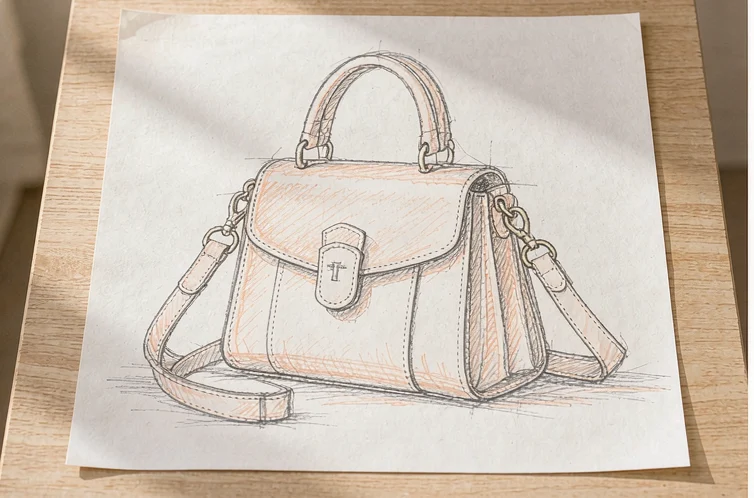
What does it take to develop a fully custom handbag, and how long does it actually take? A custom handbag is a new pattern: the shape does not exist yet, so the work runs through twelve checkpoints - brief, feasibility, tech pack, pattern and dies, first sample, material and colour, revision, tooling, bulk, inspection, packing and delivery - before one saleable unit exists. Custom handbag development takes 6-10 working days to a first sample and 35-50 days of bulk production at MOQ 500 pcs per style / colourway, and the two variables that stretch it are tooling and revision rounds. Complex builds - framed, woven or stacked constructions - move sampling to 12-15 working days because a die or a mould has to be cut before the pattern can be made. Inspection runs at AQL 2.5 under ISO 2859-1 and shipment is FOB Xiamen. This page is written as a checklist: every stage, what it produces, what it costs and what to hand over at the hand-off.
- What Custom Handbag Development Actually Involves
- The Twelve-Stage Checklist From Sketch to Bulk
- Stage One: Brief and Feasibility Review
- Stage Two: Tech Pack and Specification
- What Every Page of a Tech Pack Should State
- Stage Three: Pattern, Dies and the First Sample
- Stage Four: Material Selection and Colour Matching
- Stage Five: Sample Revision and Approval
- Stage Six: Tooling, Deposit and Slot Booking
- Stage Seven: Bulk Production and In-Line Inspection
- What to Check at Each Production Gate
- Cost Drivers Unique to a Custom Build
- Timeline Arithmetic for a Custom Programme
- When Custom Is the Wrong Answer
- How to Keep the Second Run Identical
What does it take to develop a fully custom handbag, and how long does it actually take? A custom handbag is a new pattern: the shape does not exist yet, so the work runs through twelve checkpoints - brief, feasibility, tech pack, pattern and dies, first sample, material and colour, revision, tooling, bulk, inspection, packing and delivery - before one saleable unit exists. Custom handbag development takes 6-10 working days to a first sample and 35-50 days of bulk production at MOQ 500 pcs per style / colourway, and the two variables that stretch it are tooling and revision rounds. Complex builds - framed, woven or stacked constructions - move sampling to 12-15 working days because a die or a mould has to be cut before the pattern can be made. Inspection runs at AQL 2.5 under ISO 2859-1 and shipment is FOB Xiamen. This page is written as a checklist: every stage, what it produces, what it costs and what to hand over at the hand-off.
Custom development parameters
What Custom Handbag Development Actually Involves
Three routes are usually confused with one another. Stock means buying what already exists. Private label means an existing pattern produced with the buyer's material, colour, hardware and brand marks. Custom means the pattern itself is new: the panels, the gusset geometry, the strap attachment and the closure are being drawn for the first time, and every downstream cost - hide yield, die count, operation count - is unknown until the first sample exists. That uncertainty is the price of the route, and it is what the checklist below exists to control.
| Route | What is new | Tooling | Sampling | Unit cost |
|---|---|---|---|---|
| Stock | Nothing | None | Not required | Lowest, but no differentiation |
| Private label | Material, colour, hardware, brand marks | Usually none beyond a logo die | 6-10 working days | Mid; branding absorbed at 500 pcs |
| Modified private label | Dimensions, pocket layout, strap drop | A pattern adjustment, occasionally a new die | 6-10 working days; 12-15 framed or woven | Mid-high |
| Full custom | The pattern, the dies, often a mould and a hardware specification | Dies, moulds, embossing plates, stitch files | 12-15 working days, often two rounds | Highest at 500 pcs, falls sharply with volume |
The practical question is not which route is best but which route answers the question the buyer actually has. Where the question is whether a market wants a bag at all, custom is the wrong instrument, because it spends the budget on a pattern before the market has spoken. Where the question is how to own a silhouette that no competitor can buy, custom is the only instrument. Most programmes start on private label and move to custom on the third or fourth season, once the sell-through data justifies a signature shape. The decision framing is set out in seven questions to ask before private labelling a first handbag.
The Twelve-Stage Checklist From Sketch to Bulk
- Brief: silhouette intent, dimensions, target retail price, quantity, destination market.
- Feasibility review: can the shape be made, and what will it cost to make it.
- Tech pack: dimensioned views, materials, hardware, construction notes, branding positions.
- Pattern and dies: panels drawn, graded if sized, cutting dies cut.
- First sample: panels cut, sewn, branded, photographed.
- Material and colour: swatch approval, Pantone matching, hardware plating confirmed.
- Revision: a written revision list, then a second sample where needed.
- Tooling settlement: die and mould cost agreed, ownership recorded.
- Deposit and slot: material released, production slot reserved, cartons ordered.
- Bulk production: cutting, skiving, assembly, finishing, packing.
- Inspection: in-line check, then pre-shipment at AQL 2.5 under ISO 2859-1.
- Delivery: packing list, documents, FOB Xiamen handover.
Twelve stages sounds like a lot, and buyers who see it for the first time usually try to compress it. The stages that can be compressed are the administrative ones: feasibility and quotation can happen in parallel with material sourcing. The stages that cannot be compressed are the physical ones - a die has to be cut, a sample has to be sewn, a bulk run has to be assembled - and no amount of urgency changes the operation count. The full sequence from a buyer's side is set out in the checklist from sketch to first order.
Stage One: Brief and Feasibility Review
The brief is where a custom programme is won or lost, and it needs four things rather than twenty: a clear idea of the silhouette, the dimensions that matter to the customer, the retail price the market will bear, and the destination market. The feasibility review that follows answers three questions - can the shape be sewn, will it hold its form in use, and what will it cost - and a good review returns a concern as well as a price. A sketch that draws beautifully and collapses when empty is the single most common outcome at this stage.
- Silhouette intent: a front view, a side view and a note on how the bag is carried.
- The three dimensions customers actually judge: width, height and strap drop.
- Target retail price, which sets the ceiling for the landed cost.
- Quantity per colourway, because the tooling amortisation depends on it.
- Destination market, which sets the compliance documents required.
Stage Two: Tech Pack and Specification
What Every Page of a Tech Pack Should State
A tech pack is the only artefact that survives the whole programme, and it is the document a bulk dispute is settled against. It should state dimensions in millimetres, material grade and thickness, hardware with a plating specification, stitch density, seam allowance, reinforcement at every stress point, edge finishing method, branding positions and packing instructions. Anything left to interpretation will be interpreted, and the interpretation will favour whoever is holding the scissors.
- Dimensioned views with a scale bar, not a photograph with arrows.
- Material: grade, thickness in millimetres, colour reference, tannery or mill where known.
- Hardware: type, size, plating specification and rated salt-spray hours.
- Construction: stitch density per centimetre, seam allowance, reinforcement and edge finish.
- Branding: position and method for each mark, with die dimensions.

Stitch density is the line most often omitted and most often regretted. Eight stitches per centimetre and six stitches per centimetre look identical on a photograph and behave differently under load, particularly at the strap attachment, which is the most heavily stressed point on any bag. Specify it, along with the reinforcement behind it, and the field failure rate falls for no additional cost.
Stage Three: Pattern, Dies and the First Sample
Once the pack is signed off, the pattern is drawn and the cutting dies are cut. This is the first irreversible spend on a custom programme, and it is the reason custom carries a tooling cost that private label usually does not. A standard build reaches a first sample in 6-10 working days; a framed, woven or stacked build takes 12-15 working days, because a die, a mould or a jig has to exist before the panels can be cut. Whether a tooling fee applies, and who owns the die afterwards, is set out in whether custom work requires a tooling fee.
Cutting dies
One die per panel shape. Simple shapes share dies across a family; a signature silhouette needs its own set, and the set cost is amortised across the run.
Embossing and logo dies
A heated brass or magnesium die presses the mark into leather or coated material. One die per mark, owned by the brand, and reusable on every future run.
Hardware moulds
A cast logo plate, moulded zip puller or bespoke closure needs a mould. The most expensive tooling item and the one that most rewards volume.
Digitised stitch files
Embroidery requires a digitised file rather than hard tooling, so it carries no die cost - but stitch count drives the per-unit price, so lettering beats a detailed motif.
Stage Four: Material Selection and Colour Matching
Material is chosen on three criteria: how it looks, how it behaves at the operation count the design needs, and whether it can be sourced consistently across reorders. Full-grain leather reads as quality and develops a patina, but hide-to-hide variation makes exact colour matching across 500 pieces harder. Top-grain is corrected and pigmented, so it matches far more reliably. Coated fabric is the most consistent of all and the standard route where the design calls for a bright or unusual colour. The cost consequences are set out in a real cost breakdown per piece.

Compliance is settled at this stage rather than at the end. Leather into the European Union needs a chromium VI result to ISO 17075 and a REACH declaration, and hides from a Leather Working Group audited tannery arrive with traceability already documented. Coated material needs a phthalate-free formulation where the destination is the European Union or California, and hardware needs a Prop 65 statement. Asking for these before sampling rather than after approval is the difference between a document that exists and one being written.
Stage Five: Sample Revision and Approval
Revision is where schedules slip, and almost always for the same reason: feedback arrives as adjectives rather than measurements. A revision list that says the strap feels short cannot be actioned; a list that says the strap drop should be 260 millimetres rather than 240 can be. Two rounds are usually enough when the first list is written that way, and five rounds are rarely enough when it is not. The approval mechanics are covered in the sample approval process explained.
- Write every revision as a measurement or a named component change, never as an impression.
- Photograph the sample from six angles and mark the revision points on the photographs.
- Confirm which round is chargeable before starting, so the cost is not a surprise.
- Approve a numbered sample and have it retained as the bulk reference.
- Sign the pack at the same moment, since the sample is the pack made physical.
Stage Six: Tooling, Deposit and Slot Booking
Tooling is settled once, separately from the unit price, with ownership recorded and an inactivity clause - typically 12 months - agreed. A die or mould charged inside the unit price instead is charged on every piece for the life of the programme, which is why an itemised tooling line matters more on a custom build than anywhere else. The deposit that follows releases material, the only genuinely irreversible step, and books the production slot on one of the seven lines.
Stage Seven: Bulk Production and In-Line Inspection
What to Check at Each Production Gate
Bulk runs 35-50 days on a custom build, and three checks catch almost everything that can go wrong: a cutting check against the dye lot, an in-line check at around 40 percent completion, and a pre-shipment inspection at AQL 2.5 under ISO 2859-1. The first catches a material problem, the second catches a construction drift while it can still be corrected, and the third produces the report a claim depends on. Programmes coordinated through our validated partner factory Quanzhou Yingming Bags run those three gates on every custom build.
- Check the cut panels against the approved swatch and the dye lot number before assembly starts.
- Check strap attachment reinforcement and stitch density at the in-line stage.
- Check the branding position and depth against the approved die sample.
- Check the closure action and hardware plating on finished units, not on the sample.
- Check packing: carton grade, quantity per carton and barcode readability.
Cost Drivers Unique to a Custom Build
Two cost drivers are unique to custom and consistently underestimated. The first is yield: an existing pattern has a known nesting efficiency, and a new one does not, so the first hundred units of a custom build waste more material than the last hundred. The second is the operation count: a shape that needs hand-setting at the gusset, a turned edge or a lined flap costs more per operation than buyers expect, and the count does not fall with quantity the way a material lot price does. Both stabilise after the first run, which is why the second custom run is usually cheaper for reasons that have nothing to do with goodwill.
| Cost driver | Why it is higher on custom | Does volume help? | How to control it |
|---|---|---|---|
| Tooling | Dies, moulds and plates are cut for the first time | Yes - amortised across the run | Itemise it once; confirm ownership |
| Yield and nesting | An unknown pattern wastes more hide per unit | Partly - the second run nests better | Ask for the yield figure on the first run |
| Operation count | Complex geometry adds hand operations | No - the count is fixed per bag | Simplify the geometry at the feasibility stage |
| Hardware | Bespoke closures need a mould and a plating bath | Yes - strongly at 1,000+ pcs | Use a standard closure with a branded puller |
| Sampling rounds | A new pattern needs more correction | No | Write revision lists as measurements |
Timeline Arithmetic for a Custom Programme
Add the stages rather than guessing: one to three days for feasibility and quotation, two to four days for material confirmation, 12-15 working days for sampling on a complex build, three to six days per revision round, one or two days to settle tooling and book the slot, then 35-50 days of bulk production. A realistic custom programme therefore runs 60-90 days from a signed pack to goods leaving Xiamen, and a launch date should be set backwards from that. How the timing shapes a launch is set out in how lead times shape a launch.

When Custom Is the Wrong Answer
Custom is the wrong answer when the market has not yet spoken, when the budget cannot carry tooling, or when the differentiation the buyer wants can be achieved with material, colour and hardware on an existing pattern. Those three cover most first launches. Custom is the right answer when the silhouette is the brand, when the shape has to do something an existing pattern cannot, or when the volume is high enough that tooling is noise. A buyer unsure which applies should price both routes against the same brief before committing; the gap is usually larger than expected at 500 pcs and smaller than expected at 2,000.
How to Keep the Second Run Identical
Three artefacts make a second custom run match the first: the numbered retain sample, the signed tech pack with its revision log, and the material lot record with a retained cutting swatch. Hold all three and the reorder is a repetition; lose any one and it becomes a redevelopment. Most of the cost advantage of a second run comes from that continuity rather than from any price negotiation. Sizing and hardware decisions that survive a reorder are covered in bucket bag sizing and hardware specifications, and the launch context in a 2026 starter roadmap for small brands.
Develop a custom handbag from sketch
Send the sketch, the dimensions that matter and the target retail price. A handbag programme specialist will return a feasibility note, a tooling estimate, a sampling window of 6-10 working days and a bulk window of 35-50 days at MOQ 500 pcs per style / colourway. Get a quote.
Frequently Asked Questions
What is the difference between a custom handbag and a private label handbag?
Private label uses a pattern that already exists and changes the material, colour, hardware and brand marks. Custom draws a new pattern: the panel shapes, gusset geometry and closure are designed from scratch, which adds tooling, a longer sampling window and a higher unit cost at low volume.
How long does it take to develop a custom handbag?
A realistic custom programme runs 60-90 days from a signed tech pack to goods leaving Xiamen. That covers feasibility, material confirmation, 12-15 working days of sampling on a complex build, revision rounds, tooling settlement and slot booking, and 35-50 days of bulk production.
Why does a complex build need 12-15 working days rather than 6-10?
Because a die, mould or jig has to be cut or made before the panels can be cut. Framed, woven, braided and stacked constructions all fall into this category, and a promise of seven days for such a build describes a sample that will not actually be built.
Is there a tooling fee for custom handbag development?
Yes, where new tooling is needed: cutting dies, embossing dies, hardware moulds or a jig. It should be charged once and itemised separately from the unit price, with ownership recorded and an inactivity clause agreed, typically after 12 months of no orders.
Who owns the cutting die after the run is finished?
The brand should. Ownership belongs in the order confirmation along with what happens after a period of inactivity and whether the die may be used for another customer. Tooling buried inside the unit price rather than itemised is usually tooling the buyer does not own.
What should a custom handbag tech pack contain?
Dimensioned views in millimetres, material grade and thickness, hardware with a plating specification, stitch density per centimetre, seam allowance, reinforcement at every stress point, edge finishing method, branding positions with die dimensions, and packing instructions.
How many sample revision rounds are normal?
Two is normal and five is a warning sign. The number depends almost entirely on how the feedback is written: a revision list expressed as measurements resolves in two rounds, while a list expressed as impressions rarely resolves at all.
Can a custom design use a standard closure with branded hardware?
Yes, and it is usually the smartest compromise. A standard closure avoids a mould entirely while a branded zip puller, cast plate or engraved lock still carries the mark, which puts the differentiation where the customer sees it and the cost where volume can amortise it.
Why is the first custom run more expensive than expected?
Two reasons dominate: yield, because a new pattern wastes more material until nesting is optimised, and operation count, because complex geometry adds hand operations that do not fall with quantity. Both stabilise on the second run, which is usually cheaper for structural reasons.
What material works best for a first custom build?
Top-grain leather or a coated fabric. Top-grain is corrected and pigmented so it matches reliably across 500 pieces, and coated fabric is the most consistent of all, which matters when the pattern is new and the yield is still unknown.
Which compliance documents does a custom build need?
A chromium VI result to ISO 17075 and a REACH declaration for leather sold into the European Union, a Prop 65 statement on hardware and coatings for California, CPSIA documentation for children's products, and GRS certification if recycled content is claimed.
How is quality checked on a custom bulk run?
Three gates: a cutting check against the dye lot, an in-line check at around 40 percent completion where a drift can still be corrected, and a pre-shipment inspection at AQL 2.5 under ISO 2859-1 with a written defect classification list.
What is the minimum quantity for a custom handbag?
500 pcs per style and colourway. Below that, the tooling cannot be amortised across enough units and the material lot, plating bath and line changeover are all inefficient, so the unit price rises faster than the saving from ordering less.
How do you make sure a reorder matches the first custom run?
Keep three artefacts: the numbered retain sample, the signed tech pack with its revision log, and the material lot record with a retained cutting swatch. With all three the reorder is a repetition; without one of them it becomes a redevelopment at full sampling cost.
People Also Ask
How much does it cost to develop a custom handbag?
Beyond the unit price, budget for tooling: cutting dies, embossing dies, hardware moulds and digitised stitch files. Tooling is a one-off charged separately, and it amortises across the run, which is why the same bag is materially cheaper at 1,000 pcs than at 500 pcs.
What is a tech pack and why does it matter?
It is the dimensioned specification a bag is made from and the document a bulk dispute is settled against. Without measurements, stitch density and a hardware specification in writing, anything unspecified will be decided on the cutting table rather than by the brand.
How long does sampling take for a custom handbag?
12-15 working days for a complex build and 6-10 for a standard one, measured from a signed specification. The longer window exists because a die or mould must be produced before the first panel can be cut.
Should a first launch be custom or private label?
Private label, unless the silhouette itself is the brand. Custom spends the budget on a pattern before the market has spoken, while private label tests material, colour and hardware on an existing shape and still supports a full branding package at 500 pcs.
What makes a bag programme reorder cleanly?
Continuity of artefacts. A numbered retain sample, a signed tech pack with a revision log and a recorded material lot mean the second run repeats the first instead of re-developing it, which is where most of the second-run cost advantage comes from.
Sources and further reading
Every figure on this page is either our own programme data or attributed below. Open the originals before you write them into a specification.
- Leather Working Group — environmental auditing for tanneriesLeather Working Group Environmental audit protocol for tanneries and leather traceability.
- SATRA — technical services for leather, footwear and accessoriesSATRA Independent leather, hardware and accessories testing protocols.
- REACH — chemical substances regulationEuropean Commission Annex XVII restricts the substances that may appear in finished leather and coatings.
- FashionUnited — fashion industry news and dataFashionUnited Industry news and company data for the fashion sector.