Handbag Manufacturers: How to Evaluate and Compare Handbag Production Partners Before You Commit to a Run
How should a buyer evaluate and compare handbag production partners? Score every candidate on five gates - material traceability, sample-room capability, quotation transparency, inspection discipline and capacity honesty - and compare unit prices only among the candidates that clear all five. Price is the last variable to read, not the first, because a cheap quote from a partner that cannot hold a specification costs more in rework, air freight and a missed season than the saving ever returned. The parameters that a credible programme will put in writing are fixed and checkable: MOQ 500 pcs per style / colourway, 6-10 working days to a first sample (12-15 for complex builds), 35-50 days of bulk production, inspection at AQL 2.5 under ISO 2859-1, and shipment FOB Xiamen. Compare production partners on five gates before comparing price, because only the candidates that clear all five produce a quotation worth reading. This page walks the decision tree gate by gate, sets out the six quotation lines that carry real information, lists the red flags that should end a conversation, and maps the onboarding path from first email to first bulk order.
- The Five-Gate Method for Comparing Handbag Manufacturers
- Gate 1: Material Traceability and Tannery Records
- What to Request Before the First Sample
- Gate 2: Sample-Room Capability and Sampling Speed
- Gate 3: Quotation Transparency and Tooling Disclosure
- Gate 4: Inspection Discipline and Defect Language
- Gate 5: Capacity Honesty and Reorder Behaviour
- Comparing Quotes Line by Line
- Reading a Quotation: The Six Lines That Matter
- Audits, Certificates and What Each One Actually Proves
- Red Flags That Should End the Conversation
- Onboarding Timeline: From First Email to First Bulk Order
- Contract, Payment Terms and Deposit Structure
- Documents Worth Requesting Before a Deposit
- Questions to Put in Writing Before Sampling
How should a buyer evaluate and compare handbag production partners? Score every candidate on five gates - material traceability, sample-room capability, quotation transparency, inspection discipline and capacity honesty - and compare unit prices only among the candidates that clear all five. Price is the last variable to read, not the first, because a cheap quote from a partner that cannot hold a specification costs more in rework, air freight and a missed season than the saving ever returned. The parameters that a credible programme will put in writing are fixed and checkable: MOQ 500 pcs per style / colourway, 6-10 working days to a first sample (12-15 for complex builds), 35-50 days of bulk production, inspection at AQL 2.5 under ISO 2859-1, and shipment FOB Xiamen. Compare production partners on five gates before comparing price, because only the candidates that clear all five produce a quotation worth reading. This page walks the decision tree gate by gate, sets out the six quotation lines that carry real information, lists the red flags that should end a conversation, and maps the onboarding path from first email to first bulk order.
What a credible production partner confirms in writing

The Five-Gate Method for Comparing Handbag Manufacturers
Every sourcing season produces the same argument. Two quotations arrive for the same tote, one is 18 percent cheaper, and the buyer spends a week deciding whether the difference is a real efficiency or a hidden substitution. The argument is unwinnable at the price line, because the price line does not say what it is made of, how it was inspected, or whether the second run will match the first. The five-gate method moves the decision upstream: each gate tests one capability, each gate has written pass evidence, and price is read only at the end. The full line-by-line reading of a quotation is set out in how to compare handbag manufacturer quotes line by line.
| Gate | What you are testing | Pass evidence | Fail signal |
|---|---|---|---|
| 1. Material traceability | Can the hide, coating and hardware be traced to a named source? | Tannery name, lot number, Leather Working Group audit reference, chromium VI test to ISO 17075 | Generic phrases such as genuine leather with no tannery named |
| 2. Sample-room capability | Can the pattern be cut, sewn and corrected in-house? | 6-10 working days to a first sample, 12-15 for complex builds, with a written revision log | Samples that take a month or arrive without a spec sheet |
| 3. Quotation transparency | Is every cost line identified and dated? | Separate lines for material, labour, trimming, tooling, packing and freight | One all-in number with no breakdown |
| 4. Inspection discipline | Is there a written defect standard and a sampling plan? | AQL 2.5 to ISO 2859-1, a defect classification list, third-party inspection by SGS on request | Inspection described as full check with no sampling plan |
| 5. Capacity honesty | Will the slot exist when the order doubles? | Named lines, a stated monthly figure, a reorder policy in writing | Every date promised, no reservation mechanism described |
Gate 1: Material Traceability and Tannery Records
Material is where the quote is made or lost, and it is the gate most buyers skip because the swatch looks right. Leather is graded by where it sits on the hide and how much of the grain surface is corrected: full-grain keeps the surface intact, top-grain is sanded and refinished, and split is a lower layer that has to be coated to be usable. Two quotations can both say leather and sit 40 percent apart, because one is buying full-grain from a Leather Working Group audited tannery and the other is buying a corrected split with a heavy finish. The Leather Working Group audit protocol exists precisely to make that difference documentable: it scores a tannery on traceability, environmental performance and restricted substances, and the audit reference is checkable.
- Tannery name and country, with the audit reference and its expiry date.
- Dye lot number for the run, plus a retained cutting sample kept against reorders.
- Substance test for chromium VI to ISO 17075, which is the test that decides whether leather can be sold into the European Union at all.
- A REACH Annex XVII declaration covering azo dyes, nickel release and phthalates in coated material.
- A California Prop 65 statement on hardware and any painted or plated component.
- A CPSIA declaration where the bag is marketed to children, including lead content and tracking labels.
What to Request Before the First Sample
Ask for the material dossier before the pattern is cut, not after the sample is approved. A dossier produced early is a document the partner already holds; a dossier produced after approval is a document being written for the first time, and the difference is visible in the turnaround. Request the swatch card with the lot number written on it, the substance test that matches that lot, and a statement of what happens if the lot is exhausted mid-run. A partner that has run export programmes since 2014 will answer all three in a day. A partner that cannot answer them will ask why the question matters, which is itself the answer.
Gate 2: Sample-Room Capability and Sampling Speed
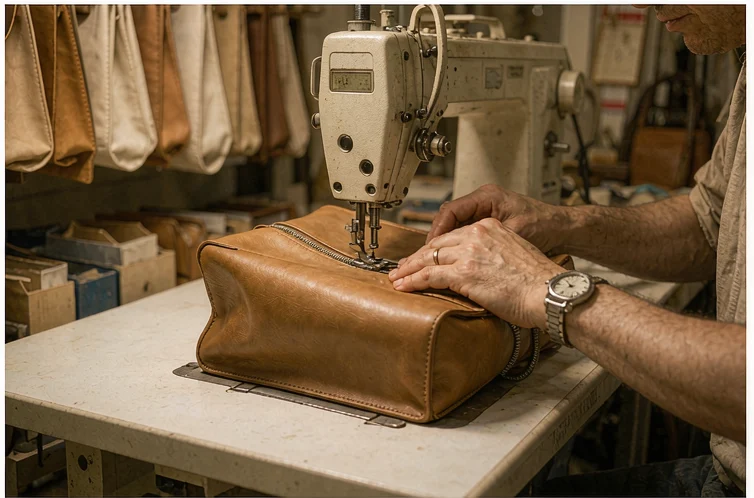
Sampling speed is a proxy for everything else. A partner that can turn a first sample in 6-10 working days has pattern cutters, an interruptible sewing cell and a trimming store holding the parts the sample needs. A partner that needs 25 days is subcontracting one of those three. Complex builds - a framed satchel, a woven panel, a stacked or moulded construction - legitimately take 12-15 working days, and a partner that promises 7 days for a framed bag is describing a sample it will not actually build. The reality of the two clocks is set out in handbag manufacturer lead times: sampling versus bulk, and the room itself is covered in how to vet a sample room before bulk.
- Is the pattern cut in-house, and will the cutter's name appear on the sample record?
- How many rounds of revision are included before the sample is re-quoted?
- Does the sample carry a spec sheet with measurements, not just a photograph?
- Will the approved sample be retained and numbered so the bulk run can be matched to it?
- Is the trimming used in the sample the trimming that will be used in bulk, or a stand-in?
Gate 3: Quotation Transparency and Tooling Disclosure
A quotation is a description of a supply chain. Where it is itemised, the buyer can see which cost moved and why; where it is collapsed into one number, the buyer is consenting to substitutions they cannot detect. The classic failure is the tooling line: a die, a mould or an embossing plate is a real cost, and hiding it inside the unit price means it is being charged on every piece forever. Nine of the most common quotation problems are covered in nine red flags in a handbag manufacturer quote, and the structure a professional document should follow is in what a professional quotation should contain.
| Line | What it should state | What a vague entry hides |
|---|---|---|
| Material | Grade, thickness in millimetres, tannery or mill, dye lot | A downgrade from full-grain to corrected grain at bulk |
| Trimming and hardware | Zipper brand or gauge, plating specification, closure type | A cheaper slider or a thinner plating bath |
| Labour and operations | Operation count or a construction note | Dropped steps: skiving, edge painting, reinforcement |
| Tooling | Die, mould or plate cost stated once, with ownership | Tool cost buried in the unit price permanently |
| Packing | Polybag, carton grade, carton quantity, barcode | Cartons that fail a drop test at the destination |
| Commercial terms | Trade term, port, validity date, payment split | A price that expires before the buyer can approve it |
Gate 4: Inspection Discipline and Defect Language
Inspection is the only gate that produces a number, which is why it is the one buyers feel they understand. AQL 2.5 under ISO 2859-1 sets the sample size and the accept and reject counts for a given lot size; it does not say what counts as a defect. That is the defect classification list, and a partner without one is inviting the buyer to argue about scratches after the goods have shipped. The classification should name critical, major and minor defects for the specific product: broken stitch, misaligned panel, plating blemish, loose thread, carton damage. The meaning of the standard in practice is set out in what AQL 2.5 inspection really means.

Third-party inspection is the second half of this gate. An internal report is useful; an SGS report on the same lot is evidence. Where a programme is large, where the buyer is not present, or where the goods ship direct to a marketplace warehouse, the third-party report is what turns a claim into a recoverable one. Inspection should be booked before the bulk run starts, not after packing finishes, because a mid-run inspection can still be corrected and a final inspection can only be argued. Physical testing at laboratories such as SATRA covers strap pull, seam strength and colour fastness to rubbing, and those tests are worth specifying on any programme where the bag will carry weight.
Gate 5: Capacity Honesty and Reorder Behaviour
Capacity is the gate that decides whether a first order becomes a programme. A partner running 7 production lines with about 200,000 pcs per month of throughput has slack to absorb an urgent reorder; a partner running at 98 percent utilisation will accept the reorder and quietly move the buyer's slot. The question to ask is not how many bags can be made, but what happens when the order doubles in week six. The framing is set out in the capacity question every buyer must ask, and the seasonal behaviour is covered in how reorders and seasonal peaks are handled. Programmes coordinated through our validated partner factory Quanzhou Yingming Bags run on those seven lines, which is what makes a reserved slot a real thing rather than a reassurance.
Named lines, not a total
A partner that names the lines a programme will run on has accepted a commitment. A partner that quotes only a monthly total is describing a ceiling, and the buyer is last in the queue when the ceiling is reached.
A reservation mechanism
Capacity that is promised but not reserved disappears at peak. Ask how a slot is held: deposit against a booked window, a rolling forecast, or a seasonal agreement that reserves a share of output.
Reorder price behaviour
The second order is where the relationship is tested. Material is re-bought at a new lot price, so a reorder is not automatically cheaper; a partner holding retained cutting samples and a standing trimming store can hold the price anyway.
Export track record
Documentation errors cost more than production errors at the destination. Programmes shipped since 2014 have met the packing, labelling and declaration requirements of the main import markets repeatedly, which is the only real preparation for them.
Comparing Quotes Line by Line
Once the gates have reduced the field, the comparison itself is mechanical. Put both quotations on the same six lines, and where a line is missing on one side, treat it as a blank rather than as a zero. A quotation without a tooling line is not a quotation without tooling cost; it is a quotation that has distributed the tooling cost across the units. This is why the low quote often flips at higher volume: a per-unit recovery of a fixed cost scales with the run, while a properly itemised tooling charge does not.
Reading a Quotation: The Six Lines That Matter
- Material: grade and thickness in millimetres, matched across both documents.
- Hardware: plating specification and rated salt-spray hours, matched across both documents.
- Construction: operation count, reinforcement at stress points, edge finishing method.
- Tooling: stated separately, with a note on who owns the die or mould.
- Packing: carton grade and quantity per carton, since freight is quoted per carton.
- Terms: validity date, deposit split, balance trigger, and the port named.
Audits, Certificates and What Each One Actually Proves
The certificate folder is the most over-read document set in sourcing. Each audit has a scope narrower than buyers assume: a social audit says nothing about chromium VI, and a substance test says nothing about working hours. Read the certificate for what it covers and note the expiry. A BSCI or Sedex SMETA audit covers labour standards at a named site; ISO 9001 covers the quality management system rather than the product; GRS covers recycled content in a declared input; Oeko-Tex Standard 100 covers substances in textile components including lining and webbing.
Red Flags That Should End the Conversation
- A single all-in price with no breakdown, offered as a simplification rather than as a mistake.
- A material described only as genuine leather with no grade, thickness or tannery named.
- A sample that arrives without a spec sheet, measurements or a revision log.
- A quoted sampling window shorter than 6-10 working days for a construction that is plainly complex.
- No named port, or a trade term that shifts the freight risk onto the buyer without saying so.
- A request for full payment before production, with no inspection milestone described.
- Reluctance to name the site that will run the order, or a visit that is postponed twice.
- A certificate folder with no expiry dates, or documents naming a different legal entity.
None of these is fatal on its own - every one has an innocent explanation, and the first email is not the place to be adversarial. The test is the second answer. A partner that explains a collapsed price, or produces the tannery name after being asked, is a partner that was being brief. A partner that repeats the reassurance without producing the document is a partner that does not have it. The full screening sequence is set out in a 12-point due diligence audit, and the annual version is in the 2026 buyer due diligence checklist.
Onboarding Timeline: From First Email to First Bulk Order
The path from first contact to goods on the water is shorter than most buyers plan for, provided the brief is complete. A specification, a target price and a quantity allow a quotation inside a few days; material confirmation and swatch matching add a week; sampling takes 6-10 working days; revision and approval add three to six days; deposit and slot booking add a day or two; and bulk production runs 35-50 days. Allow 55-80 days from a signed brief to goods leaving Xiamen, and plan the marketplace or retail launch date backwards from that. The stage-by-stage path is described in how a new brand is onboarded in 30 days.

Contract, Payment Terms and Deposit Structure
Payment structure is a risk allocation, not a formality. A deposit releases material, which is the only genuinely irreversible step in the process, and the balance should fall due against a defined event - inspection pass, or release of the bill of lading - rather than against a date on a calendar. The normal structure on an export programme is a deposit with the order confirmation and the balance against documents or an inspection pass, with the split depending on whether tooling is involved. The mechanics are covered in payment terms, deposits and balance, and the tooling question in whether a tooling fee applies to custom work.
Documents Worth Requesting Before a Deposit
- A signed specification, including measurements, material grade and hardware finish.
- The retained sample number, with photographs from six angles attached.
- The defect classification list that will be used at AQL 2.5.
- Packing instructions: carton marks, barcode artwork, quantity per carton.
- The compliance declarations required by the destination market.
Questions to Put in Writing Before Sampling
Before the pattern is cut, put four questions in one email and keep the reply: what is the sampling window and what counts as a complex build; how many revision rounds are included; who owns the tooling and what happens to it after 12 months of inactivity; and what the reorder price mechanism is. Four questions, one thread, and the answers become the reference for the next three seasons. Buyers who do this once rarely need to do it again, because the thread is the specification.
Compare production partners on evidence
Send the silhouettes, the material direction and the target landed cost. A handbag programme specialist will return a scored comparison across the five gates, a sampling window of 6-10 working days, a bulk window of 35-50 days and a unit-price band at MOQ 500 pcs per style / colourway. Get a quote.
Frequently Asked Questions
How do you evaluate a handbag production partner before requesting a quotation?
Start with the documents rather than the price. Ask for the tannery name and audit reference, a chromium VI result to ISO 17075, a REACH Annex XVII declaration and a Prop 65 statement on hardware. A partner that produces these in a day is describing an existing system; a partner that asks why they are needed is describing the absence of one.
What does an MOQ of 500 pcs per style and colourway actually mean?
The minimum applies to each style in each colourway, not to the order as a whole. A capsule of three styles in one shared colourway is 1,500 pcs; three styles across two colourways each is 3,000 pcs. The minimum exists because of four upstream lot sizes: the hide or coating lot, the trimming and hardware lots, the plating bath and the line changeover.
Why is 500 pcs considered the practical entry point for a first own-brand run?
Below roughly 500 units the fixed costs dominate: a plating bath costs the same for 300 pieces as for 3,000, and a woven label weaving minimum is absorbed rather than avoided. At 500 pcs the branding package - embossing die, woven label, engraved hardware - is priced into a unit cost that still supports a retail multiple. The economics are set out in why 500 pieces is the sweet spot.
How long should sampling take, and what makes a build complex?
A standard private label build should return a first sample in 6-10 working days from an approved brief. Complex builds take 12-15 working days: a framed satchel, a woven or braided panel, a moulded component, a stacked construction, or anything requiring a new die before the pattern can be cut.
What is AQL 2.5 and what does it not tell a buyer?
AQL 2.5 under ISO 2859-1 sets the sample size and the accept and reject counts for a given lot size. It does not define a defect. That definition comes from the classification list - critical, major and minor - written for the specific product, naming broken stitches, misalignment, plating blemishes and carton damage.
Should inspection be internal or third-party?
Both, ideally at different points. An internal inspection during the run catches a drift that can still be corrected; a third-party inspection by SGS before shipment produces the report that turns a claim into a recoverable one. A final-only inspection can be argued; a mid-run inspection can be fixed.
How can a buyer tell whether two quotations describe the same bag?
Normalise them onto six lines: material grade and thickness, hardware and plating, construction and operations, tooling, packing, and commercial terms. Where a line is missing on one side, treat it as a blank rather than a zero. A missing tooling line usually means the die cost has been distributed across the units.
What is the difference between a production partner and a sourcing and programme-management company?
A production partner controls the pattern, the cutting and the assembly, and can answer a technical question without telephoning someone else. A sourcing and programme-management company coordinates; it may be excellent at consolidation and documentation, but a technical question has to travel. The difference shows up in sampling speed and in who signs the inspection report.
Which certificates matter when selling into the European Union?
A REACH Annex XVII declaration covering restricted substances, an ISO 17075 chromium VI result for leather, and a GRS certificate if recycled content is claimed. Oeko-Tex Standard 100 is worth holding for lining and webbing. Social audits such as BSCI or Sedex SMETA are frequently requested by retailers but are not product-safety documents.
Which declarations matter when selling into the United States?
A California Prop 65 statement covering hardware, coatings and any painted component, plus CPSIA documentation - lead content and tracking labels - where the product is marketed to children. REACH alone does not satisfy either requirement, and a partner that offers one as a substitute for the other has not read the destination rules.
How much capacity should a buyer reserve for a reorder?
Ask what happens when the order doubles in week six, and get the mechanism in writing: a deposit against a booked window, a rolling forecast, or a seasonal agreement. Capacity promised but not reserved disappears at peak. Seven production lines with about 200,000 pcs per month of throughput provides real slack; a site at full utilisation does not.
Is the second order automatically cheaper than the first?
Not automatically. Material is re-bought at the market price on the reorder date and plating is re-bath-priced, so the input cost can rise. What improves is yield, waste and speed, because the pattern is known and the operators have run it. A partner holding retained cutting samples and a standing trimming store can usually hold the price.
What is a fair deposit and when should the balance fall due?
A deposit with the order confirmation releases material, which is the only irreversible step. The balance should fall due against a defined event - an inspection pass or release of the shipping documents - rather than against a calendar date. A request for full payment before any production milestone is a red flag, not a term.
Should a buyer pay a tooling fee, and who owns the die afterwards?
A die, mould or embossing plate is a real cost and should be stated once, separately. Ownership should be written down, along with what happens after a period of inactivity - typically 12 months. Tooling charged inside the unit price instead is charged on every piece for the life of the programme.
People Also Ask
What is the best way to compare handbag manufacturers?
Score every candidate on five gates - material traceability, sample-room capability, quotation transparency, inspection discipline and capacity honesty - and compare price only among those that clear all five. Normalise the remaining quotations onto six lines so that a missing line counts as a blank rather than a zero.
How many bags should a first order be?
Plan around 500 pcs per style and colourway. That is the level at which the hide or coating lot, the trimming lots, the plating bath and the line changeover are all efficient, and at which a full branding package can be priced into a unit cost that still supports a retail multiple.
What does FOB Xiamen mean for a buyer?
The price covers the goods and their delivery onto the vessel at Xiamen. Freight, insurance, duty and inland delivery fall to the buyer from that point. CIF adds freight and insurance to the named port; DDP adds duty and delivery, and both can be quoted where a buyer wants the landed cost in one number.
How do you verify a material claim on a quotation?
Ask for the tannery or mill name, the audit reference and its expiry, the dye lot number, and the substance tests that match that lot - chromium VI to ISO 17075 and a REACH Annex XVII declaration. A certificate that does not name the lot is a document about a different batch.
What makes a handbag build complex enough to need a longer sampling window?
A frame, a woven or braided panel, a moulded component, a stacked construction, or any new die that must be cut before the pattern is made. Those move the sampling window from 6-10 working days to 12-15, and a promise of seven days for such a build describes a sample that will not be built.
Sources and further reading
Every figure on this page is either our own programme data or attributed below. Open the originals before you write them into a specification.
- REACH — chemical substances regulationEuropean Commission Annex XVII restricts the substances that may appear in finished leather and coatings.
- Leather Working Group — environmental auditing for tanneriesLeather Working Group Environmental audit protocol for tanneries and leather traceability.
- Fashion Revolution transparency reportingFashion Revolution Transparency reporting used to benchmark disclosure.
- SATRA — technical services for leather, footwear and accessoriesSATRA Independent leather, hardware and accessories testing protocols.