Private Label Handbags: Build a Bag Line Without a Factory
What are private label handbags, and can you build a bag line without owning a factory? Private label handbags are existing bag patterns produced under your own brand name, logo and packaging, so you can launch a bag line without owning a factory or funding a new pattern. The commercial parameters are fixed and knowable before you commit: MOQ 500 pcs per style / colourway, 6-10 working days from approved brief to first sample (12-15 for complex constructions), 35-50 days of bulk production, inspection at AQL 2.5 under ISO 2859-1, and shipment FOB Xiamen with CIF and DDP on request. Private label handbags are existing bag patterns produced under your brand name, logo and packaging, with the silhouette, material, colour, lining and hardware chosen by you but not engineered from scratch. This page is the working reference for that route: what the term covers, six launch silhouettes, four material families, four branding methods, how the 500-piece MOQ ladder behaves, and how many days each stage from brief to delivery takes.
- What Is Private Label in the Handbag Trade
- What a Private Label Programme Includes
- Who Private Label Suits (and Who It Does Not)
- Style Grid: Six Silhouettes for a Launch Line
- Material Grid: Leather, PU and Canvas
- Branding Grid: Embossing, Woven Labels, Embroidery, Hardware
- The MOQ Ladder: What Changes at Each Tier
- Timeline: From Brief to Delivery in Days
- Quality Control and Compliance
- Cost Structure and Commercial Terms
- How to Choose a Handbag Manufacturer for Private Label
- Mistakes That Quietly Cost Money
- What to Send With Your First Enquiry
What are private label handbags, and can you build a bag line without owning a factory? Private label handbags are existing bag patterns produced under your own brand name, logo and packaging, so you can launch a bag line without owning a factory or funding a new pattern. The commercial parameters are fixed and knowable before you commit: MOQ 500 pcs per style / colourway, 6-10 working days from approved brief to first sample (12-15 for complex constructions), 35-50 days of bulk production, inspection at AQL 2.5 under ISO 2859-1, and shipment FOB Xiamen with CIF and DDP on request. Private label handbags are existing bag patterns produced under your brand name, logo and packaging, with the silhouette, material, colour, lining and hardware chosen by you but not engineered from scratch. This page is the working reference for that route: what the term covers, six launch silhouettes, four material families, four branding methods, how the 500-piece MOQ ladder behaves, and how many days each stage from brief to delivery takes.
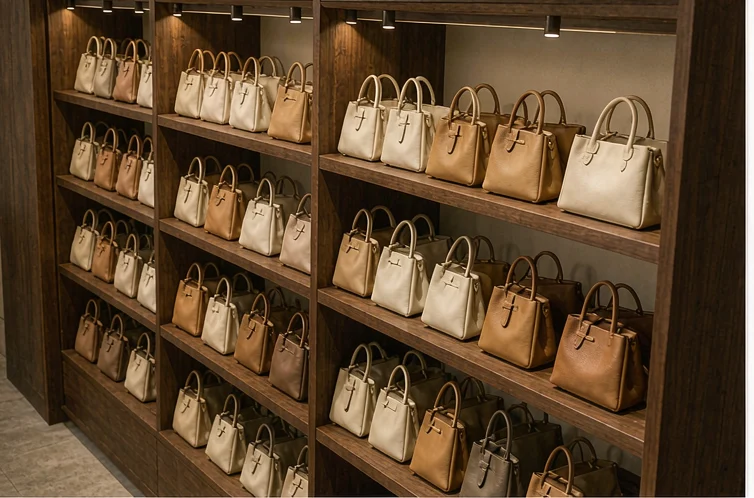
Private label parameters at a glance
What Is Private Label in the Handbag Trade
Three words get used loosely in this trade: private label, white label and custom. Sellers use them interchangeably, buyers sign assuming one meaning and receive another, and the argument that follows is always about money. Precision matters because each route carries a different minimum, a different sampling clock and a different unit cost. Private label sits in the middle: you choose the silhouette, material, colour, lining, hardware and brand marks, but the pattern already exists and you own the brand, the artwork and the logo tooling.
That distinction is what makes private label the practical entry point for brand owners, e-commerce sellers and importers. A full custom development asks you to fund a new pattern, fresh cutting dies, possibly a moulded frame or an injection-moulded logo plate, and several rounds of fit testing before one saleable unit exists. Private label skips that cost: the hide yield is already known and the difficult operations are already mapped.
What you give up is exclusivity of shape. Two brands can specify the same tote pattern in different leathers and hardware finishes and end up with products no shopper would connect. If your differentiation lives in material, colour, hardware, print, packaging and price — true for most e-commerce assortments and retail house brands — private label is the right instrument. If it lives in a patented frame or a new silhouette, you want full custom development, a longer calendar and a bigger budget.
What Is the Difference Between Private Label, White Label and Custom Handbags?
The cleanest way to separate the three routes is to ask how much of the product you decide, and how much has to be engineered before anything can be cut. The table answers that in the terms that appear on a quotation.
| Route | Design input | MOQ | Sampling | Best for |
|---|---|---|---|---|
| Stock / ready-to-brand | None — select from what exists | Set by the stock holder | Not required | Testing a market |
| Private label (standard) | Pattern, material, colour, hardware, brand marks | 500 pcs per style / colourway | 6-10 working days | A first own-brand line |
| Modified private label | Pattern adjustments: dimensions, pockets, strap drop | 500 pcs per style / colourway | 6-10 working days; 12-15 framed or woven | Differentiation without tooling |
| Full custom development | New pattern, new dies, new hardware moulds | 500 pcs per style plus tooling | 12-15 working days, several rounds | A signature silhouette |
One clarification buyers ask about constantly: private label is not the same as buying wholesale handbags and sewing in a label. Wholesale means buying what exists, in colours somebody else chose. Private label means the run is made for you — material bought against your order, colour matched to your Pantone reference, hardware plated to your specification, packaging printed with your artwork. The trade-off is the minimum and the 35-50 day window, which is why the rest of this page is about planning both.
What a Private Label Programme Includes
A private label programme is a package of deliverables, not a purchase order for goods. Buyers who treat it as the second thing end up paying separately for what they assumed was included — artwork setup, a second sample, a test report.
- Design brief and specification. Dimensions, material, hardware, stitch density, pocket layout, lining and the retail price you need to hit.
- Material and colour matching. Leather, coated fabric or canvas sourced to your Pantone reference or an approved swatch, signed off before bulk.
- Sampling. One physical sample in 6-10 working days; framed, hand-woven or stacked constructions take 12-15 because part of the sequence is manual.
- Branding application. Embossing, debossing, woven label, embroidery, metal logo plate, printed lining or custom zip puller, specified by position and size.
- Packaging. Dust bag, care card, hangtag, barcode label and carton marks printed to your artwork, in the symbology your channel requires.
- Compliance pack. Test reports against REACH, California Proposition 65 and CPSIA where they apply, plus the audit reference for the validated partner factory.
- Inspection. Pre-shipment inspection at AQL 2.5 under ISO 2859-1, with third-party inspection by SGS or your own QC team available.
- Logistics. FOB Xiamen as default, CIF and DDP quoted on request, plus consolidation of several SKUs into one container.
Two lines cause most disputes, so settle them in writing at brief stage. Sampling rounds: a first sample is often credited against the order, but later rounds are chargeable, and an unclear brief is the usual reason one is needed. Tooling: dies, label setups and hardware moulds are physical assets — state who owns them and whether they will run for another brand.
Who Private Label Suits (and Who It Does Not)
Minimum quantity is the filter every enquiry should pass first. At 500 pcs per style / colourway, a run is a commitment of real cash and warehouse space, priced for resale rather than for sampling. Below a few hundred units the fixed costs of material, trimming lots and line setup dominate the unit price completely.
- E-commerce sellers moving to own brand. You know which silhouettes convert at your price point; private label lets you own the SKU and the margin.
- Retailers building a house brand. Three silhouettes in one leather family give a coherent shelf story at the cost of one development.
- Importers and distributors. You control the market, the customs entry and the sell-through; the programme supplies goods built to your specification.
- Licence holders and corporate programmes. You hold the artwork and need a defined quantity quickly, with tooling you own.
It is equally useful to say when private label is the wrong instrument, because forcing it wastes the sampling window.
- You need 50-200 pcs to test a market. Test with stock, then return at 500 pcs with evidence.
- Your concept depends on a shape that does not exist. That is a custom handbag development with a different budget.
- You need goods on a shelf in three weeks. The bulk window alone is 35-50 days.
- You want to change the design monthly. Private label rewards repeat orders of a stable specification.
Style Grid: Six Silhouettes for a Launch Line
Six silhouettes carry most private label volume: tote, shoulder bag, crossbody, satchel, hobo and bucket. Each has a different construction difficulty, a different hide yield and a different natural place for a brand mark — and those three variables decide both your unit cost and how the line photographs.

Tote Bag
The volume workhorse: open or zip-top, flat or gusseted. Totes offer the largest uninterrupted panel for embossing or print and read best in a listing photograph.
Shoulder Bag
Single strap, mid volume, carried under the arm. Strap drop decides whether it sells, so specify it in millimetres and check it on the physical sample.
Crossbody Bag
Long adjustable strap, and the highest repeat purchase in most assortments. Hardware carries the brand here: buckle, slider and zip puller.
Satchel Bag
Structured, top-handle, usually with a turn-lock or magnetic closure. Structure means interlining and a stiffener, which adds operations — hence the top of the cost band.
Hobo Bag
Soft, slouchy, crescent-shaped. The pattern is forgiving and the leather does all the work: a soft temper drapes, a firm temper stands up and looks wrong.
Bucket Bag
Cylindrical body with a drawcord or cinch top. Small panels mean good hide yield, but the base needs reinforcement and the channel shows cheap work first.
Read across those six and the cost logic is clear. Operations drive labour, 15-25% of unit price: a soft hobo and a structured satchel use similar leather area, but the satchel adds interlining, a stiffener and a closure. Yield drives material, 40-55%: a bucket cut from small clean panels wastes far less hide.
| Silhouette | Typical size | Construction notes | Best branding position | Works best for |
|---|---|---|---|---|
| Tote | 34-42 cm wide | Flat or gusseted panels; optional interior zip pocket | Centre front panel, below the top edge | Work, travel, gift |
| Shoulder | 26-34 cm wide, 22-30 cm drop | Single strap; the strap attachment is the stress point | Flap edge or a small leather patch | Day-to-evening |
| Crossbody | 18-26 cm wide, 110-130 cm strap | Adjustable strap; slider and buckle quality is visible | Zip puller, buckle, embossed patch | Travel, commuting |
| Satchel | 28-36 cm wide, structured base | Interlining, stiffener, turn-lock, feet | Lock plate, handle root, front panel | Premium and office |
| Hobo | 30-40 cm wide, soft body | Curved seam; soft-temper material only | Embossed patch at the strap root | Relaxed and resort |
| Bucket | 20-28 cm diameter, reinforced base | Drawcord channel, reinforced base disc | Drawcord toggle, base panel | Casual and seasonal |
Which Silhouettes Should a First Line Include?
A first line works best as three silhouettes in two colourways: 3 × 2 × 500 = 3,000 pcs in one production window, one container, one inspection and one set of branding tooling spread across six SKUs. A single silhouette in one colourway is 500 pcs and the lowest cash commitment, but it gives you a product rather than a line. Two silhouettes in two colourways — 2,000 pcs, four SKUs — is the most common starting shape.
Material Grid: Leather, PU and Canvas
Material sets your retail price band, and it is the decision buyers most often make backwards: they choose a leather, build the bag around it, then discover the landed cost forces a price their channel will not support. Work from the price down instead — target retail less channel margin, your margin, freight, duty and packaging gives a landed cost ceiling, and that number chooses the material.

Full-Grain Leather
Strongest and most expensive: the grain is left intact and uncorrected. It develops a patina and justifies a premium price, and because the surface is not sanded, natural marks stay visible.
Top-Grain Leather
Grain lightly sanded and finished, then pigmented or embossed. Far more uniform hide to hide, so colour matching across 500 pieces is realistic. The mid-market default.
PU (Polyurethane-Coated)
A polyurethane coating on a split or fabric base that reads as leather at a fraction of the cost. Consistent, waterproof, no hide variation, and the standard vegan route.
Canvas
Cotton, linen or recycled polyester woven fabric, usually trimmed with leather at the stress points. Light, printable, and the cheapest way to carry a large graphic.
| Material | Hand and durability | Cost band | Compliance and sourcing | Typical use |
|---|---|---|---|---|
| Full-grain leather | Firm to soft temper; patina; 5-10+ years | High | Leather Working Group audited tanneries; REACH-compliant finishing | Tote, satchel, hobo |
| Top-grain leather | Uniform, firmer hand; 3-7 years | Mid-high | REACH: chromium VI, azo dyes; Prop 65 review on hardware | Shoulder, crossbody |
| PU coated | Consistent, soft, waterproof; 2-4 years | Low-mid | REACH; phthalate-free formulations for EU and California | Crossbody, tote, bucket |
| Canvas | Matte, light, breathable; 3-6 years | Low | GRS-certified recycled polyester; CPSIA for children's items | Tote, backpack |
Two practical notes decide whether a material choice survives contact with a quotation. Leather is priced per square foot and cut by yield, so a pattern of large clean panels costs more than one of small pieces — why a bucket can undercut a satchel in the same hide. And 500 pcs in one colourway is one dye lot: splitting it three ways means three dye-lot minimums. Want three colours, plan 1,500 pcs.
Sourcing transparency is now part of the material decision rather than an afterthought. The handbag materials guide covers the full specification set; in short, hides can come from tanneries audited under the Leather Working Group environmental protocol, and recycled content can be documented through the Global Recycled Standard. Ask for the tannery name, not the phrase genuine leather.
Branding Grid: Embossing, Woven Labels, Embroidery, Hardware
Branding is where a private label run stops being somebody else's bag and becomes your product, and it is where a surprising amount of cost and delay hides. Four methods cover almost every brief: embossing or debossing, woven label, embroidery and hardware. Each has a natural position and a different effect on the schedule, and two of the four need tooling made before sampling can start.

Embossing and Debossing
A heated brass or magnesium die presses your mark into leather or PU — raised or sunk. It is permanent, adds no separate part, and reads as quality. Foil gives a metallic mark on dark grounds.
Woven Label
A woven damask or satin label sewn into the lining seam or an interior pocket. The cheapest way to put a wordmark inside a bag, and it outlasts a printed label by years.
Embroidery
Your mark stitched onto canvas, lining or an applied leather patch, and the only one of the four that works on canvas. Stitch count drives cost, so lettering beats a detailed motif.
Hardware
A cast logo plate, moulded zip puller, engraved closure or branded feet. The most expensive route and the most noticeable, because it is the part customers handle in the shop.
| Method | Position | Tooling | MOQ effect | Durability |
|---|---|---|---|---|
| Embossing / debossing | Front panel, leather patch, strap end | One metal die per mark | None — runs at any private label quantity | Permanent; wears with the leather |
| Woven label | Lining seam, interior pocket, back panel | Woven to order, no hard tooling | Weaving minimum, absorbed at 500 pcs | Excellent; outlasts the lining |
| Embroidery | Canvas body, lining, leather patch | Digitised stitch file | None | Good; thread abrades in heavy use |
| Hardware | Flap closure, zip puller, feet, slider | Casting or engraving mould | Tool cost amortised; cheaper above 1,000 pcs | Depends on plating thickness |
Order these decisions by permanence rather than by cost. Anything involving a die, a mould or a woven label is tooling money and several days of setup, so it is settled at brief stage rather than after the sample arrives. Printed packaging is reversible late in the process; a mark pressed into leather is not. A split that works across most price bands: an embossed exterior mark, a woven interior label, one branded zip puller.
Specify plating in numbers, not adjectives. Gold is not a specification; plating thickness in microns plus a salt-spray target tested to ASTM B117 is. Vague plating specs are the usual reason a beautiful sample is followed by bulk hardware that dulls in a season — and hardware is 15-25% of unit cost, so it is expensive to get wrong.
The MOQ Ladder: What Changes at Each Tier
MOQ 500 pcs per style / colourway is not an arbitrary gate and not a negotiating position. It is roughly the point at which four upstream minimums stop dominating the unit price, and below which you pay for material and setup that never becomes a bag. Knowing which minimum you are fighting is what makes the number productive to discuss.

| Upstream minimum | Why it exists | Effect on your price |
|---|---|---|
| Hide, roll or coating lot | A dye lot or coating run has a production minimum | Below it you pay for material you never use |
| Trimming and hardware lots | Zipper chain, webbing, closures and plated parts come in set lot sizes | A short run buys a full lot and carries dead stock |
| Plating bath | A plating run costs the same for 300 or 3,000 pieces | Why branded hardware is costly at low volume |
| Line changeover | Setting the line for a new pattern is priced into the run | A longer run spreads it across more units |
| Tier | Quantity | What improves | Typical buyer |
|---|---|---|---|
| Entry | 500 pcs per style / colourway | Full branding package at the baseline price | First own-brand line |
| Capsule | 500 pcs per colourway across 2-3 colourways | One shared material buy; labelling priced once | Retail house brand |
| Volume | 1,000-3,000 pcs per style | Better hide nesting, hardware breaks, amortised tooling | Established e-commerce assortment |
| Seasonal programme | 5,000+ pcs across a season | Reserved capacity and a price held for the season | Importer or distributor |
Plan in SKUs rather than units. Three silhouettes in two colourways is 3,000 pcs and fills a 20-foot container; two silhouettes in two colourways is 2,000 pcs and four SKUs, the most common first order; one style in one colour is 500 pcs and the lowest commitment. The step from 500 to 1,000 usually buys more than the step from 1,000 to 3,000, because most fixed cost is absorbed in the first thousand.
Timeline: From Brief to Delivery in Days
The schedule is where most first programmes go wrong, and for one consistent reason: buyers budget the 35-50 day bulk window and forget everything that surrounds it. Sampling, decision time, revision rounds, inspection, export handling and freight all sit outside it. The realistic number from signed brief to goods handed to your forwarder is the only one that matters for a launch date.
| Stage | Duration | What happens | What you supply |
|---|---|---|---|
| 1. Brief and quotation | 1-3 days | Specification review, material check, price band | Tech pack or photos, quantity, target price |
| 2. Material confirmation | 2-4 days | Swatches, Pantone matching, hardware finish | Approved swatch, plating spec |
| 3. Sampling | 6-10 working days (12-15 complex) | Pattern cut, panels sewn, branding applied | Nothing — the spec is signed off |
| 4. Sample review and revision | 3-6 days | Fit, strap drop, closure action, branding position | A written revision list |
| 5. Deposit and slot booking | 1-2 days | Material released, slot reserved, cartons ordered | Deposit, carton marks, barcode artwork |
| 6. Bulk run | 35-50 days | Cutting, skiving, assembly, finishing, packing | Nothing — the quiet part |
| 7. Inspection | 1-2 days | Pre-shipment check at AQL 2.5 under ISO 2859-1 | Your QC checklist if you have one |
| 8. Export handling | 2-4 days | Carton packing, stuffing, FOB Xiamen handover | Balance payment, forwarder, marks |
| 9. Transit | 18-28 days to the US West Coast; 30-38 days to Northern Europe; 5-8 days by air | Ocean or air freight to port or door | Customs entry, HTS class, duty |
Plan for 55-80 days from signed brief to goods handed to your forwarder; 35-50 days of that is the bulk run and the rest is decision time, sampling, inspection and freight. Buyers who plan on 50 days and book a launch on that basis are the ones paying for air freight on the last 300 units.
- Send the brief with a target retail price attached. Material selection follows the price ceiling, and without it the first quotation is a guess.
- Approve the material swatch in hand rather than on screen. Screens lie about temper and colour, and this is the hardest decision to reverse.
- Treat sample review as a specification exercise: numbered items against measurements. A photograph with circles on it produces another 6-10 working days.
- Book the slot when you pay the deposit, not when you approve the sample. Slots tighten before Chinese New Year and the autumn rush.
Quality Control and Compliance
Quality on a private label run is not a matter of trust, it is a matter of a written standard. The reference both brands and inspection companies work to is ISO 2859-1, which defines how many units to pull from a lot of a given size and how many defects of each class trigger a pass, a fail or a re-sort.
AQL 2.5 under ISO 2859-1 sets both the sample size and the accept and reject thresholds for a given lot size; write it into your purchase order, because good quality is not enforceable and AQL 2.5 is. Third-party inspection can be booked through SGS or your own QC team, and the report is yours either way. What the inspector checks is set out on the handbag quality control page.
- Inspection standard. Pre-shipment inspection at AQL 2.5 under ISO 2859-1, with third-party inspection by SGS available. Ask for the report, not a verbal pass, and request an ISO 9001 quality system reference alongside it.
- EU chemicals. Leather and coated materials tested against REACH (EC 1907/2006) restrictions — in practice chromium VI, azo dyes, nickel release and phthalates.
- California. Proposition 65 requires a warning where a listed substance exceeds the safe-harbour level; on bags the exposure points are hardware, coated trim and some dyes.
- US children's products. Where a bag is marketed to children, CPSIA applies: lead and phthalate limits, tracking labels, and sometimes testing by a CPSC-accepted laboratory.
- Social compliance. BSCI (amfori) and Sedex / SMETA are the two frameworks retail buyers ask for, and both can be referenced for the validated partner factory.
- Leather traceability. Hides can be sourced from tanneries audited under the Leather Working Group environmental protocol, the benchmark most brand compliance teams recognise.
- Recycled content. Recycled polyester linings and canvas can carry Global Recycled Standard transaction certificates, which is what makes a percentage claim on a hangtag defensible.
- Hardware finish. Plated hardware is tested by salt-spray exposure to ASTM B117. Specify hours to first corrosion in the brief rather than leaving it to the plating shop.
On the inspection table, the defects that generate returns are unglamorous: stitch density below the specified 7-9 per inch, edge paint cracking at the fold, a strap that stretches because reinforcement tape was skipped, plating rubbing off at contact points, a zip catching the lining. Ask for the crocking result on dark linings — it catches the most expensive complaint a bag brand can receive.
Cost Structure and Commercial Terms
Unit price is the sum of five components, and knowing the split turns a quotation from a number you accept into one you can work on. When a quote lands above your ceiling, the fix is almost always in one of these lines rather than in a discount.
- Material — 40-55%. Leather priced per square foot and cut by yield; PU and canvas per metre. Responds best to simplifying the pattern.
- Trimming and hardware — 15-25%. Zipper chain, webbing, magnetic closures, feet, plated plates and branded pullers. The fastest way to add cost and the easiest place to cut.
- Cutting, sewing and finishing — 15-25%. Operations drive this line: a structured satchel costs more labour than a soft hobo from the same hide.
- Packaging — 3-8%. Dust bag, hangtag, care card, polybag and carton. Cheap per unit, but artwork setup and printing plates are fixed charges.
- Tooling — one-off. Embossing die, woven-label setup, hardware mould. Ask whether it is amortised into the unit price or billed separately, and who owns it.
Trade terms default to FOB Xiamen: goods delivered on board, with freight, insurance and customs entry yours from that point. CIF, carried and insured to your port, and DDP, delivered duty paid to your door, can both be quoted. Incoterms 2020, published by the International Chamber of Commerce, defines where risk and cost transfer under each term — cite the rule in the purchase order, because the three-letter word alone does not say who pays for what at the port.
Two money items catch first-time buyers out. Payment is typically a deposit to release material with the balance against the inspection report or before loading; tie it to a document rather than a date, so a schedule slip does not cost you money for goods you have not seen. And duty: yours under FOB, inside the price under DDP. Bags are classified by outer surface material, and leather, coated fabric and textile sit at different rates.
How to Choose a Handbag Manufacturer for Private Label
Most private label programmes fail at the selection stage rather than the production stage, and for a predictable reason: buyers compare quotations and choose on price, when the variables that decide the outcome are documentation, tooling ownership and slot honesty. This checklist is for buyers with no QC team on the ground who decide from documents, a sample and a video walk-through.
- Ask for the tannery, not just the leather. A production partner that names the tannery and shows a Leather Working Group audit is describing a supply chain; genuine leather is a marketing term.
- Ask which AQL they inspect to. If the answer is not a number tied to ISO 2859-1, the inspection is a photography session.
- Ask who owns the tooling. Dies and moulds you paid for should be identified, stored, and never run for another brand.
- Ask what the second sample costs. A first sample is often credited; the second and third round is where the relationship is tested.
- Ask about the peak-season slot. Windows tighten before Chinese New Year and the autumn shipping rush, which is when optimistic lead times get quoted.
- Ask for a counter sample cut from the actual bulk material, not a prototype sewn from whatever was nearest at hand.
- Ask for the compliance pack before you order: REACH, Proposition 65, CPSIA where relevant, and the current BSCI or Sedex audit reference.
- Ask for references in your market. A partner who has shipped to US FBA prep requirements or met EU General Product Safety Regulation labelling will save you a packaging rewrite.
- Ask how many units of your silhouette have been run before. Pattern familiarity is the difference between a clean first sample and three revision rounds.
- Ask for the written MOQ per colourway. 500 pcs and 500 pcs per colourway are different numbers, and the difference is a great deal of money.
The three questions that separate a real handbag production partner from a broker: which tannery, which AQL, and who owns the tooling. A broker can answer none of them, because a broker sells access rather than a process. A production partner answers all three in one email with documents attached, and that is worth more than 5% on unit price. The full evaluation sequence is in the handbag sourcing guide, with a capability comparison of handbag manufacturers.
Mistakes That Quietly Cost Money
Each of these is common, avoidable, and expensive in a way that never appears as a line item. They cost money indirectly — through a second sample round, a re-cut, an air-freight bill or a season of returns.
- Choosing the leather before the retail price. Material is 40-55% of unit cost, so it is downstream of the price you can sell at.
- Skipping the second sample to save a week. A week saved at sampling costs 35-50 days if the error surfaces in bulk, and then it cannot be corrected.
- Changing hardware after cutting starts. Tooling is ordered early; a late change means the run waits or the parts are scrapped.
- Splitting 500 pcs into five colourways. Five dye lots, five trimming setups and 100 pcs of each colour to sell.
- Forgetting Proposition 65 on hardware. A warning discovered after packing is a relabelling job, not a paperwork fix.
- Booking freight in December or before Chinese New Year. Rates rise, slots vanish, and the cost lands on your margin.
- Approving the sample from photographs. Temper, drape, strap drop and hand-feel cannot be judged on a screen.
What to Send With Your First Enquiry
The quality of the first quotation is set almost entirely by the quality of the first email. A specification, a quantity and a price ceiling come back as a number you can plan against; how much for a handbag comes back as a range too wide to use.
- Silhouettes and quantities, per style and per colourway.
- Material direction and the target retail price per SKU.
- Reference photographs or a tech pack with dimensions and strap drop.
- Branding method and position: embossing, woven label, embroidery, hardware.
- Packaging: dust bag, hangtag, barcode format, carton marks.
- Destination market and preferred term: FOB Xiamen, CIF or DDP.
- Your launch date, stated honestly, so the slot quoted matches the slot you need.
Start your private label handbag programme
Send the silhouettes, the material direction and your target retail price. A private label coordinator will come back with a specification, a sampling window of 6-10 working days, a bulk window of 35-50 days and a unit-price band at MOQ 500 pcs per style / colourway. Get a quote.
Frequently Asked Questions
What is a private label handbag?
A private label handbag is an existing bag pattern produced under your own brand name, logo and packaging. You choose the silhouette, material, colour, lining, hardware and brand marks, while the pattern itself already exists and has already been produced many times. You own the brand, the artwork and the logo tooling. That is the practical difference from wholesale, where you buy what already exists, and from full custom development, where a new pattern must be engineered before anything can be cut.
How is private label different from wholesale handbags?
Wholesale means buying finished goods in the colours and quantities somebody else chose. Private label means the run is made for you: material purchased against your order, colour matched to your Pantone reference, hardware plated to your specification, packaging printed with your artwork. The trade-off is a minimum of 500 pcs per style / colourway and a production window of 35-50 days, in exchange for a product nobody else can list.
What is the MOQ for private label handbags?
MOQ is 500 pcs per style / colourway. It is not per order, so a three-silhouette capsule in two colourways is 3,000 pcs. The number reflects four upstream minimums: the hide or coating lot, trimming and hardware lot sizes, the plating bath, and the line changeover. Below roughly 500 units those fixed costs dominate the unit price, which is why a lower quantity comes back at a higher price per piece rather than at a discount.
Can I split the MOQ across several colourways?
No — 500 pcs is per style / colourway, so two colourways of one style is 1,000 pcs. The reason is material: each colourway is its own dye lot or coating run with its own minimum. Splitting 500 pcs into three colours means three dye-lot minimums and three trimming setups, which costs more per unit than 500 pcs in one colour. If you need three colours, plan for 1,500 pcs rather than dividing 500.
How long does sampling take for a private label handbag?
Sampling takes 6-10 working days from an approved specification to a finished physical sample. Constructions with moulded frames, hand-woven panels, stacked leather or bonded reinforcement take 12-15 working days because part of the sequence is done by hand. The clock starts when the specification and material are signed off, not when the first email arrives, so a clear brief with a target retail price and reference photographs is the fastest route to a first sample.
How long does bulk production take?
The bulk run takes 35-50 days from material release to packed cartons. The realistic planning number for the whole route is 55-80 days from signed brief to goods handed to your forwarder, because sampling, review, inspection, export handling and freight all sit outside the bulk window. Ocean transit adds 18-28 days to the US West Coast or 30-38 days to Northern Europe, or 5-8 days if the goods fly.
Can I send my own design or tech pack?
Yes, and it is the best way to start. A full tech pack with dimensions, strap drop, pocket layout, stitch density and hardware references removes the guesswork from sampling and usually keeps the job inside the 6-10 working day window. Three reference photographs and a one-page specification are enough where no tech pack exists. If your design needs a shape that does not exist yet, that is a full custom development rather than private label, and it carries tooling cost and a longer calendar.
Who owns the logo tooling and hardware moulds?
You should, and you should get that in writing before paying a deposit. An embossing die, a woven-label setup and a hardware mould are physical assets that cost money to make. Ask whether the tooling cost is amortised into the unit price or billed separately, where the tooling is stored, and whether it will be used for another brand's run. This is one of the three questions that separates a genuine production partner from a broker.
Which materials can I choose for a private label line?
Four families cover most programmes: full-grain leather, top-grain leather, PU-coated material and canvas. Full-grain is the strongest and most expensive and develops a patina; top-grain is more uniform and easier to colour-match across 500 pieces; PU is the consistent, waterproof and vegan route at lower cost; canvas is the lightest and cheapest and the best carrier for a large graphic. Leather can come from Leather Working Group audited tanneries, and recycled canvas can carry Global Recycled Standard certification.
What branding methods are available?
Four: embossing or debossing with a heated metal die, a woven label sewn into the lining seam or pocket, embroidery onto canvas or an applied leather patch, and hardware such as a cast logo plate, engraved zip puller or branded feet. Embossing and hardware need tooling made before sampling starts; woven labels and embroidery have no hard tooling cost. A common combination is an embossed exterior mark, a woven interior label and one piece of branded hardware.
What does AQL 2.5 mean for my inspection?
AQL 2.5 under ISO 2859-1 sets both how many units are pulled from your lot and how many defects trigger a pass, a fail or a re-sort. It is the number to write into your purchase order, because good quality is not enforceable and AQL 2.5 is. Inspection takes 1-2 days at the end of the run, and third-party inspection can be booked through SGS or your own QC team, with the report issued to you in either case.
Which compliance documents can I get for the US and EU?
For the EU, material test reports against REACH (EC 1907/2006), covering chromium VI, azo dyes, nickel release and phthalates. For California, a Proposition 65 review of metal hardware, coated trim and dyes. For children's products, CPSIA lead and phthalate limits plus tracking labels. Social compliance through BSCI (amfori) and Sedex / SMETA audits, leather traceability through Leather Working Group audited tanneries, and recycled content through Global Recycled Standard certificates.
What are the trade terms and can you ship DDP?
The default is FOB Xiamen, meaning goods are delivered on board at Xiamen and you control freight, insurance and customs entry from there. CIF, carried and insured to your port, and DDP, delivered duty paid to your door, can both be quoted when you prefer one price and one responsible party. Incoterms 2020, published by the International Chamber of Commerce, defines where risk and cost transfer under each term and is worth citing in the purchase order.
Can I visit the production floor?
Yes. Visits to our validated partner factory Quanzhou Yingming Bags can be arranged, and a video walk-through can be scheduled where travel is not practical. Either is worth doing before the first bulk run: you learn more from watching the assembly sequence than from any document. Ask to see the material store, the cutting table and the finishing bench, and watch a strap attachment being sewn, because that is the joint that fails first in the field.
How much does a private label handbag cost per unit?
Unit price is the sum of five components: material 40-55%, trimming and hardware 15-25%, cutting and sewing labour 15-25%, packaging 3-8%, plus one-off tooling. Where a quotation sits inside those bands depends on material choice, how many operations the silhouette needs, and whether hardware is branded. Send a target retail price with your enquiry and the specification can be engineered to that ceiling rather than quoted blindly.
How do I start a private label handbag programme?
Send silhouettes and quantities per colourway, material direction, a target retail price, reference photographs or a tech pack, your branding method and position, packaging requirements, destination market and launch date. That is enough to generate a specification, a sampling window of 6-10 working days, a bulk window of 35-50 days and a unit-price band at MOQ 500 pcs per style / colourway. Then request a quote and the first reply will be a number you can plan against.
People Also Ask
Is private label the same as white label?
No. White label means the same product is sold to many brands with only the name changed. Private label means you specify the material, colour, hardware and packaging, so the finished bag differs in substance rather than only in the label.
Why is the MOQ 500 pcs and not 100?
Because four upstream minimums — the hide or coating lot, trimming and hardware lots, the plating bath and the line changeover — cost the same whether 100 or 500 pieces are made. Below 500 those fixed costs dominate and the unit price rises sharply.
How many days should I allow before my launch date?
Allow 55-80 days from signed brief to goods handed to your forwarder, plus 18-28 days of ocean transit to the US West Coast or 30-38 days to Northern Europe. The bulk run alone is 35-50 days.
Can I use my own hardware design?
Yes. Custom zip pullers, logo plates and closures can be cast or engraved to your drawing, but each needs its own mould and plating specification, and the tool cost is amortised over the run, so it is cheaper above 1,000 pcs.
Do I own the design if I use an existing pattern?
You own your brand, artwork, logo tooling and packaging. The underlying pattern remains shared, which is why two brands can use the same base pattern and still ship visibly different products.
Sources and further reading
Every figure on this page is either our own programme data or attributed below. Open the originals before you write them into a specification.
- Leather Working Group — environmental auditing for tanneriesLeather Working Group Environmental audit protocol for tanneries and leather traceability.
- REACH — chemical substances regulationEuropean Commission Annex XVII restricts the substances that may appear in finished leather and coatings.
- Incoterms rulesICC The rules that decide where cost, risk and insurance transfer.
- Consumer Product Safety Improvement Act of 2008 (full text)U.S. Congress / GovInfo The statute behind childrens-product limits and tracking labels.