The Private Label Handbag Service: What Is Included, How Branding and Packaging Work, and How Long Each Stage Takes
What does a private label handbag service actually include, and what will you be asked to pay for separately? A standard private label programme covers eight deliverables: specification review, material and colour matching, sampling, branding application, packaging, compliance testing, pre-shipment inspection and export handling. It runs at MOQ 500 pcs per style / colourway, samples in 6-10 working days (12-15 for complex constructions) and produces in 35-50 days. Everything except material, tooling and freight is inside the service; the three exclusions are quoted separately because they are bought against your specification, not held in stock. This page sets out the scope in the order a programme uses it, with the numbers that belong to each stage.
- What the Service Covers, Stated as Deliverables
- The Eight Deliverables in a Standard Programme
- Which of these are included and which are quoted separately?
- Branding: Four Methods, Specified by Position
- How is artwork supplied and approved?
- Packaging: What Is Printed, and to Whose Format
- Timelines: What Each Stage Costs in Calendar Days
- How should I plan around the sampling window?
- Three Programme Tiers and What Changes Between Them
- Compliance and Testing Inside the Pack
- What Is Not Included, and Why That Matters
- How a Programme Is Handled Day to Day
- Who do I talk to while production is running?
- Starting: What to Send in the First Email
What does a private label handbag service actually include, and what will you be asked to pay for separately? A standard private label programme covers eight deliverables: specification review, material and colour matching, sampling, branding application, packaging, compliance testing, pre-shipment inspection and export handling. It runs at MOQ 500 pcs per style / colourway, samples in 6-10 working days (12-15 for complex constructions) and produces in 35-50 days. Everything except material, tooling and freight is inside the service; the three exclusions are quoted separately because they are bought against your specification, not held in stock. This page sets out the scope in the order a programme uses it, with the numbers that belong to each stage.
Service scope at a glance
What the Service Covers, Stated as Deliverables
A private label service is not a purchase order for goods; it is a package of work that ends in goods, which is why the service scope in detail is worth reading before the first enquiry. Writing the scope as deliverables rather than as a product description is what prevents the two conversations buyers complain about: the charge for a second sample they assumed was included, and the tooling invoice they had not budgeted for.
The commercial parameters are fixed and knowable before you commit. MOQ is 500 pcs per style / colourway. Sampling returns in 6-10 working days, or 12-15 for framed, hand-woven or stacked constructions. Bulk runs 35-50 days. Inspection is at AQL 2.5 under ISO 2859-1. Shipment is FOB Xiamen, with CIF and DDP quoted on request.
The Eight Deliverables in a Standard Programme
These are the items in a standard private label programme, in the order a programme uses them. Each one has a document attached to it, and the document is what makes the deliverable enforceable. The service scope in full works through the same eight items in more detail.
- Specification review. Dimensions, material, hardware, stitch density, pocket layout and lining are checked for buildability before quotation; output is a signed tech pack.
- Material and colour matching. Leather, coated fabric or canvas sourced to your Pantone reference or approved swatch; output is a signed swatch card.
- Sampling. One physical sample in 6-10 working days, or 12-15 for complex constructions; output is the sample plus a measurement sheet.
- Branding application. Embossing, debossing, woven label, embroidery, metal logo plate or custom zip puller, specified by position and size.
- Packaging. Dust bag, care card, hangtag, barcode label and carton marks printed to your artwork in the symbology your channel requires.
- Compliance pack. Test reports against REACH, California Proposition 65 and CPSIA where they apply, plus the audit reference for the partner factory.
- Inspection. Pre-shipment inspection at AQL 2.5 under ISO 2859-1, with third-party inspection by SGS available.
- Logistics. FOB Xiamen as default, CIF and DDP on request, plus consolidation of several SKUs into one container.
Which of these are included and which are quoted separately?
Specification review, sampling coordination, branding artwork setup, inspection and export handling sit inside the service. Material, tooling and freight are quoted separately. The distinction is practical rather than commercial: material is bought against your order and cannot be stocked in advance, tooling is a physical asset with a make cost, and freight moves at market rates that change week to week.
Branding: Four Methods, Specified by Position
Branding is where a private label run stops being somebody else's bag and becomes your product. Four methods cover almost every brief, each has a natural position, and two of the four require tooling made before sampling can start. Decide in order of permanence rather than in order of cost, because a mark pressed into leather cannot be reversed late in the process. Choosing between the private label and full custom routes comes before any of it.
| Method | Natural position | Tooling | Durability |
|---|---|---|---|
| Embossing or debossing | Front panel, leather patch, strap end | One heated metal die per mark, typically 2-6 cm wide | Permanent; wears with the leather |
| Woven label | Lining seam, interior pocket, back panel | Woven to order; no hard tooling | Excellent; outlasts the lining |
| Embroidery | Canvas body, lining, applied leather patch | Digitised stitch file, 3,000-9,000 stitches | Good; thread abrades under heavy use |
| Hardware | Flap closure, zip puller, feet, strap slider | Casting or engraving mould; plating thickness in microns | Depends on plating thickness and sealer |
A combination that works across most price bands: an embossed exterior mark, a woven interior label and one piece of branded hardware. It puts the brand in three places the customer actually touches, spreads the tooling cost across three methods rather than concentrating it, and survives the first washing of the bag's newness.
How is artwork supplied and approved?
As vector artwork with dimensions and a position marked on the tech pack. Vector matters because a die is cut from a path, not from a raster image. Approval happens twice: once as a digital proof showing position and size against the panel outline, and once on the physical sample, where depth and edge definition can be judged. Foil gives a metallic mark on dark grounds where embossing alone reads too quietly, and the same artwork usually carries onto the hang tag.
Packaging: What Is Printed, and to Whose Format
Packaging is 3-8% of unit cost and a disproportionate share of perceived value. It is also the item most often left until the end and then rushed, which is how a brand discovers at goods-in that its barcode will not scan at the fulfilment centre. Specify the format that your channel requires at brief stage, not the format that looks best in a mock-up, using the sketch-to-first-order checklist as the index.
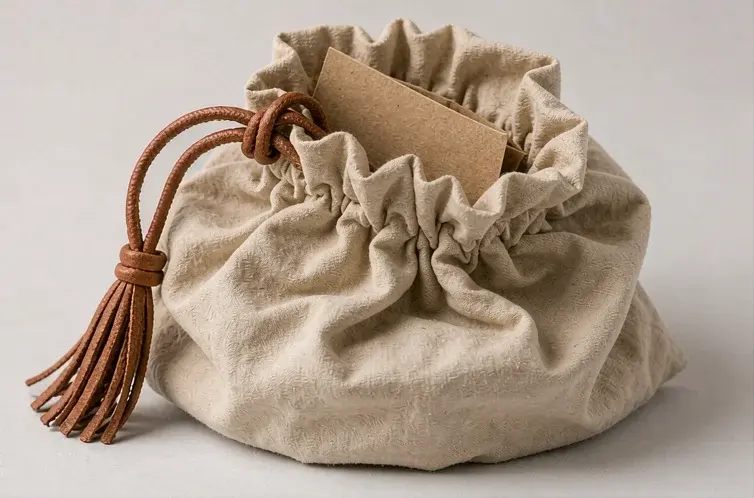
- Dust bag. Non-woven, cotton or polyester drawstring bag, screen or heat-transfer printed; the weight is specified in g/m².
- Hangtag. Coated card, typically 300-350 gsm, printed both sides, with string or rivet attachment specified.
- Care card. Small folded insert carrying fibre content, care instructions and country of origin where required.
- Barcode label. EAN-13 or UPC-A depending on channel, supplied as a number range and proofed before the print run.
- Polybag. Typically 40-60 micron, with a warning print where the destination market requires one.
- Carton. Export carton with a burst or edge-crush rating named, plus marks, count per carton and net and gross weights.
Printing plates and setup charges are fixed costs, which is why packaging behaves differently from material on a small run: the unit cost falls steeply between 500 and 2,000 pieces. Marketplace packing rules and unboxing-led packaging choices both start from the same place — know the channel's requirements before the artwork is drawn.
Timelines: What Each Stage Costs in Calendar Days
Most first programmes go wrong on the schedule for the same reason: the 35-50 day bulk window gets budgeted and everything surrounding it does not. Sampling, review, inspection, export handling and freight all sit outside it, and they add up to more than most buyers expect, which is why how lead times shape a launch is worth reading before you fix a date.
| Stage | Days | Deliverable | What you supply |
|---|---|---|---|
| Brief and quotation | 1-3 | Priced specification | Tech pack or photos, quantity, target price |
| Material confirmation | 2-4 | Signed swatch card | Approved swatch and plating specification |
| Sampling | 6-10 (12-15 complex) | Physical sample | Nothing — the specification is signed off |
| Review and revision | 3-6 | Closed revision list | Numbered written comments |
| Deposit and slot | 1-2 | Booked production slot | Deposit, carton marks, barcode artwork |
| Bulk production | 35-50 | Packed cartons | Nothing |
| Inspection | 1-2 | AQL 2.5 report | Your QC checklist, if you have one |
| Export handling | 2-4 | FOB Xiamen handover | Balance payment, forwarder details, marks |
| Transit | 18-38 by sea, 5-8 by air | Goods at port or door | Customs entry, HTS class, duty |
How should I plan around the sampling window?
Treat it as a decision slot rather than a waiting slot. The 6-10 working days run from specification and material sign-off, so the useful work — reviewing artwork, confirming barcodes, booking the slot — happens in parallel rather than after. Buyers who wait for the sample before starting any of that lose the equivalent of a full sampling round to their own calendar.
Three Programme Tiers and What Changes Between Them
The service is the same at every tier; what changes is how many specifications are being run, how the material is bought and how the tooling cost is spread. Understanding which tier you are in tells you which costs will fall on the reorder, and how the MOQ changes at 500 and 2,000 pieces explains the threshold effect.
Single style
500 pcs in one colourway. The lowest cash commitment and the highest unit cost, because tooling and setup sit on 500 pieces alone.
Capsule
Two or three silhouettes in two colourways — 2,000 to 3,000 pcs. One shared material buy, one inspection, branding tooling spread across the SKUs.
Seasonal programme
5,000 pcs and above across a season, with reserved capacity on the lines and a price held for the season rather than per order.
The step from 500 to 1,000 pieces usually buys more than the step from 1,000 to 3,000, because most fixed cost — tooling setup, print plates, line changeover — is absorbed inside the first thousand. Plan in SKUs rather than in units: one style in one colourway is 500 pcs, two styles in two colourways is 2,000 pcs across four SKUs, and three styles in two colourways is 3,000 pcs across six. Most first programmes sit at the capsule tier.
Compliance and Testing Inside the Pack
Compliance documentation is issued to the brand rather than held by the production partner, because the importer of record is the party that needs it. Which regulations apply is a function of your market, not of the line.
- REACH (EC 1907/2006) Annex XVII. Chromium VI in leather tested to ISO 17075, plus azo dyes, nickel release and phthalates depending on component.
- California Proposition 65. Review of plated hardware, coated trim and dyes against the safe-harbour levels for listed substances.
- CPSIA. Lead and phthalate limits plus tracking labels where a bag is marketed to children in the United States.
- BSCI (amfori) and Sedex / SMETA. Social compliance audit references for the validated partner factory.
- Global Recycled Standard. Transaction certificates supporting a recycled-content claim on linings and canvas.
- Leather Working Group. Hides traced to tanneries audited under the environmental protocol.
- ISO 9001. Quality system certificate covering the process behind the sample and the bulk.
Ask for the report reference rather than a pass statement. A test report identifies the laboratory, the method, the sample and the date, which is what a marketplace or a customs authority will want if they ask. A verbal assurance is worth nothing at goods-in. See what AQL 2.5 inspection really means for the release criteria.
What Is Not Included, and Why That Matters
Three items sit outside the service, and each is quoted separately for a structural reason rather than a commercial one. Knowing which is which prevents the two conversations that damage a first programme.
- Material. Bought against your specification and your order; it cannot be stocked in advance, which is why the deposit releases it.
- Tooling. A physical asset — embossing die, woven-label setup, hardware mould — with a make cost and an owner. Confirm who that owner is, in writing.
- Freight. Quoted at market, and market rates move. Under FOB Xiamen it is yours to book; under CIF or DDP it is inside the price.
- Import duty. Determined by your customs classification, which is set by outer surface material. Yours under FOB, inside the price under DDP.
- Additional sampling rounds. The first sample is often credited against the order; second and later rounds are chargeable.
One boundary is worth naming explicitly, because it is where most first-order disputes start. A revision requested after sample approval is a specification change, not a correction — even when it is small. Changing a zip puller at that point does not cost the price of a zip puller; it costs the plated parts already made, the station time to fit them, and the slot that has moved on. This is why the gate log exists.
How a Programme Is Handled Day to Day
Programme management is the part of the service that is easy to describe badly and expensive to get wrong. The sequence below is the working pattern: one named contact, one document set, and scheduled touchpoints rather than ad-hoc requests.
- Brief received and logged, with gaps identified and returned as questions rather than assumptions.
- Quotation issued as a price band with the excluded items named explicitly.
- Specification closed — tech pack, BOM, swatch card and plating specification all signed.
- Sample dispatched with a measurement sheet so review is a comparison rather than an opinion.
- Slot booked on deposit, with a production calendar issued showing each checkpoint date.
- Progress reported at the checkpoints, with photographs at cutting, assembly and packing.
Who do I talk to while production is running?
One named private label coordinator who owns the programme from brief to handover and reports at each checkpoint. That matters more than it sounds: the alternative is a thread that passes between departments, where a question about strap drop asked on Monday is answered on Friday by somebody who was not in the original conversation. Requests for changes to the specification go through the same person precisely so that the cost and schedule effect is stated before the change is made.
Starting: What to Send in the First Email
The quality of the first quotation is set almost entirely by the quality of the first email. A specification, a quantity and a price ceiling come back as a number you can plan against; how much for a handbag comes back as a range too wide to use. Seven items is all it takes, and the starter roadmap for small brands works through the same sequence in more detail.
- Silhouettes and quantities, stated per style and per colourway.
- Material direction and the target retail price for each SKU.
- Reference photographs or a tech pack with dimensions and strap drop.
- Branding method and position: embossing, woven label, embroidery or hardware.
- Packaging: dust bag, hangtag, barcode format and carton marks.
- Destination market and preferred term: FOB Xiamen, CIF or DDP.
- Your launch date, stated honestly, so the slot quoted matches the slot you need.
Scope your private label programme
Send the silhouettes, the material direction, the quantity per colourway and your launch date. A private label coordinator will return a specification with the eight deliverables, a sampling window of 6-10 working days and a bulk slot of 35-50 days at MOQ 500 pcs per style / colourway. Get a quote.
Frequently Asked Questions
What does a private label handbag service include?
Eight deliverables: specification review, material and colour matching, sampling, branding application, packaging, compliance testing, pre-shipment inspection and export handling. Each has a document attached — signed tech pack, swatch card, measurement sheet, test report, AQL report and export marks — which is what makes the scope enforceable rather than implied. Material, tooling and freight are the three items quoted outside the package.
What is not included in a private label programme?
Material, tooling and freight. Material is bought against your specification rather than held in stock, tooling is a physical asset with a make cost and an owner, and freight is quoted at market rates that move. Import duty is also yours under FOB terms. Additional sampling rounds beyond the first are chargeable.
What is the MOQ for the private label service?
500 pcs per style / colourway. It is not 500 pcs per order, so two colourways of one style is 1,000 pcs and a three-silhouette capsule in two colourways is 3,000 pcs. The number reflects four upstream minimums: the hide or coating lot, trimming and hardware lots, the plating bath and the line changeover.
How long does the private label service take end to end?
Plan 55-80 days from signed brief to cartons handed to your forwarder, then add transit. That covers 1-3 days of quotation, 2-4 days of material confirmation, 6-10 working days of sampling, 3-6 days of review, 1-2 days for deposit and slot, 35-50 days of production 35-50 days of inspection and 2-4 days of export handling.
Which branding methods are offered?
Four: embossing or debossing with a heated metal die, a woven label sewn into the lining seam or pocket, embroidery onto canvas or an applied leather patch, and hardware such as a cast logo plate, engraved zip puller or branded feet. Embossing and hardware need tooling before sampling; woven labels and embroidery have no hard tooling cost.
How is artwork supplied for branding?
As vector artwork with the dimensions and the position marked on the tech pack. Vector matters because a die is cut from a path rather than from a raster image. Approval happens twice: once as a digital proof showing position and size, and once on the physical sample where depth and edge definition can be judged.
Who owns the logo tooling?
You should, and that should be confirmed in writing before any deposit is paid. Ask whether the tooling charge is amortised into the unit price or invoiced separately, where the tooling is stored, and whether it will be run for another brand's programme. These are physical assets with a real cost. Ask for the tooling to be identified and photographed so there is no dispute later.
What packaging is included?
Dust bag, care card, hangtag, barcode label and carton marks printed to your artwork, in the symbology your channel requires — EAN-13 or UPC-A are the usual choices. Printing plates and setup are fixed charges, so the unit cost of packaging falls steeply between 500 and 2,000 pieces. Specify the format your channel requires at brief stage, not the one that looks best in a mock-up.
Which compliance documents come with the order?
Material test reports against REACH, in practice chromium VI to ISO 17075, azo dyes, nickel release and phthalates; a California Proposition 65 review of hardware and trim; CPSIA documentation for children's items; BSCI or Sedex / SMETA audit references for the partner factory; and Global Recycled Standard certificates where recycled content is claimed.
What are the payment terms?
A deposit releases material and books the production slot, with the balance against the inspection report or before loading. Tie the balance to a document rather than a calendar date, so a schedule slip does not mean paying for goods that have not yet been inspected. The exact split is agreed at quotation stage and written into the purchase order.
Which trade terms are available?
FOB Xiamen is the default, with CIF and DDP quoted on request. Under FOB, freight, insurance, customs entry and duty are yours from the port; CIF carries and insures to your port; DDP delivers duty paid to your door. Incoterms 2020, published by the International Chamber of Commerce, defines each rule.
Can several SKUs be shipped in one container?
Yes, and it is the usual arrangement. Three silhouettes in two colourways — 3,000 pcs, six SKUs — typically fill a 20-foot container with one inspection and one document set, which spreads fixed logistics cost across the whole programme rather than across a single style. Consolidation across a capsule programme reduces the fixed logistics cost carried by each unit.
How is a reorder different from a first order?
The specification is already signed off, so the sampling round is skipped and production starts from material release. Unit cost usually improves because tooling is amortised and the line does not need a new setup. The lead time is the bulk window plus inspection and export handling rather than the full 55-80 days.
Can I visit before placing an order?
Yes. Visits to our validated partner factory Quanzhou Yingming Bags can be arranged, and a video walk-through can be scheduled where travel is not practical. Ask to see the material store, the cutting table and the finishing bench, and watch a strap attachment being sewn, because that joint fails first in the field.
What is the SGS-validated status of the partner factory?
Our validated partner factory Quanzhou Yingming Bags is SGS-validated, which covers the audit and testing relationship behind the compliance pack. Capacity runs across 7 production lines at about 200,000 pcs per month, and programmes have shipped for export since 2014. Ask for the current audit reference rather than a summary.
People Also Ask
Is private label the same as white label?
No. White label means the same product is sold to several brands with only the name changed. Private label means you specify material, colour, hardware and packaging, so the finished bag differs in substance rather than only in the label.
Do I need a tech pack to start?
Not strictly. Three reference photographs and a one-page specification with dimensions, strap drop and material direction are enough to generate a quotation. A full tech pack simply keeps the programme inside the 6-10 working days of sampling window more reliably.
Can I mix materials across a capsule?
Yes, though each material is its own buy with its own minimum. A leather front panel with a canvas body is common, and trimming the stress points with leather is a standard way to hold cost down without changing the silhouette.
How many colourways make sense for a first line?
Two. One colourway is the minimum commitment at 500 pcs per style; two gives the shopper a choice without multiplying dye lots. Three colourways is realistic once the style has a reorder history.
Is inspection included or billed separately?
In-house pre-shipment inspection at AQL 2.5 under ISO 2859-1 is included. Third-party inspection, for example through SGS, is quoted separately and is worth booking for first orders, large single lots, or where a retailer requires an independent report.
Sources and further reading
Every figure on this page is either our own programme data or attributed below. Open the originals before you write them into a specification.
- Incoterms rulesICC The rules that decide where cost, risk and insurance transfer.
- SATRA — technical services for leather, footwear and accessoriesSATRA Independent leather, hardware and accessories testing protocols.
- REACH — chemical substances regulationEuropean Commission Annex XVII restricts the substances that may appear in finished leather and coatings.
- Consumer Product Safety Improvement Act of 2008 (full text)U.S. Congress / GovInfo The statute behind childrens-product limits and tracking labels.