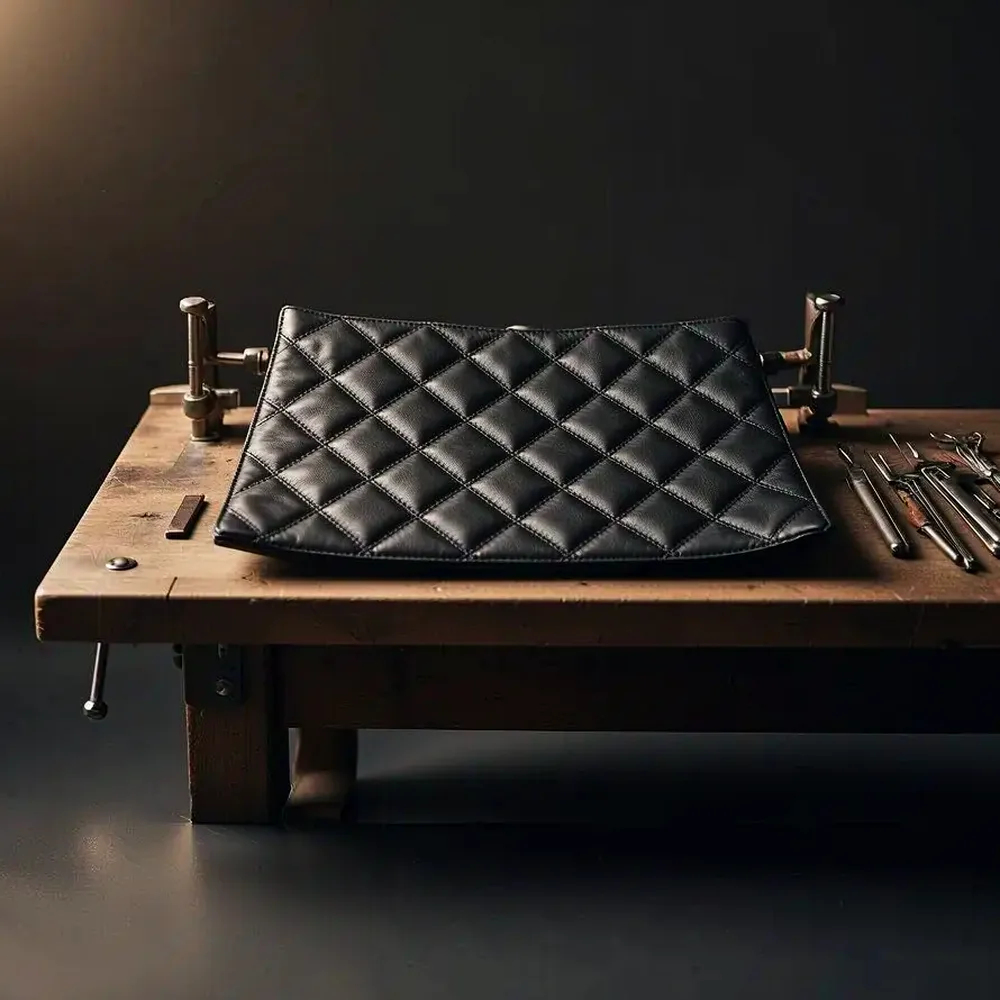
How does the handbag private label process run from first enquiry to goods on the water, and how long does it take? A private label handbag programme runs from a signed brief to cartons handed to your forwarder in 55-80 days: 1-3 days of quotation, 2-4 days of material confirmation, 6-10 working days of sampling (12-15 for framed, woven or stacked constructions), 35-50 days of production 35-50 days of pre-shipment inspection at AQL 2.5 under ISO 2859-1. The process is controlled by five decision gates — brief approval, material sign-off, sample approval, deposit and inspection release — and both money and risk move only when a gate is signed in writing. This page walks the commercial sequence: what each stage costs in calendar days, which document closes it, who owns the decision, and which four gate failures quietly destroy a launch date.
- The Five Commercial Stages and Where Money Moves
- Stage One: Enquiry, and What a Complete Brief Contains
- Stage Two: Quotation Is a Band, Not a Number
- Stage Three: Sampling Inside the 6-10 Working Day Window
- Stage Four: Bulk Production and the Quiet Middle
- Stage Five: Inspection, Handover and Transit
- The Decision Gate Log
- Four Gate Failures That Quietly Cost Money
- How Risk Is Shared Between Brand and Production Partner
- Questions Buyers Ask at Each Gate
- Who Asks for Each Document After the Goods Ship
How does the handbag private label process run from first enquiry to goods on the water, and how long does it take? A private label handbag programme runs from a signed brief to cartons handed to your forwarder in 55-80 days: 1-3 days of quotation, 2-4 days of material confirmation, 6-10 working days of sampling (12-15 for framed, woven or stacked constructions), 35-50 days of production 35-50 days of pre-shipment inspection at AQL 2.5 under ISO 2859-1. The process is controlled by five decision gates — brief approval, material sign-off, sample approval, deposit and inspection release — and both money and risk move only when a gate is signed in writing. This page walks the commercial sequence: what each stage costs in calendar days, which document closes it, who owns the decision, and which four gate failures quietly destroy a launch date.
The commercial clock at a glance
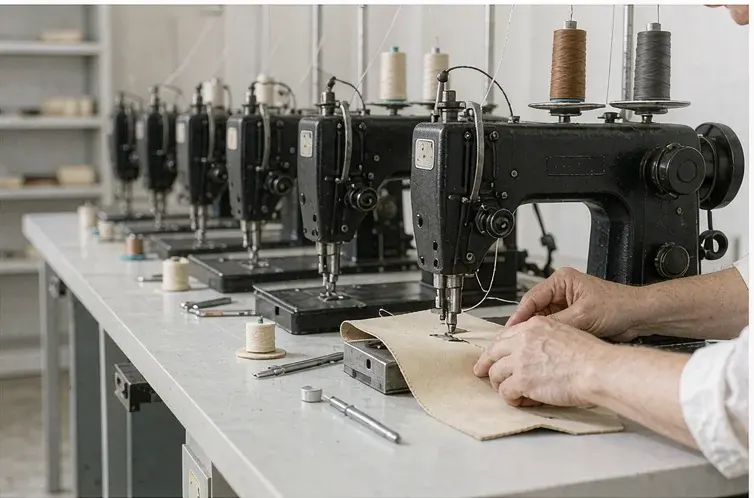
The Five Commercial Stages and Where Money Moves
A handbag programme is a sequence of commercial events before it is a sequence of operations. Each stage has an owner, a document that closes it, and a payment that follows it. Buyers who manage the sequence land their goods in the right month; buyers who manage only the calendar discover the slip two weeks before launch, when the only lever left is air freight at four times the ocean rate.
The five stages are enquiry, quotation, sampling, bulk and shipment. Between them sit five gates: brief approval, material sign-off, sample approval, deposit and inspection release. Nothing downstream begins until the gate before it is signed in writing. That is not bureaucracy — it is the point at which a change is still cheap, and after which it very quickly is not.
Stage One: Enquiry, and What a Complete Brief Contains
An enquiry is not a request for a price, it is a request for a specification. The difference shows up in the reply: a brief carrying dimensions, material direction, hardware references and a target retail price comes back as a number you can plan against, while 'how much for a handbag' comes back as a range too wide to be useful. What a production partner needs at this stage is the information that locks cost, and there are eight fields that do it. The reasoning behind the 500-piece minimum sits underneath the colourway field in particular.
| Field | What it locks | What happens without it |
|---|---|---|
| Silhouette and dimensions | The pattern, the cutting die and the hide yield | A quotation built on assumption |
| Material and temper | Price band, lot quantity, colour fastness target | A sample that photographs well and feels wrong |
| Colourway count | How many dye or coating lots are bought | A 500-piece run split five ways |
| Hardware and plating spec | Tooling, salt-spray target, unit cost | Plating that dulls within a season |
| Branding method and position | Die, mould or woven setup time | A second full sampling round |
| Packaging and barcode format | Artwork, print plates, carton marks | A relabelling job at your warehouse |
| Target retail price | The material cost ceiling | Three quotation rounds to find the band |
| Launch date | The production slot | Peak-season rates and missed shelf dates |
What happens when the brief is incomplete?
It is quoted optimistically and then corrected. A missing strap drop becomes a full-size revision, a missing lining specification becomes a substitute the brand never approved, and a missing hardware reference becomes the cheapest plated part in the catalogue. Each correction costs days, and the days come out of the 6-10 working days of sampling window rather than out of thin air. The remedy is unglamorous: send the sketch-to-first-order checklist with the first email, filled in.
Stage Two: Quotation Is a Band, Not a Number
A quotation for a private label run is five lines, and knowing the split is what turns it from a number you accept into one you can work on. When a quote lands above your ceiling, the fix is almost always inside one of these lines rather than in a discount request — a discount is a one-off, whereas a specification change is permanent and repeats on every reorder.
| Line | Share of unit price | The variable that moves it |
|---|---|---|
| Material | 40-55% | Pattern yield, hide or roll grade, number of colourways |
| Trimming and hardware | 15-25% | Branded tooling versus stock parts; plating thickness in microns |
| Cutting, sewing and finishing | 15-25% | How many operations the silhouette needs |
| Packaging | 3-8% | Print method, insert count, barcode symbology |
| Tooling, one-off | Billed or amortised | Whether it is folded into the unit price or invoiced separately |
Two commercial terms are settled at quotation stage rather than afterwards. Payment conventionally runs as a deposit to release material with the balance against the inspection report or before loading; tie the balance to a document rather than a date, so a schedule slip does not cost you money for goods you have not seen. And the trade term: FOB Xiamen is the default, with CIF and DDP quoted on request. Spending an hour with the quotation checklist and comparing quotations line by line before signing is the highest-return hour in the whole programme.
Stage Three: Sampling Inside the 6-10 Working Day Window
Sampling is the only stage at which a brand can still change the product at no cost. The clock starts when the specification and the material are signed off, not when the first email arrives — which is why the 2-4 days of material confirmation sitting in front of it matter more than they appear to. Standard constructions return in 6-10 working days; framed, hand-woven, stacked or bonded constructions take 12-15, because part of the sequence is executed by hand on a bench rather than on a line.
- Pattern and die check. Panels are checked against the approved dimensions and the cutting die is confirmed before anything is cut in bulk material.
- Material confirmation on the actual hide or roll. Colour is judged under the same light the retail photography will use, not under the fluorescent tube of a sample room.
- Prototype assembly. The sample room sews the bag by hand, applies branding at the specified positions and fits the closure.
- Measurement and dispatch. The prototype is measured against the tech pack, photographed from the agreed angles and sent for your written review.
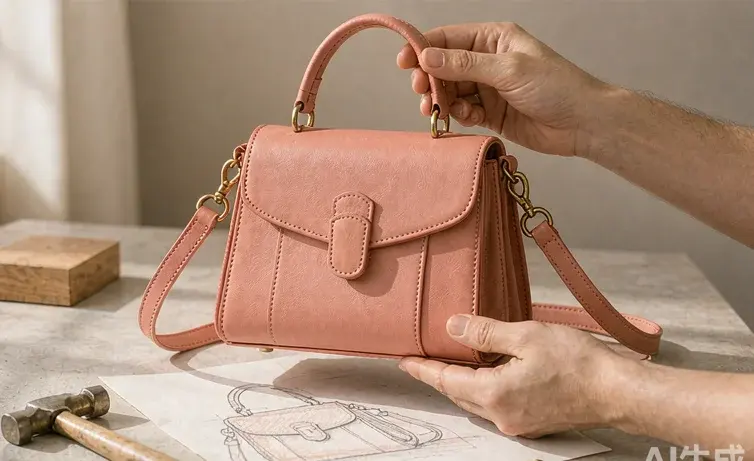
How should a physical sample be reviewed?
As a specification exercise rather than as a reaction. Number the items, measure them, and write the revision list against the tech pack: strap drop in millimetres, stitch density per inch, closure action, branding position, panel alignment at the seam. A photograph with circles on it produces another 6-10 working days. The approval process in full is the cheapest insurance on this page, and how sampling and bulk lead times actually behave explains the calendar that approval sits inside.
Stage Four: Bulk Production and the Quiet Middle
Once the deposit clears and the slot is booked, 35-50 days pass with very little to look at. That silence is the part first-time buyers find hardest, and it is also the part where the schedule can still be protected, provided the checkpoints inside it are real. A production partner running 7 production lines at about 200,000 pcs per month is sequencing several programmes at once, which is exactly why deposit and slot booking are tied together rather than handled separately. What production capacity actually means is the detailed version of this block.
- Material release, day 0-3. Hides, coated rolls, lining, interlining and hardware are received and counted against the order quantity.
- Cutting, day 3-8. Panels are nested and cut; yield is measured and any shortfall is re-ordered immediately rather than at packing.
- Preparation, day 6-12. Splitting, skiving, reinforcement tape and edge preparation take place ahead of assembly.
- Assembly, day 10-32. The longest block: strap attachment, lining insertion, closure fitting and topstitching.
- Finishing, day 30-44. Edge paint, hardware polish, final pressing, cleaning and thread trimming.
- Packing, day 42-50. Polybag, dust bag, hangtag, carton marks and palletising, ready for inspection.
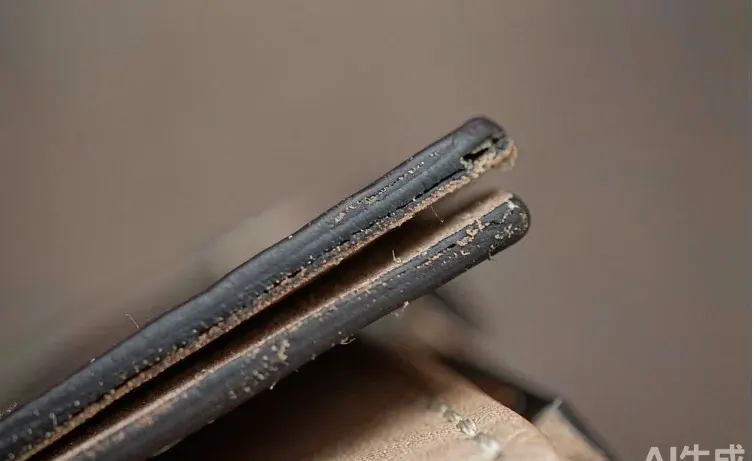
Two specifications belong in the brief because they are the ones most often left vague. Plating: state the thickness in microns and a salt-spray target tested to ASTM B117, because 'gold' is not a specification. Chemistry: leather is tested for chromium VI to ISO 17075 and checked against the REACH Annex XVII restrictions, while California Proposition 65 and CPSIA review covers hardware, coated trim and children's items respectively.
Material sourcing is documented rather than asserted. Hides can be traced to tanneries audited under the Leather Working Group environmental protocol, and recycled linings and canvas can carry Global Recycled Standard transaction certificates — which is what makes a percentage claim printed on a hangtag defensible rather than decorative. Where the cost actually sits in a leather bag sets out the same split in per-piece terms.
Stage Five: Inspection, Handover and Transit
The final gate is inspection, and it is the only one where the outcome is measured rather than agreed. Pre-shipment inspection at AQL 2.5 under ISO 2859-1 takes 1-2 days, and the report is issued to you whether it is run in-house or booked through SGS. Export handling follows, then transit: 18-28 days to the US West Coast, 30-38 days to Northern Europe, or 5-8 days by air. The FOB Xiamen route in detail covers what the term includes.
What does AQL 2.5 actually decide?
AQL 2.5 is the Acceptable Quality Limit expressed as a percentage. Under ISO 2859-1 it fixes three things at once: how many cartons are opened, how many units are pulled from a lot of a given size, and the accept and reject counts for critical, major and minor defects. It does not mean 2.5% of units are defective — a confusion that costs buyers money in every season. Independent laboratories including SGS and SATRA run seam strength, handle attachment and colour fastness testing to published methods; ask for the report reference rather than a verbal pass.
Who pays for what under FOB Xiamen?
Under FOB Xiamen the goods are delivered on board at Xiamen and risk transfers there, so freight, insurance, customs entry and duty are yours from that point forward. CIF carries and insures to your port; DDP delivers duty paid to your door. Incoterms 2020, published by the International Chamber of Commerce, defines exactly where cost and risk transfer under each rule, so cite the edition in the purchase order rather than the three letters alone.
The Decision Gate Log
The practical instrument for running all of this is a gate log: one line per gate, with the owner, the document that closes it and the payment that follows. A programme with a signed gate log can be handed to a colleague halfway through and still arrive on time. The version below is the one used on handbag programmes at MOQ 500 pcs per style / colourway.
| Gate | Owner | Document that closes it | Money that moves | Stop condition |
|---|---|---|---|---|
| 1. Brief approval | Brand | Signed tech pack and BOM | None yet | Dimensions or target retail price unresolved |
| 2. Material sign-off | Brand, on a physical swatch | Approved swatch card and plating specification | None yet | Colour or temper not matched to reference |
| 3. Sample approval | Brand, sample in hand | Numbered revision list, every item closed | Sample fee credited against the order | Any measurement outside the stated tolerance |
| 4. Deposit and slot | Brand | Purchase order and deposit advice | Deposit releases material and books the slot | Deposit not received; the slot is released |
| 5. Inspection release | Inspector; brand accepts the report | AQL 2.5 report under ISO 2859-1 | Balance payment before loading | Critical defect found, or major count above the reject number |
Ask for the ISO 9001 quality system certificate alongside the inspection report. The report tells you what happened in one lot; the certificate tells you whether the process that made your sample is the process that will make your bulk. Where a retailer is the end customer, BSCI (amfori) and Sedex / SMETA audit references are usually requested at the same time.
Four Gate Failures That Quietly Cost Money
Programmes that go badly wrong tend to fail at a gate rather than at a machine. These four are the common ones. Each is cheap to prevent at the moment it arises and expensive to discover later, and none of them appears anywhere as a line item on an invoice.
- Approving the sample from photographs. Temper, drape, strap drop and hand-feel cannot be judged on a screen, and a photographic approval converts into a bulk run that cannot then be corrected.
- Booking the slot after the sample instead of with the deposit. Slots tighten before Chinese New Year and through the autumn rush, and the delay lands as 35-50 days rather than the week you thought you saved.
- Changing hardware after cutting has started. Tooling is ordered early; a late change means the run waits for plating or the plated parts are scrapped.
- Discovering a Proposition 65 exposure at packing. A warning identified on the line is a relabelling job, not a paperwork fix, and it moves your vessel booking.
How Risk Is Shared Between Brand and Production Partner
The allocation is simpler than most contracts make it look. The brand owns specification, artwork and approval decisions; the production partner owns material conformity, workmanship and the schedule inside the agreed slot. Everything expensive happens in the gap where nobody is certain which side a decision sits on, so the cards below name the owner for each class of risk.
Specification risk
Yours. Every change after sample approval becomes a re-cut or a re-plate, so the revision list is closed before the deposit moves.
Material conformity
The partner factory's. Hides, coated rolls and hardware are bought to the signed specification and tested against agreed standards.
Workmanship
The partner factory's, measured at AQL 2.5 under ISO 2859-1 with defect classes agreed before the run starts.
Schedule
Shared. The slot is honoured once the deposit clears; buyer decision time inside sampling and review is what usually consumes it.
Compliance documentation
Joint. Test reports are issued to you, but which regulations apply is a question about your market rather than about the line.
Questions Buyers Ask at Each Gate
These come up on almost every first programme, and they are worth answering before they are asked. Each one marks a point at which a decision has usually not yet been written down, which is precisely why it becomes a question.
- Can I order fewer than 500 pcs? No. The MOQ is 500 pcs per style / colourway, and the reason is four upstream material minimums rather than a policy position taken by the production partner.
- What if I need a second sample? It is chargeable, and it restarts the 6-10 working day clock; a complete brief is the cheapest way to avoid needing one.
- Can I change the colour after paying the deposit? Only by buying a new dye lot, which means a new material minimum and, in peak season, a new slot.
- Who owns the embossing die? You should, in writing, together with the storage location and a commitment that the tool will never run for another brand.
- What happens if inspection fails? Where the defect is workmanship, the lot is re-sorted or re-made at the partner factory's cost; the schedule slip is the part that cannot be recovered.
Who Asks for Each Document After the Goods Ship
A programme produces about a dozen documents, and each one has a second reader months after it was written. The inspector reads the report, the broker reads the packing list, the marketplace reads the compliance file and the next production partner reads the specification. Knowing who asks, and when, is the reason to assemble the folder as the programme runs rather than at the end, because three of these documents cannot be reconstructed after the fact. The checklist that gathers them is in the sketch-to-first-order reference.
| Document | Who asks | When | Cost of the gap |
|---|---|---|---|
| Tech pack and revision history | The next production partner | At the reorder | The repeat is re-quoted as if new, 6-10 working days lost |
| Approved swatch card | The inspector | At final inspection | A colour dispute nobody can rule on |
| AQL 2.5 report under ISO 2859-1 | The brand and any stockist | At goods-in | No basis for a claim |
| REACH Annex XVII report | An EU importer or marketplace | At onboarding | The listing is blocked |
| Proposition 65 review | A California retailer | At onboarding | A relabelling job at the warehouse |
| CPSIA documentation | A child-market retailer | At onboarding | The line is delisted |
| BSCI or Sedex SMETA reference | A retail buyer | At onboarding | The account is not opened |
| Leather Working Group reference | A brand making a provenance claim | At listing | The claim has to be withdrawn |
| GRS transaction certificate | A marketplace verifying recycled content | At listing | The claim is removed |
| Packing list and carton marks | The third-party warehouse | At goods-in | Demurrage at 35-180 a day |
| Bill of lading and origin certificate | The customs broker | At clearance | Duty charged at the wrong rate |
| Tooling inventory and storage record | The brand | At a change of partner | A die re-cut at 180-420 |
Walk your programme through the gates
Send the silhouettes, the material direction, the quantity per colourway and your launch date. A private label coordinator will return a quotation in 1-3 days, a sampling window of 6-10 working days and a bulk slot of 35-50 days at MOQ 500 pcs per style / colourway. Get a quote.
Frequently Asked Questions
How long does the private label handbag process take from enquiry to delivery?
Plan 55-80 days from signed brief to cartons handed to your forwarder, then add transit. Inside that figure sits 1-3 days of quotation, 2-4 days of material confirmation, 6-10 working days of sampling, 3-6 days of review, 1-2 days for deposit and slot booking, 35-50 days of production 35-50 days of inspection and 2-4 days of export handling. Ocean transit then adds 18-28 days to the US West Coast or 30-38 days to Northern Europe.
What is the MOQ for a private label handbag programme?
The MOQ is 500 pcs per style / colourway, which is not the same as 500 pcs per order. A three-silhouette capsule in two colourways is therefore 3,000 pcs. The number reflects four upstream minimums — the hide or coating lot, trimming and hardware lot sizes, the plating bath and the line changeover — all of which cost the same whether 100 or 500 pieces are made.
What should my first enquiry include?
Eight fields: silhouette and dimensions, material and temper, colourway count, hardware and plating specification, branding method and position, packaging and barcode format, target retail price, and an honest launch date. The last two are the ones most often omitted and the two that most affect the reply. Without a price ceiling the material selection is a guess; without a date the slot quoted may not be the slot you need.
How long does sampling take and when does the clock start?
Sampling takes 6-10 working days for standard constructions and 12-15 for framed, hand-woven, stacked or bonded work. The clock starts when the specification and the material are signed off, not when the first email arrives. That distinction matters: enquiry threads that run for two weeks before a swatch is approved consume calendar time without consuming any of the sampling window.
What happens if I need a second sample?
A second sample is chargeable and restarts the 6-10 working day clock. The first sample fee is often credited against the order, but later rounds are billed, and an unclear brief is the usual reason one is needed. The cheapest prevention is a numbered revision list written against the tech pack during the first review, covering measurements rather than impressions.
When is the deposit due and what does it release?
The deposit is due at gate four, once the sample is approved and the purchase order is issued. It releases two things: material, which is bought against your order rather than held in stock, and the production slot, which is a reservation on one of 7 production lines. Booking the slot with the deposit rather than after it is the single most effective way to protect a launch date.
How long does bulk production take?
The bulk run takes 35-50 days from material release to packed cartons. The spread depends on how many operations the silhouette needs and how tight the slot is when it is booked. Soft constructions sit at the lower end; structured satchels with interlining, stiffeners and a fitted closure sit at the top. Material release, cutting, preparation, assembly, finishing and packing each occupy a defined block inside that window.
What is the inspection standard and who runs it?
Pre-shipment inspection runs at AQL 2.5 under ISO 2859-1, taking 1-2 days at the end of the run. It can be carried out in-house or booked through a third party such as SGS, and the report is issued to you in either case. AQL 2.5 fixes the cartons opened, the units pulled and the accept and reject counts for critical, major and minor defects.
What are the payment terms on a handbag order?
The conventional structure is a deposit to release material with the balance against the inspection report or before loading. Tie the balance to a document rather than to a calendar date: if the run slips, you should not be paying for goods that have not yet been inspected. The exact split is agreed at quotation stage and written into the purchase order, and the payment terms comparison covers the usual variations.
Which trade terms are available besides FOB Xiamen?
FOB Xiamen is the default, with CIF and DDP quoted on request. Under FOB the goods are delivered on board and freight, insurance, customs entry and duty are yours. CIF carries and insures to your port. DDP delivers duty paid to your door, which suits brands without a customs broker. Incoterms 2020, published by the International Chamber of Commerce, defines each rule.
Who owns the tooling, dies and hardware moulds?
You should, and that should be written down before any deposit is paid. An embossing die, a woven-label setup and a hardware mould are physical assets with a real cost. Ask whether the tooling charge is amortised into the unit price or billed separately, where the tooling is stored, and whether it will be run for another brand's programme.
Can I change the colour or hardware after paying the deposit?
Only at the cost of a new material buy. Each colourway is its own dye or coating lot with its own minimum, so a late colour change means a second lot and often a second slot. Hardware is worse: tooling is ordered early in the cycle, and a late change either holds the run waiting for plating or scraps the plated parts already made.
What causes most delays in a handbag programme?
Buyer decision time, not machine time. The delays that move a launch date are an incomplete brief, a sample reviewed from photographs, a revision list that arrives a week late, and a slot booked after approval rather than with the deposit. Each costs days at the front of the calendar, and each is recoverable only by paying for air freight at the back of it.
Can I visit the production floor before ordering?
Yes. Visits to our validated partner factory Quanzhou Yingming Bags can be arranged, and a video walk-through can be scheduled where travel is impractical. Either is worth doing before a first bulk run. Ask to see the material store, the cutting table and the finishing bench, and watch a strap attachment being sewn, because that is the joint that fails first in the field.
Which compliance documents come with a handbag order?
For the EU, material test reports against REACH, in practice covering chromium VI to ISO 17075, azo dyes, nickel release and phthalates. For California, a Proposition 65 review of hardware, coated trim and dyes. For children's items, CPSIA lead and phthalate limits plus tracking labels. Social compliance under BSCI or Sedex / SMETA, leather traceability through Leather Working Group audited tanneries, and recycled content through Global Recycled Standard certificates.
People Also Ask
What is the first step in the private label handbag process?
A written brief: silhouettes and dimensions, material direction, colourway count, hardware and plating specification, branding method, packaging format, target retail price and launch date. That file is what turns an enquiry into a quotation you can plan against rather than a range too wide to use.
How many samples should I approve before bulk production?
One physical sample reviewed in hand is normally enough when the brief is complete. A second round is chargeable and restarts the 6-10 working day clock, so the goal is a numbered revision list at first review rather than a third prototype.
What is a decision gate in a handbag programme?
A point where a document is signed before anything downstream begins. Five gates govern a private label run: brief approval, material sign-off, sample approval, deposit and inspection release. Each has an owner, a closing document and a stop condition.
When should freight be booked for a handbag shipment?
After inspection release and before export handling, which normally means 3-6 days before the vessel cut-off. Booking in December or in the weeks before Chinese New Year costs more and is harder to secure, so rates and slots should be checked at quotation stage.
Can several SKUs be consolidated into one container?
Yes, and it is the usual arrangement. Three silhouettes in two colourways — 3,000 pcs, six SKUs — typically fill a 20-foot container with one inspection and one set of export documents, which spreads fixed logistics cost across the whole programme.
Sources and further reading
Every figure on this page is either our own programme data or attributed below. Open the originals before you write them into a specification.
- Incoterms rulesICC The rules that decide where cost, risk and insurance transfer.
- REACH — chemical substances regulationEuropean Commission Annex XVII restricts the substances that may appear in finished leather and coatings.
- SATRA — technical services for leather, footwear and accessoriesSATRA Independent leather, hardware and accessories testing protocols.
- Leather Working Group — environmental auditing for tanneriesLeather Working Group Environmental audit protocol for tanneries and leather traceability.