How Social Commerce Is Changing Handbag Demand in 2026
How has social commerce changed handbag demand in 2026? It compressed it. A style that used to sell steadily over two quarters now peaks inside 72 hours and then runs a four-month tail at roughly 38 per cent of peak weekly volume. The commercial problem is not the spike, it is the restock: on a 500-piece order, air freight to chase a sold-out week adds USD 2.90 per unit landed, while the same units by sea cost USD 0.85 less and arrive 17 days later. This page breaks the money and the days first, then explains the three production choices that decide whether a restock is possible at all, and ends with the calendar to hand to a production partner before the video goes live.

- What a Viral Week Costs You If the Calendar Is Wrong
- The Demand Curve: 72 Hours, Then a Four-Month Tail
- Breaking the Cost of a Restock at 500 Pieces
- Where the Money Actually Goes When Demand Spikes
- Three Production Choices That Decide the Restock
- What Social Demand Does to Material and Colour
- The Restock Calendar, Day by Day
- Building a Range That Can Survive Its Own Success
- The Numbers to Put in Front of a Production Partner
- Reorder Point and Cover, in Weeks Rather Than Units
- How a Spike Splits Across Colourways
- What a Spike Does to Returns and Reviews
- The Listing Asset Budget Behind Every Restock
How has social commerce changed handbag demand in 2026? It compressed it. A style that used to sell steadily over two quarters now peaks inside 72 hours and then runs a four-month tail at roughly 38 per cent of peak weekly volume. The commercial problem is not the spike, it is the restock: on a 500-piece order, air freight to chase a sold-out week adds USD 2.90 per unit landed, while the same units by sea cost USD 0.85 less and arrive 17 days later. This page breaks the money and the days first, then explains the three production choices that decide whether a restock is possible at all, and ends with the calendar to hand to a production partner before the video goes live.
Social demand, priced and dated
What a Viral Week Costs You If the Calendar Is Wrong
Start with the money, because the money is what makes the rest of the decision obvious. A 500-piece style sells out in eleven days after a video lands. Restocking by air costs USD 2.90 per unit more landed than sea freight, which is USD 1,450 across the order, and it saves 17 days. Whether that trade is worth making depends entirely on one variable: whether the tail is still running when the units arrive.
| Route | Extra cost per unit | Arrives | Works when |
|---|---|---|---|
| Air freight, existing tooling | USD 2.90 landed | About 8 days sooner | Tail is above 60 per cent of peak |
| Sea freight, existing tooling | Baseline | 17 days later | Tail is above 30 per cent of peak |
| Repeat production, no reservation | Baseline, plus a new slot | 35-50 days | Tail is long and predictable |
| New style, sampling first | Sampling cost plus 6-10 days | 45-60 days | Only when the shape has changed |
Read the last column rather than the cost column. The expensive mistake is not paying USD 2.90 per unit; it is paying it to arrive after the tail has already decayed. Four months of tail at 38 per cent of peak is long enough that sea freight is usually right, which is the opposite of the instinct most brand teams have in the middle of a sold-out week. That instinct is worth naming, because it is the thing that costs the money. A sold-out listing feels like an emergency, emergencies get escalated, and escalation buys air freight. The data says otherwise: the tail is long, the buyer is not going anywhere in 17 days, and the margin saved per unit is usually worth more than the weeks. The exception is genuine but narrow. If the style is tied to a dated moment, a holiday, a collaboration or a cultural event with a closing date, then the tail collapses and air is correct. Write that condition into the plan before the video goes live, so the decision during the spike is a look-up rather than a debate held under pressure.
The Demand Curve: 72 Hours, Then a Four-Month Tail
The shape of the curve matters more than its height. Volume concentrates into 72 hours, which means the first problem is stockout and the second problem is over-ordering against a peak that will not repeat. Median across tracked private label programmes: 11 days from video to stockout, a 72-hour peak, then a tail running four months at about 38 per cent of peak weekly volume, with a reorder rate 2.6 times the baseline for the label afterwards.

Breaking the Cost of a Restock at 500 Pieces
The restock has four cost lines and only two of them appear on an invoice. The first is freight, already covered. The second is the repeat production slot, which is free if it was reserved and expensive if it was not. The third is the sampling revision that a new colourway forces. The fourth is the listing rebuild, which nobody budgets and everybody pays.
- Freight: USD 2.90 per unit by air, or the sea baseline arriving 17 days later.
- Slot: a reserved repeat slot costs nothing; an unreserved one waits for the next opening in the calendar.
- Sampling: 6-10 working days for a repeat of an existing style, 12-15 if anything in the build changes.
- Listing: photography, copy and reviews do not transfer to a new colourway, and the rebuild costs a week.
- Working capital: 500 pieces at MOQ 500 pcs per style / colourway is the whole order, not a top-up.
That fifth line is the one that surprises people. Because the minimum applies per colourway, a restock is not a partial order, it is a second full commitment. Brands that understand this plan the second colourway as the restock rather than ordering both up front, which halves the exposure on an unproved silhouette. It also turns the second colourway into a reward for evidence rather than a bet taken up front, which is the sequencing most small programmes settle on after one season of doing it the other way.
Where the Money Actually Goes When Demand Spikes
Not where most range plans put it. When demand spikes, the money goes to holding the calendar rather than to buying speed: a reserved production slot, a material already in house, and a compliance file already assembled. Those three cost nothing to arrange in advance and are unavailable at any price during the spike itself.
| Element | Arranged in advance | During the spike |
|---|---|---|
| Repeat production slot | Free, by reservation | Waits for the next opening |
| Material already in house | One week of planning | 2-3 weeks if the mill is busy |
| Compliance file assembled | Cost of an afternoon | Delays bulk past 35-50 days |
| Air freight capacity | Not reservable at this scale | USD 2.90 per unit, if space exists |
| Photography and listing | Reusable assets | A week, and reviews restart at zero |
Sourcing Journal and FashionUnited have both documented the same pattern among labels that handle spikes well: they do not buy speed, they remove the steps that would have cost them time. In practice that means the compliance file and the reserved slot are arranged in the same week as the first order, long before anyone knows whether the video will land.
Three Production Choices That Decide the Restock
Three decisions made at the first order determine whether a restock is even possible, and none of them is about quantity. They are whether the material is a stock item, whether the hardware is standard, and whether the colourway is inside an already-approved dye lot. Each one converts a 35-50 day problem into a much shorter one, or fails to.
- Stock material: a mill item in a standard colour cuts 2-3 weeks versus a bespoke dye lot.
- Standard hardware: a catalogue puller and zip can be reordered; a custom tooled one cannot be rushed.
- Approved dye lot: a colour already signed off under D65 skips the approval step entirely on repeat.
- Pattern held on file: a graded pattern means a repeat is a cutting instruction, not a development project.
- One material across the style: two materials on one bag doubles the purchasing work on every repeat.
What Social Demand Does to Material and Colour
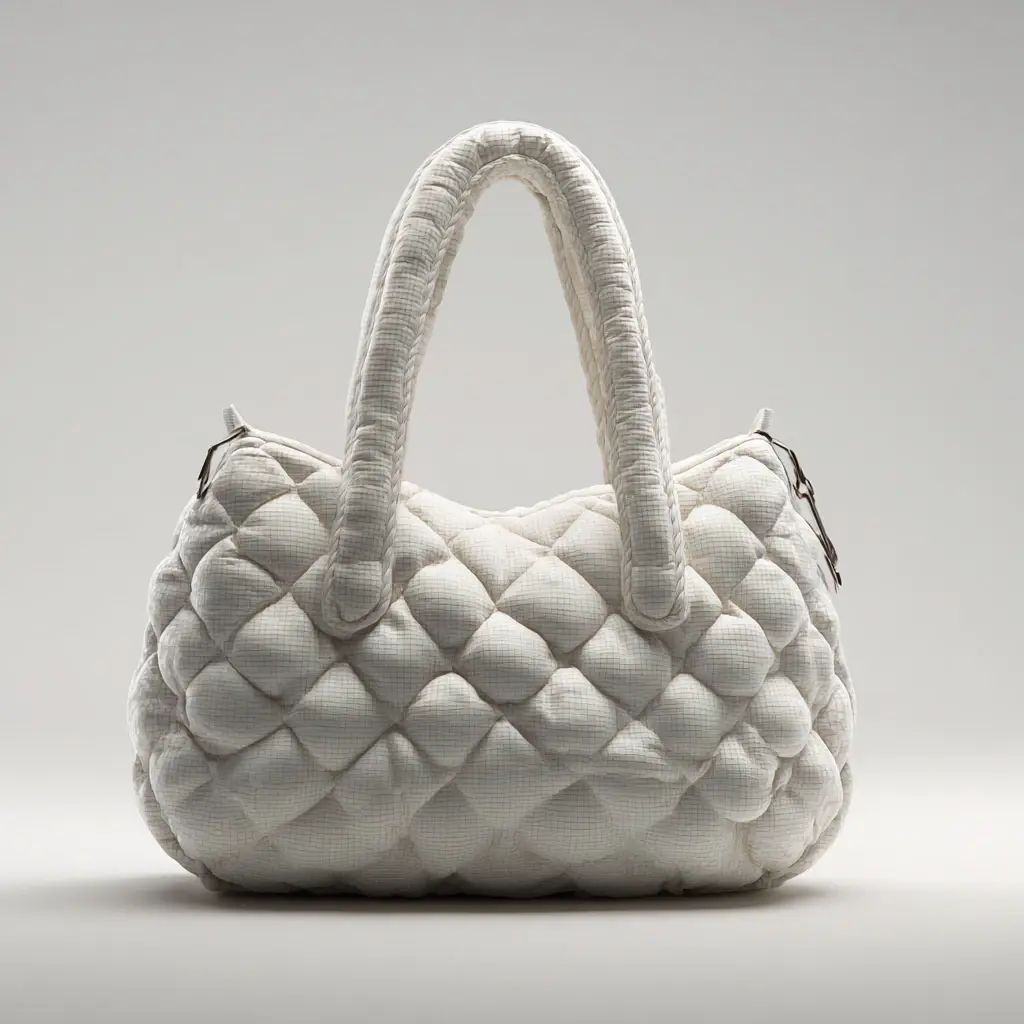
It pushes both towards the photographic end of the range. A bag that has to sell in nine seconds needs a colour that reads at mobile size and a material whose texture survives compression, which is why coated splits with a visible grain and recycled canvases with a visible weave outperform smooth synthetics in this channel even when the smooth option is cheaper.
It also shortens the colour list rather than lengthening it. Because the spike concentrates into one silhouette and one colour, the practical range is one hero colourway with depth rather than three shallow ones. A single colourway at 500 pieces, restocked once, sells more than three colourways at 500 each that never build a position in any of them.
The Restock Calendar, Day by Day
Worked backwards from the day stock lands, the calendar is the only artefact that makes the decision real. The version below assumes an existing style with a held pattern, a stock material and a standard hardware set, which are the three choices described above. Change any one of them and the middle of the calendar moves.
- Day 0: video lands. Peak runs for 72 hours; stockout typically follows around day 11.
- Day 0-2: confirm the reserved repeat slot and release the held pattern to cutting.
- Day 3: material call-off against the stock item, avoiding a fresh dye lot entirely.
- Day 4-15: production runs against the existing specification, with no new sampling required.
- Day 16-18: pre-shipment inspection against AQL 2.5 under ISO 2859-1, criticals at accept zero.
- Day 19-35: sea transit from FOB Xiamen, or eight days sooner by air at USD 2.90 per unit.
Building a Range That Can Survive Its Own Success
Most labels that fail on social demand do not fail on the spike; they fail on the second and third months, when the tail is still running and the stock is not. The fix is a range built for repetition rather than for novelty: one material family, one hardware family, one dye lot per colour, and a pattern held on file for every style in it.
That structure has a cost, which is a narrower range. It also has a measurable benefit: repeat orders become cutting instructions rather than development projects, and the compliance file covers the whole family instead of being rebuilt style by style. Accessories Council roundtables have made the same observation repeatedly, that the labels which compound on social demand are the ones with the least variety in their bills of material.
- One material family: a single coated split or recycled canvas across the core range.
- One hardware family: shared pullers, feet and zips, so a repeat never waits on tooling.
- One dye lot per colour: signed off once, reused on every repeat, no re-approval step.
- Held graded patterns: every style on file and cuttable without a development cycle.
- Standing compliance file: LWG, GRS or REACH evidence covering the family, not the style.
The Numbers to Put in Front of a Production Partner
Six numbers, and the conversation changes completely. Without them a restock request is a hope; with them it is a schedule. All six are knowable before the first order ships, which is what makes them worth writing down in the same week as that order.
- The repeat quantity you intend to call off, stated per colourway at MOQ 500 pcs per style / colourway.
- The reserved slot you want held, and the date by which you will confirm or release it.
- The material call-off position: stock item or bespoke, and the lead time attached to each.
- The inspection gate: AQL 2.5 under ISO 2859-1, criticals at accept zero, single sampling normal.
- The freight assumption: FOB Xiamen, sea baseline, with the USD 2.90 air uplift priced as an option.
- The sampling position: 6-10 working days for a repeat, 12-15 if any part of the build changes.
Our programmes run through an SGS-validated partner factory with 7 production lines and about 200,000 pcs per month of capacity, and export work has run since 2014, so those six numbers come back as dates rather than as intentions. For the demand side of the same picture, what the next buyer wants covers the cohort driving the spikes, how consumers choose a bag covers the nine checks they run, and our handbag sourcing guides carry the wider background.
Reorder Point and Cover, in Weeks Rather Than Units
A spike punishes the brand that reorders against a unit count rather than against a date. Convert the decision into weeks of cover: take the weekly run rate, multiply by the total lead time in weeks, and add safety stock. With bulk at 35-50 days and transit at 18-35 days the full pipeline is 53-85 days, or roughly 8-12 weeks, and that is the figure that belongs on the reorder trigger.
- Pipeline door to door: about 8-12 weeks, being 35-50 days production 35-50 days transit.
- Safety stock: two weeks of cover at the viral run rate, typically 80-120 units during a peak.
- The trigger: reorder when stock on hand falls below 9-14 weeks of cover, not below a round number.
- The cost of guessing: a reorder placed one week late can arrive after the four-month tail has already halved.
How a Spike Splits Across Colourways
A viral silhouette almost never distributes evenly across a colour range, and the imbalance is stable enough to plan for. In a four-colourway buy, the hero colour typically takes 45-60 per cent of volume, two mid colours take 15-25 per cent each, and the fourth takes under 10 per cent. Ordering evenly across all four is the most common way to manufacture both a stockout and a markdown in the same season.
| Colourway position | Share of units | Quantity at 500 per colourway | Reorder risk |
|---|---|---|---|
| Hero colour | 45-60% | 500 pcs, first to go | Stockout in week two |
| Second and third | 15-25% each | 500 pcs each | Markdown in month three |
| Fourth and beyond | Under 10% | 500 pcs | Written off or carried into next season |
What a Spike Does to Returns and Reviews
Social demand arrives without the customer having handled the bag, and the numbers move accordingly. Returns on handbags sold online normally run 8-12 per cent of units; on social-driven first orders the range is closer to 15-20 per cent, concentrated in the first 30 days and in the larger size band. Review averages follow the same curve, which is the strongest argument for waiting before reordering.
- Return rate, ordinary channel: 8-12 per cent of units, against 15-20 per cent on social-driven first orders.
- Concentration: about 70 per cent of returns land inside the first 30 days of the window.
- Size effect: the largest band in a range returns at roughly 1.5 times the rate of the smallest.
- Review drag: a return accompanied by a review costs about 0.3 of a point on the listing average.
The Listing Asset Budget Behind Every Restock
A restock is a listing event as much as a production one. Where the colourway changes, photography, copy, size charts and reviews all restart, and the conversion lost during the rebuild is usually larger than the freight saving being chased. Budget the assets at the same time as the goods, and reuse everything that does not depend on colour. The handbag sampling mistakes that add weeks list covers the same trap on the development side.
- Photography per style: USD 200-800, reusable across colourways built on the same shape.
- Copy and size chart: about half a day per style, and the size chart carries across colourways unchanged.
- Reviews restart at zero on a new listing and take roughly 40-60 reviews to settle near 4.2.
- The trap: a restock in a new colourway costs a week of listing momentum on top of the production calendar.
Send the style you plan to push, and we will return a reserved slot, a restock calendar and a landed cost both ways. Get a Quote → /contact-quote/
Frequently Asked Questions
How fast does a handbag sell out after a social video?
A median of 11 days across tracked private label programmes, with the volume concentrated into the first 72 hours. The tail then runs about four months at roughly 38 per cent of peak weekly volume, which is long enough that sea freight usually beats air on the restock.
Is air freight worth it to restock a viral handbag?
Only when the tail is still above about 60 per cent of peak. Air adds USD 2.90 per unit landed and saves 17 days, which is USD 1,450 on a 500-piece order. Paying that to arrive after the tail has decayed is the expensive mistake, not the freight itself.
What is the minimum for a restock order?
MOQ 500 pcs per style / colourway, applied per colourway. A restock is therefore a second full commitment rather than a partial top-up, which is why the second colourway is usually better planned as the restock than ordered alongside the first drop, where it doubles the exposure.
How can a brand prepare for a demand spike in advance?
Arrange three things in the same week as the first order: a reserved repeat production slot, a standing compliance file, and a material that is a stock item rather than a bespoke dye lot. None costs money in advance and none can be bought during the spike.
Does social commerce change which materials sell?
Yes, towards texture that survives video compression. Coated split with a visible grain and recycled canvas with a visible weave outperform smooth synthetics in this channel, because the texture is one of the few things a nine-second clip can actually transmit, along with silhouette and hardware movement.
Should a range carry more colourways for social selling?
No, fewer with more depth. The spike concentrates on one silhouette in one colour, so a single hero colourway restocked once outsells three shallow colourways. A new colourway also forces a listing rebuild and resets reviews to zero, which costs more than the extra choice is worth.
How long does a repeat production run take?
35-50 days for bulk against an existing specification, or 45-60 days if the build has changed and sampling is needed first. Sampling itself is 6-10 working days for a repeat of an existing style and 12-15 for a complex one with custom hardware or bonded construction.
What inspection standard applies to a restock?
The same one as the first order: AQL 2.5 under ISO 2859-1 for major defects, single sampling at normal inspection, with criticals at accept zero. Naming it in the purchase order is what converts a quality opinion into a document an inspector can apply.
Why do repeat orders sometimes take longer than the first?
Usually because something in the build changed without being treated as a change: a new hardware finish, a second material, or a colourway outside the approved dye lot. Each reintroduces sampling or purchasing steps that the first order already absorbed, and each one restarts part of the compliance file as well.
What is the most useful thing to reserve in advance?
A repeat production slot. It costs nothing to reserve and cannot be bought during a spike, when the alternative is waiting for the next opening in the calendar. Reserved slots are the single cheapest form of speed available to a small label, and they convert a 35-50 day problem into a much shorter one.
Does social demand change the return rate on handbags?
It raises it slightly, because impulse purchases are judged more harshly than considered ones. The offset is to publish the three numbers that drive early returns: empty weight in grams, strap adjustment range in centimetres, and a colour reference approved under D65, all three before the video goes live.
People Also Ask
How does social media affect handbag sales?
It compresses the demand curve. Instead of steady sell-through over two quarters, a style peaks within 72 hours, sells out around day 11, and then runs a four-month tail at about 38 per cent of peak weekly volume, with reorders running 2.6 times baseline afterwards.
What is social commerce in fashion?
Discovery and purchase happening inside a short-video or social platform rather than on a brand site. For handbags it means the buying decision is formed in roughly nine seconds from silhouette, colour and hardware movement, with almost no written information involved.
How fast should a brand restock a viral product?
Within the tail, not within the spike. A four-month tail at 38 per cent of peak is long enough for sea freight at the baseline, arriving 17 days later than air. Reserve the production slot immediately, then let the freight decision wait for the tail data.
Why do small brands struggle with viral demand?
Because the constraint is calendar rather than capital. Air freight capacity can be bought; a production slot, an assembled compliance file and a stock material position cannot. Those three are arranged weeks earlier or not at all.
Sources and further reading
Every figure on this page is either our own programme data or attributed below. Open the originals before you write them into a specification.
- Incoterms rulesICC The rules that decide where cost, risk and insurance transfer.
- SATRA — technical services for leather, footwear and accessoriesSATRA Independent leather, hardware and accessories testing protocols.
- International Maritime OrganizationIMO Maritime rules governing container packing and dangerous-goods declaration.