Best Custom Shoulder Bag Silhouettes for Emerging Brands
Which custom shoulder bag silhouette should an emerging brand build first? Take the structured shoulder satchel at 28 x 20 x 8 cm as the default and the slouchy hobo as the second samples; those two account for most first-year shoulder volume and differ in exactly one expensive way — the satchel needs interfacing plus a base board, while the hobo needs soft material and nothing structural. Every silhouette below is scored against four pass or fail gates: whether it holds shape empty, whether the strap stays on the shoulder at a 22-30 cm drop, whether it survives 5 kg at 1,000 load cycles, and whether it can be tooled without rew developing the pattern. Read the checklists rather than the aesthetics; a shape that fails any one of those four gates returns as complaints rather than as revenue.
- How to Use This Checklist
- Silhouette One: The Structured Shoulder Satchel
- Silhouette Two: The Slouchy Hobo Shoulder
- Silhouette Three: The Half-Moon Shoulder
- Silhouette Four: The Compact Zip Shoulder
- Silhouette Five: The East-West Shoulder
- Silhouette Six: The Quilted Shoulder With Chain
- The Three Numbers Behind Every Shoulder Bag
- Strap Attachment: The Checklist Nobody Completes
- Scoring Six Shapes Against a First Order
- Which Two to Take to Sampling
Which custom shoulder bag silhouette should an emerging brand build first? Take the structured shoulder satchel at 28 x 20 x 8 cm as the default and the slouchy hobo as the second samples; those two account for most first-year shoulder volume and differ in exactly one expensive way — the satchel needs interfacing plus a base board, while the hobo needs soft material and nothing structural. Every silhouette below is scored against four pass or fail gates: whether it holds shape empty, whether the strap stays on the shoulder at a 22-30 cm drop, whether it survives 5 kg at 1,000 load cycles, and whether it can be tooled without redeveloping the pattern. Read the checklists rather than the aesthetics; a shape that fails any one of those four gates returns as complaints rather than as revenue.
The four pass or fail gates
How to Use This Checklist
Silhouette round-ups tend to be written like shopping lists, which is useless to somebody who is about to commit 500 pieces to a shape. This one is written as a checklist instead. Each shape below carries the same four gates — whether it holds form empty, whether the strap stays put, whether it survives loaded carry, and whether the pattern is already understood — and only shapes clearing all four belong in a first order. Where a shape clears three and fails one, the failure is named and priced, so it can be accepted knowingly rather than discovered in a return.
- Score each gate pass or fail before falling in love with the drawing. Aesthetics decide conversion; the gates decide whether there is anything left to convert on.
- Cost and difficulty indices are relative to the structured satchel at 100. Anything below 100 is cheaper to build, above 100 costs more operations.
- Every checklist should end up on your tech pack. These are not questions to hold in your head, they are lines to write down before sampling opens.
- Take two shapes to sampling, not six. Two divergent shapes teach you more for the same money and give the line a coherent story.
A note on scale: an emerging brand usually has one launch window and one budget, and the temptation is to cover every taste with six shapes. Six shapes at this stage means six pattern setups, six material buys and six chance-to-be-wrong entries in a warehouse, and it rarely produces more sales than two shapes done properly. The first-time founder economics cover why narrower ranges convert better at small scale.
Silhouette One: The Structured Shoulder Satchel
The default for good reason. A satchel-derived shoulder bag at 28 x 20 x 8 cm takes an A4 notebook laid flat, holds its form when empty, photographs predictably from every angle, and has been built so often that yield and stress behaviour are known quantities rather than hopes. It clears all four gates. Its weakness is that it is nobody's idea of exciting, which is why the branding and the material usually need to carry the personality.
- Body
- 28 x 20 cm with an 8 cm gusset, tolerance plus or minus 3 mm
- Strap
- Drop 25 cm, width 22 mm, for shoulder carry over a coat
- Structure
- 0.8 mm non-woven interfacing plus a 2.0 mm base board
- Cost index
- 100 — the baseline for this article
- Difficulty index
- 100 — known yields, known operations
Checklist for the structured shoulder satchel
- Base board specified as 2.0 mm with wrapped edges so it cannot wander inside the lining after three weeks of use.
- Top edge finished with a 20 mm folded facing rather than a 10 mm turning, because this is the edge hands brush daily.
- Flap closure placed so the magnet lands at least 40 mm above the main compartment opening, or the bag will sit slightly ajar.
- Feet: four 8 mm domed studs, which cost almost nothing and prevent base abrasion complaints entirely.
- Interior: one zip pocket, two slip pockets, no more — see the interior decision sequence used across every build we specify.
Silhouette Two: The Slouchy Hobo Shoulder
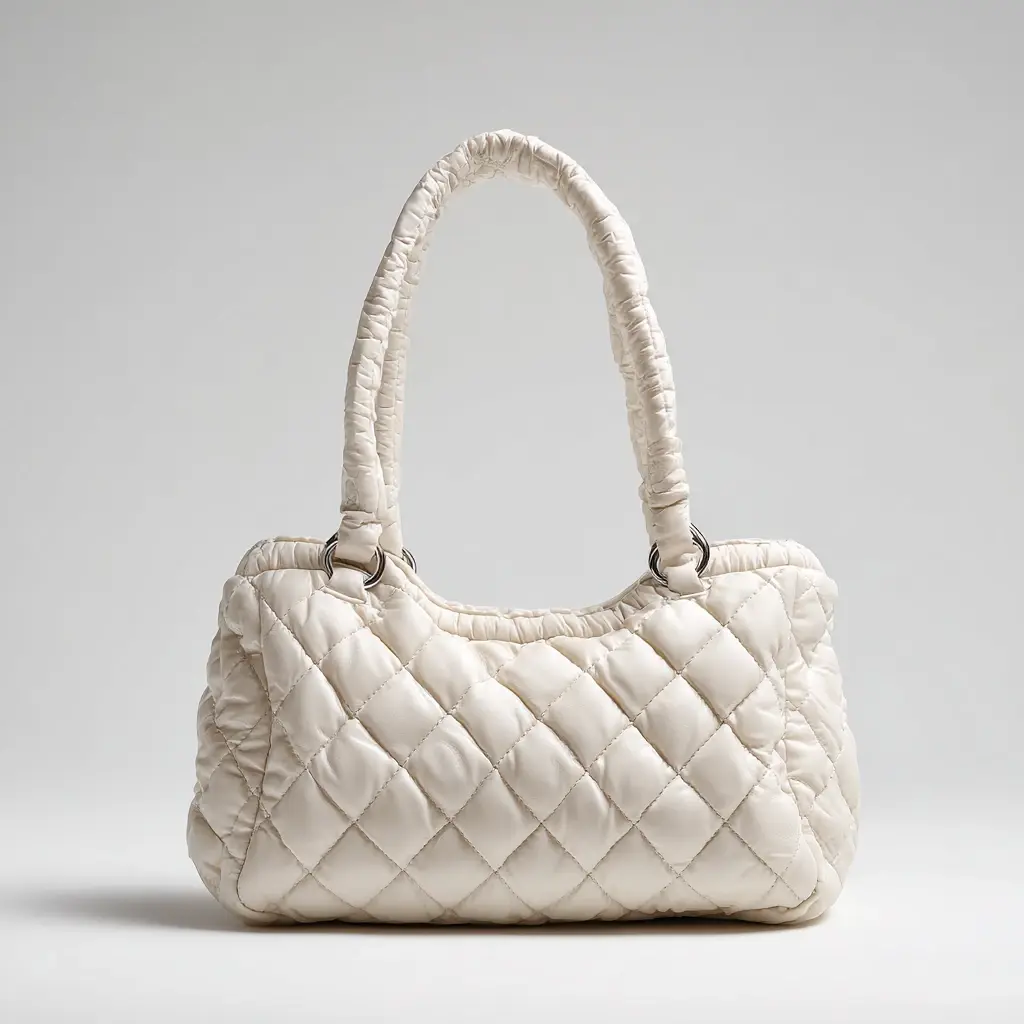
The hobo is the opposite bet: all character in the drape, almost no internal structure. It fails gate one by definition — it is supposed to collapse when empty — which is fine provided that failure is deliberate and consistent. The practical risk is inconsistency: slouch depends entirely on how much the material gives, and a material substitution late in development changes the entire silhouette without anybody noticing until the samples arrive.
- Body
- 30-34 cm wide at the mouth, tapering to 24-26 cm at the base
- Strap
- Drop 23-25 cm, width 25 mm with a 6 mm foam shoulder pad option
- Material
- 1.1-1.2 mm soft leather, or 0.6 mm microfibre at 170-190 gsm
- Cost index
- 88-94 — no interfacing, no base board, fewer operations
- Difficulty index
- 108 — drape is material-dependent and hard to correct later
Checklist for the slouchy hobo shoulder
- Lock the material before the pattern is graded, because a substitution changes the drape and therefore the shape.
- Specify the slouch itself: state the mouth-to-base taper in millimetres so 'slouchy' becomes a measurement.
- Reinforce only the strap roots, where the load concentrates; everything else can stay soft.
- Use continuous magnetic closure along the whole mouth rather than a single point, or the top will gape at the corners.
- Avoid a heavy lining: above roughly 120 gsm the lining starts holding the shape and defeats the point.
Silhouette Three: The Half-Moon Shoulder
A half-moon or crescent shape has been the shape of the last few seasons and it earns its place here because it clears all four gates while being visually distinctive — a rare combination. The curve is also genuinely harder to build than it looks: a curved top edge must be either cut on a curve with easing around the radius, or drafted with a separate binding, and each approach changes both cost and how clean the line reads.
- Body
- 30-36 cm wide, 16-20 cm high at the centre, 4-6 cm gusset
- Strap
- Drop 26-28 cm, width 20 mm, often adjustable to 60 cm for crossbody
- Top edge
- 8 mm self-binding or a separate 10 mm tape binding
- Cost index
- 108-116 — binding and easing add operations
- Difficulty index
- 112 — curved seam consistency across 500 units
Checklist for the half-moon shoulder
- Decide binding versus easing at tech pack stage, since it is expensive to change after the pattern is cut.
- Give the top edge a grade tolerance: curve deviation above 2 mm over the span is visible to the eye in photography.
- Keep the gusset narrow at 4-6 cm; widening it turns a crescent into a tube and loses the shape.
- Check strap geometry twice, because a crescent sits further from the body and needs a longer effective drop than a flat shape.
- Test closure placement on body, since hands enter a crescent bag from the side rather than the top.
Silhouette Four: The Compact Zip Shoulder
The compact zip-top shape, derived from a camera bag, is the one that survives the widest range of uses: it converts from day to evening, carries the modern minimum, and takes to hardware branding better than any other shape here. It is also the easiest shape to over-engineer. Add a moulded insert, a base board and two external pockets and it stops being compact, which was the entire reason it was chosen.
- Body
- 22-26 cm wide, 14-18 cm high, 6-8 cm gusset
- Strap
- Drop 28-30 cm for shoulder, extendable to 55-60 cm for crossbody
- Closure
- #5 nylon coil zip, 5.5 mm chain, with a leather or webbing puller
- Cost index
- 96-104 — smaller panels, but a full zip equity across the top
- Difficulty index
- 102 — zip alignment at both ends of a curved or radiused top
Checklist for the compact zip shoulder
- Specify zip insertion as one continuous run rather than two halves, because a centre join on a compact bag always shows.
- Give the puller geometry: length 60-70 mm and width 12-15 mm, which is what makes small bags easy to open one-handed.
- Keep structure to a base board only; a moulded insert is what turns this shape bulky.
- Add one external slip pocket on the back panel and no more, sized to a phone at 165 mm.
- Ask for a zip fatigue test: the slider is the component most returned on this shape.
Silhouette Five: The East-West Shoulder
East-west means wide and low, typically 32-38 cm across and only 13-16 cm high, and it has quietly become a workhorse for brands whose customers carry a phone, glasses and little else. It fails gate two more often than any other shape here, because a long bag on a short strap swings off the shoulder when walking. The fix is unglamorous and cheap: increase strap width to 25 mm and add either a shoulder pad or a slightly textured underside.
- Body
- 32-38 cm wide, 13-16 cm high, 6-8 cm gusset
- Strap
- Drop 24-26 cm, width 25 mm, frequently shortened deliberately for under-arm carry
- Top edge
- Often a full top zip; occasionally a magnetic bridge strap
- Cost index
- 92-100 — low material height offsets width
- Difficulty index
- 106 — keeping a long straight top edge clean across production
Checklist for the east-west shoulder
- Add a 25 mm strap rather than the 20 mm used elsewhere, because width is what stops the swing.
- Option a 6 mm foam shoulder pad, which costs under 1 percent of unit price and solves the remaining cases.
- Keep contents below about 1.5 kg in the design brief, or the shape will bow at the centre over time.
- Consider a magnetic bridge strap at the centre even where the top zips, purely to hold the two top edges together.
- Photograph it worn, not flat — empty to-scale shapes look very different on a body.
Silhouette Six: The Quilted Shoulder With Chain
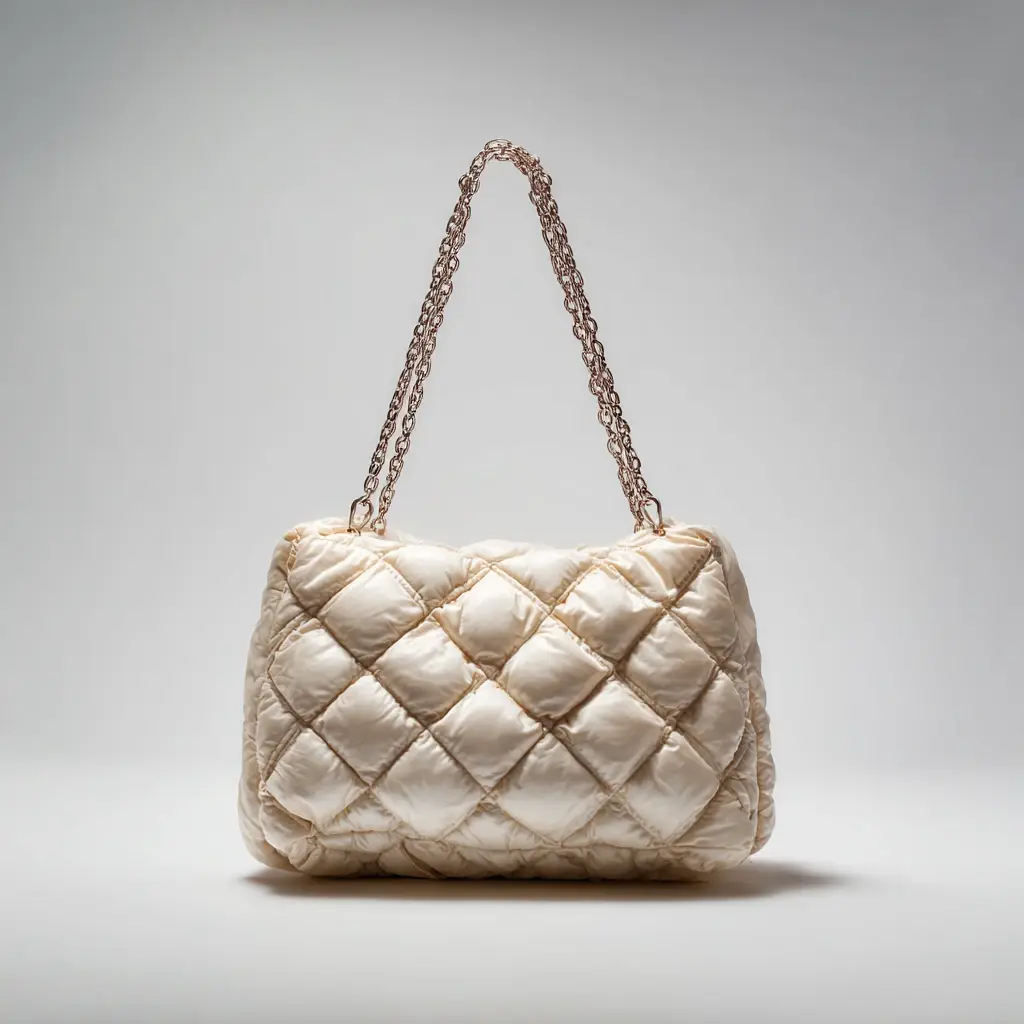
Quilting plus a chain strap is the highest perceived-value shape here and the one that most often fails gate four, because chain weight, plating and quilting pitch each need their own decision and all three interact. Chain is heavy, which loads the strap attachment far harder than leather does, and the combined strap plus chain is a single assembly that should be tested together rather than in parts.
- Body
- 26-30 cm wide, 17-20 cm high, 6-8 cm gusset
- Quilt pitch
- 25-40 mm diamond or channel; below 25 mm drives cost sharply upward
- Chain
- 8-10 mm curb or rope, plated zinc alloy, 4-6 g per link
- Cost index
- 122-135 — quilting operations plus hardware weight
- Difficulty index
- 124 — pattern matching across every panel
Checklist for the quilted shoulder with chain
- Set the quilt pitch at 25 mm or above; tighter pitch roughly doubles the quilting operations.
- Test the chain and its attachment together at 5 kg for 1,000 carry cycles, not the strap alone.
- Specify plating thickness in microns and a salt spray target — 24 hours to first corrosion tested to ASTM B117 is the usual clause.
- Use a leather shoulder insert behind the chain where the bag carries more than about 1 kg, or it digs in.
- Check REACH nickel release and Prop 65; plated chain is the most common restriction failure on this shape.
The Three Numbers Behind Every Shoulder Bag
Strip away styling and a shoulder bag is three numbers: strap drop, body width and gusset depth. Those three decide comfort, whether anything fits, and how the bag sits against a body — and they are also the three most often left off a drawing. Any request that arrives without them comes back as a question rather than a quotation, because a production partner cannot guess which of the six shapes above you meant.
| Carry style | Strap drop | Body width x gusset |
|---|---|---|
| Under arm | 22-24 cm | 26-30 cm wide, 6-8 cm gusset |
| Standard shoulder | 25-27 cm | 28-32 cm wide, 7-9 cm gusset |
| Over a winter coat | 28-30 cm | 30-34 cm wide, 8-9 cm gusset |
| Convertible to crossbody | Adjustable 28-60 cm | 22-26 cm wide, 6-8 cm gusset |
Measure drop in one specific way or arguments follow: from the top edge of the bag to the inside peak of the strap, with the bag standing empty. From an attachment point is a different number and it is not the one the customer experiences. State the tolerance as plus or minus 5 mm, because at 500 pieces the strap cut length is a real distribution rather than a single value.
Strap Attachment: The Checklist Nobody Completes
Across every shoulder shape, the strap junction is the most frequent field failure and the least specified component. It carries the entire load of the bag plus contents, repeatedly, in one direction, and it fails at the stitch line rather than in the material. The reason is rarely workmanship: it is that nobody wrote down how far into the body the strap must go, or what happens at the return.
- Engagement length: 30-40 mm into the seam, never 10 mm, with an additional row of stitching across the live end.
- Reinforcement: a hidden 20 mm webbing backing strip taken to the base of the attachment rather than stopping halfway.
- Geometry: a boxed X rather than a single bar, since the X distributes load across two axes.
- Test: 5 kg loaded for 1,000 carry cycles, with seam strength verified to ISO 13935-2 at a minimum of 180 N.
- Hardware: if the strap detaches, specify the swivel hook by material and plating thickness, not merely by colour.
Two details make the difference between a strap that survives a season and one that survives three years, and neither costs appreciable money. First, a bar-tack at 12 mm placed where the strap enters the body rather than parallel to it. Second, matching thread to load rather than to colour where the two conflict — Tex 40 polyester at 8-9 stitches per inch is the baseline, and going finer to hide a seam line is a trade most brands regret.
Scoring Six Shapes Against a First Order
Set against a first order of 500 pieces on one or two colourways, the shapes sort out as below. The point of the scoring is not to pick a winner in the abstract but to see which shapes fail which gate, because every failure has a price and some are worth paying.
| Shape | Holds form empty | Stays on shoulder | Survives loaded carry | Known pattern |
|---|---|---|---|---|
| Structured satchel | Pass | Pass | Pass | Pass |
| Slouchy hobo | Deliberate fail | Pass with 25 mm strap | Pass | Pass |
| Half-moon | Pass | Depends on gusset depth | Pass | Partial |
| Compact zip | Pass | Pass | Pass at 1 kg contents | Pass |
| East-west | Pass | Often fails without a pad | Pass below 1.5 kg | Pass |
| Quilted with chain | Pass | Pass with shoulder insert | Marginal above 1 kg | Partial |
Read across rather than down. Three shapes fail the shoulder-retention gate, and in every one of those cases the fix is a wider strap or a pad costing under 1 percent of unit price — which is to say the gate is almost never a reason to reject a shape, only a reason to specify it properly. The remaining real gate is the fourth: a shape nobody has built before needs more sampling iterations, and each iteration is a week.
Which Two to Take to Sampling
Take two, and make them different in structure rather than in decoration. The structured satchel and either the slouchy hobo or the half-moon cover the market's two dominant propositions — holds-its-shape and moves-with-you — while sharing enough of a strap and closure specification that one component buy serves both. That matters more than it sounds: one shared strap specification across two shapes is a genuine saving at 500 pieces each, whereas six shapes with six different straps is six setups for no reason.
Practicalities close the loop. Sampling runs 6-10 working days for these shapes, extending to 12-15 where quilting, chain assembly or a curved binding is involved; bulk runs 35-50 days; inspection sits at AQL 2.5 under ISO 2859-1 with a written report, and third-party inspection by SGS is available. Our validated partner factory Quanzhou Yingming Bags keeps 7 production lines with about 200,000 pcs per month available, so a second shape added later in the season rarely has to wait for capacity. Send the three numbers and the two shapes, and the rest of the conversation is easy. For help structuring that first email, see the tech pack requirements alongside the budget-limited launch guide.
Send two shapes and three numbers
Reply with the two silhouettes you are considering, strap drop, body width and gusset depth. A private label coordinator will return a dimensioned quotation with the checklist above applied to your shapes, sampling at 6-10 working days, bulk at 35-50 days and inspection at AQL 2.5 under ISO 2859-1. Get a quote.
Frequently Asked Questions
What is the best first shoulder bag silhouette for a new brand?
The structured shoulder satchel at 28 x 20 cm with an 8 cm gusset. It holds form when empty, photographs predictably from every angle, takes an A4 notebook flat, and has been built often enough that yield and stress behaviour are known rather than estimated. Take the slouchy hobo as the contrasting second shape.
How do I measure strap drop correctly?
From the top edge of the bag to the inside peak of the strap, measured with the bag standing empty, and stated with a tolerance of plus or minus 5 mm. Measuring from an attachment point gives a different number and one the wearer does not experience.
Why does my shoulder bag slide off my shoulder?
Usually because the strap is too narrow for the width of the bag, or because the load swings on a long low shape. Increasing strap width from 20 mm to 25 mm and adding a 6 mm foam shoulder pad resolves most cases for under 1 percent of unit cost.
How many silhouettes should a first shoulder bag order include?
Two, differing in structure rather than decoration. Two shapes sharing one strap and closure specification allow a shared component buy at 500 pieces each, whereas six shapes mean six setups, six material buys and six chances to be wrong.
What causes shoulder straps to tear off in use?
Insufficient engagement into the seam and load being carried by a single stitch line. Taking 30-40 mm of engagement with a hidden 20 mm webbing backing strip and a boxed X stitch, verified to ISO 13935-2 at a minimum of 180 N, removes nearly all of these failures.
What should the gusset depth be on a shoulder bag?
Six to nine centimetres depending on carry style: 6-8 cm for under-arm and evening carry, 7-9 cm where a notebook or a glasses case goes in daily. Below 6 cm the bag cannot stand on its own, and above about 9 cm it stops reading as a shoulder shape.
Is the quilted chain-shoulder shape too hard for a first order?
It is achievable but it is the highest difficulty option here at an index of 124, because quilting pitch, chain weight and plating interact. Keep the quilt pitch at 25 mm or above, specify plating thickness in microns with a 24-hour ASTM B117 salt spray target, and test the chain and its attachment together.
Which hardware tests apply to chain and strap components?
Plating thickness in microns with 24 hours to first corrosion tested to ASTM B117, nickel release and lead reviewed against REACH Annex XVII and Proposition 65, and seam strength at the strap root verified to ISO 13935-2 at a minimum of 180 N.
How long does sampling take for these shapes?
Six to ten working days for standard shoulder shapes, extending to 12-15 where quilting, chain assembly or a curved binding is involved. Bulk production runs 35-50 days, and inspection at AQL 2.5 under ISO 2859-1 adds three to six days depending on how the report is issued.
Should the slouchy hobo be lined?
Lightly, yes, but not heavily. A lining above about 120 gsm starts holding the shape and defeats the purpose of the design, so 68-90 gsm polyester or a very soft microfibre works, with the top edge folded rather than interfaced.
What tolerance should be applied to body dimensions?
Plus or minus 3 mm on body width, height and gusset depth is standard for sewn construction, since these are the measurements that decide how the bag wears and how it reviews. Anything tighter adds rejects without being visible to a customer.
People Also Ask
Do I really need two silhouettes for a first launch?
Two is the minimum that reads as a line and the maximum that keeps one component buy. A single shape leaves the brand looking like a product rather than a range, while anything above three divides attention and budget.
Which is cheaper, structured or slouchy?
Slouchy is cheaper to build at an index of 88-94 because it needs no interfacing or base board, but its difficulty is higher because the drape depends entirely on material behaviour and cannot be corrected after cutting.
Why does the east-west shape slide off the shoulder?
Because the mass is spread horizontally and the strap contact area is small. Widening the strap to 25 mm and adding either a foam pad or a textured underside fixes it without changing the shape.
Can two shapes share components?
Yes, if that is decided before the tech pack is written. Sharing one strap width, one slider and one closure hardware set across two shapes removes a component minimum and keeps the line looking intentional.
Sources and further reading
Every figure on this page is either our own programme data or attributed below. Open the originals before you write them into a specification.
- SATRA — technical services for leather, footwear and accessoriesSATRA Independent leather, hardware and accessories testing protocols.
- REACH — chemical substances regulationEuropean Commission Annex XVII restricts the substances that may appear in finished leather and coatings.
- Leather Working Group — environmental auditing for tanneriesLeather Working Group Environmental audit protocol for tanneries and leather traceability.