Custom Handbag Cost Drivers: Where Budget Is Best Spent
Where is a custom handbag budget best spent? On the material the customer touches first and on the operations the customer notices second — and not on custom hardware, which is where most first lines overspend. Material carries 46-58 percent of the landed cost, labour 22-30 percent and hardware only 8-14 percent, so a USD 2.00 upgrade to the hide is visible on the shelf while a USD 2.00 upgrade to the lock is visible to nobody. The cheapest lever of all is not a material choice at all: moving from 500 to 2,000 pieces on the same specification removes 11-16 percent from the unit price without changing a single component.
- A First Line That Came in Over Budget
- Where the Money Actually Went
- The Five Drivers, Ranked by Leverage
- Material: Where Spending More Pays Back
- Hardware: Where Spending More Does Not
- Operations: The Cost Hiding in Stitch Count
- Quantity: The Cheapest Lever of All
- A Budget Allocation That Works at 500 Pcs
- What Sits Above FOB and Gets Into the Unit Anyway
- The Sample and Tooling Budget Nobody Puts on the Sheet
- How to Ask for a Breakdown Worth Negotiating
- What the Repeat Run Gives Back, Item by Item
Where is a custom handbag budget best spent? On the material the customer touches first and on the operations the customer notices second — and not on custom hardware, which is where most first lines overspend. Material carries 46-58 percent of the landed cost, labour 22-30 percent and hardware only 8-14 percent, so a USD 2.00 upgrade to the hide is visible on the shelf while a USD 2.00 upgrade to the lock is visible to nobody. The cheapest lever of all is not a material choice at all: moving from 500 to 2,000 pieces on the same specification removes 11-16 percent from the unit price without changing a single component.
Cost structure at a glance
A First Line That Came in Over Budget
A direct-to-consumer label in Melbourne came to the programme in March with three silhouettes, a target retail of USD 68 and a ceiling of USD 19.00 landed. The first quotation came back at USD 24.60. Nothing in the brief had changed between the enquiry and the quote, so the gap was entirely a question of where the money had been allocated — and it turned out to be allocated in the two places that cost the most and show the least.
The design had specified a custom cast lock with a branded puller on all three silhouettes, at a mould charge of USD 1,850 spread across 500 pieces plus a piece-price premium. It had also specified a full-grain hide for the body and a corrected-grain hide for the gusset and base, on the assumption that the visible panels were the ones worth paying for. Both decisions were defensible in isolation. Together they put USD 5.60 of cost into places a customer would never credit.
The fix took one afternoon. The lock was replaced with a stock zinc alloy closure and a 0.8 mm branded plate, which removed USD 3.20 per piece and the whole mould charge. The corrected-grain gusset was upgraded to full grain for USD 1.10 per piece, because the gusset is what a customer grips when they pick the bag up. The landed cost came down to USD 19.40, and the third round of the sample was approved without further change.
Where the Money Actually Went
The exercise above works on any first line because the cost structure of a handbag is remarkably stable. Five buckets absorb everything, and the shares below hold across tote, shoulder, crossbody and bucket constructions at mid-market specification. Once the shares are known, the conversation stops being how do I make this cheaper and becomes which bucket do I take it out of.
| Bucket | Share | Main variable | Leverage |
|---|---|---|---|
| Material | 46-58% | Hide grade, substance, yield | High: visible to the customer |
| Labour | 22-30% | Operation count, finishing | Medium: mostly fixed by the design |
| Hardware | 8-14% | Stock versus custom, plating | High: mostly invisible to the customer |
| Packaging | 3-5% | Dust bag, hangtag, carton | Low but easy to trim |
| QC and logistics | 2-4% | Inspection level, carton efficiency | Low: do not trim this one |
The last row carries a warning. Inspection and logistics are the two items every over-budget brief tries to cut, and they are the two where cutting costs more than it saves. Pre-shipment inspection at AQL 2.5 under ISO 2859-1 costs a fraction of a percent of the order and is the only thing standing between a 500 piece run and a container of returns.
The Five Drivers, Ranked by Leverage
Leverage means how much the unit price moves for a given design decision. Ranked honestly, the order is not the one most briefs assume, and the top two entries are uncomfortable because both are decided before the design is drawn.
- Quantity. 500 to 2,000 pieces removes 11-16 percent. Nothing else comes close.
- Operation count. A design that needs 38-52 sewing operations instead of 18-24 costs materially more per unit regardless of what it is made of.
- Material grade. Full grain against corrected grain moves the hide line by 18-26 percent.
- Hardware choice. Stock against custom cast moves 8-14 percent of the total, plus tooling.
- Packaging. The smallest bucket and the easiest to trim, worth USD 0.40-1.10 per piece.
Note what is absent: trimming the inspection, changing the thread, or negotiating the labour rate. Those are the three moves a buyer reaches for first and all three produce either a worse outcome or no movement at all. Thread is a specification, not a cost line — Tex 40 at 7-9 stitches per inch is what makes the bag last, and downgrading it buys a return rate.
Material: Where Spending More Pays Back
Material is 46-58 percent of the landed cost and it is the only bucket the customer evaluates directly. Within it, not every panel is equal, and the rule that works is to spend where the hand lands: the panel the customer touches when they pick the bag up, the strap that sits against the shoulder, and the top edge that runs past the forearm.
- Spend on the gusset and the strap. These are the parts held and worn, and upgrading them is what changes a review from fine to well made.
- Spend on the temper, not only the grade. A hide with the right temper at 1.2-1.4 mm outperforms a better grade at the wrong substance.
- Spend on traceability where it sells. Leather Working Group tannery traceability is documentable and increasingly asked for by retail buyers.
- Save on internal panels. A lining at 210D does the same job as a heavier one at a fraction of the cost, and nobody grades the inside of a pocket.
Yield is the hidden half of the material line. A tote consumes 1.4-1.9 sq ft of hide and a bucket 1.5-1.8 sq ft, but the number that matters is how the panels nest — a design with large uninterrupted panels wastes more than one with a seam placed to use the offcut. Where the brief is flexible, asking the sampler to comment on yield before the first cut is free and often worth several percent of the material line.
Hardware: Where Spending More Does Not
Hardware is where first lines overspend, and the reason is psychological rather than economic: custom hardware feels like what a brand does. At 500 pieces it is almost always the wrong call, because the mould charge lands entirely on one small run and because the visible difference between a stock closure with a branded plate and a custom cast closure is smaller than the price difference suggests.
| Option | Tooling | Piece cost at 500 | At 2,000 | Verdict at 500 |
|---|---|---|---|---|
| Stock closure, no branding | None | Baseline | Baseline | Cheapest, least distinctive |
| Stock closure, 0.8 mm branded plate | USD 90-220 | Baseline +0.45 | Baseline +0.30 | Best value on a first run |
| Stock closure, custom puller | USD 700-1,800 | Baseline +1.60 | Baseline +0.55 | Reasonable above 1,000 |
| Custom cast lock | USD 900-2,600 | Baseline +3.40 | Baseline +0.95 | Only above 2,000 |
Read the last column and the recommendation is unambiguous. At 500 pieces a custom cast lock adds roughly USD 3.40 per piece plus a mould charge that amortises at USD 1.80-5.20 per piece — meaning the hardware decision alone can add USD 8.60 to a bag. At 2,000 pieces the same decision adds under USD 1.00. That is the same design choice, priced two ways by nothing but quantity.
Operations: The Cost Hiding in Stitch Count
Labour is 22-30 percent of cost and it is set almost entirely by the drawing. Every seam, every turned edge, every bound seam and every set of feet is an operation, and each one takes minutes at a machine. A structured tote passes through 38-52 operations and 42-68 minutes of labour; a simple flat tote through 18-24 operations and about 20-30 minutes.
- Edge finishing is the expensive one. Edge painting adds 6-9 minutes per bag over a turned or raw edge, and it is the single biggest labour decision on most briefs.
- Bound internal seams add operations without adding value. A lining seam that is bound rather than overlocked adds 3-5 operations that no customer ever sees.
- Feet, pockets and dividers each add operations. Four metal feet is 4-8 operations plus a hardware item.
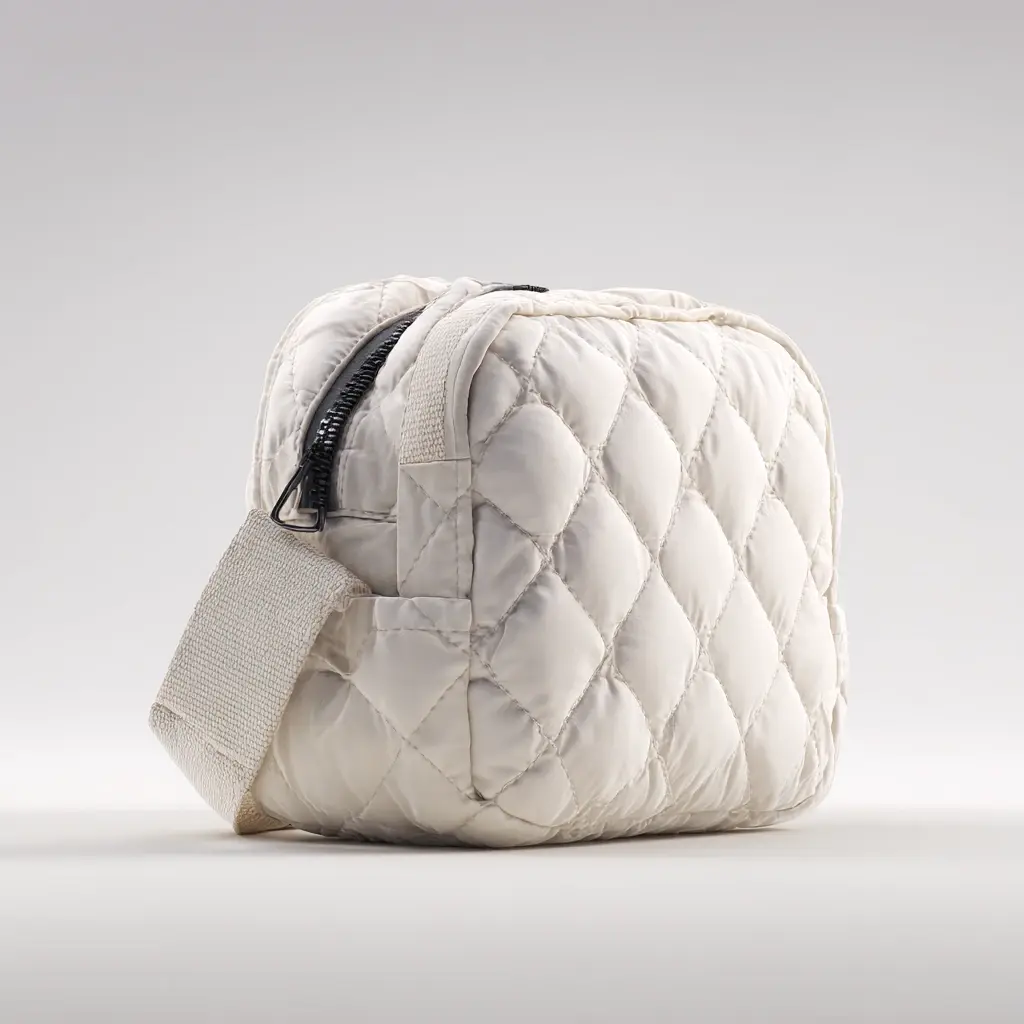
- Quilting multiplies operations fast. A quilted panel can add 12-20 operations depending on the geometry and stitch length.
The practical advice is not to strip operations out — a bag that looks cheap is worse than a bag that costs a dollar more — but to know which operations earn their cost. Edge painting on a top edge the customer touches earns it. A bound seam inside a slip pocket does not. Asking for an operation count with the quotation is a reasonable request and takes the guesswork out of the labour line.
Quantity: The Cheapest Lever of All
Quantity beats every design decision because it attacks the fixed costs rather than the variable ones. Line changeover takes 4-6 hours and costs the same whether 500 or 2,000 pieces follow it. Material is bought in larger lots at better terms. The cutting table nests more efficiently across a bigger marker. None of these require changing the design.
| Quantity | Unit price index | What improved | Caveat |
|---|---|---|---|
| 500 pcs | 100 | Baseline; MOQ per style / colourway | Fixed costs dominate |
| 1,000 pcs | 93-96 | Changeover and material lots | Two colourways or one doubled |
| 2,000 pcs | 84-89 | Marker efficiency, labour learning | Requires sell-through confidence |
| 5,000 pcs | 78-83 | Reserved line, seasonal price | Needs a forecast 60 days ahead |
The caveat is the whole point. Doubling the quantity only helps if the extra 500 pieces sell, and unsold stock is far more expensive than a 4 percent better unit price. The sensible sequence is to run 500, read the sell-through, then double on the repeat — which is also the point at which sampling can be skipped and tooling is already paid for, so the second order improves on two fronts at once.
A Budget Allocation That Works at 500 Pcs
Putting the five drivers together produces an allocation that works for a mid-market first line at 500 pieces per style / colourway. It is not a rule, but it is a starting point that survives contact with a real quotation far better than an even split.
- Put the money in the hide. Roughly half the budget, concentrated on the panels the hand touches: gusset, strap and top edge.
- Use stock hardware with one branded element. A 0.8 mm plate or a branded puller gives recognition without a mould.
- Keep the operation count between 24 and 38. Enough for the bag to look made, not enough for the labour line to dominate.
- Trim packaging deliberately. A dust bag at USD 0.35-0.90 and a hangtag at USD 0.06-0.18 are worth keeping; a rigid gift box is not at this quantity.
- Never trim inspection. AQL 2.5 under ISO 2859-1 with a written report, at a cost of a fraction of a percent.
The Melbourne label's final landed cost was USD 19.40 against a USD 19.00 ceiling, and the remaining USD 0.40 was closed on the second order when the quantity doubled and the tooling was already paid. That is the shape most first lines take: close enough on run one, comfortable on run two. The full cost breakdown takes each line further, the limited budget walkthrough covers the same problem from a tighter starting point, and the MOQ question explains the quantity floor the whole allocation sits on. The custom handbags pillar page sets the programme frame.
What Sits Above FOB and Gets Into the Unit Anyway
Every cost driver discussed so far lives inside the quotation, and a budget built on the quotation alone is still wrong, because the unit cost that matters is the landed one. On the programme above the difference between FOB and landed was several dollars a unit and none of it was negotiable at the machine. The elements below are predictable, worth modelling at brief stage and worth checking whenever the routing or the destination changes.
| Element | Typical per unit | What moves it | Levers available |
|---|---|---|---|
| Ocean freight, consolidated cartons | USD 0.80-1.60 | Mode, season and consolidation | Cubic efficiency of the carton |
| Air freight on a top-up | USD 4.00-7.50 | Weight rather than volume | Never plan for it; use only to save a date |
| Duty and entry costs | Varies by destination and classification | Classification and declared value | Correct classification at entry, verified once |
| Terminal, broker and delivery | USD 0.25-0.60 | Port, broker terms and distance | Compare CIF against FOB on the same lane |
The practical instruction is to quote both numbers from the first conversation. A landed target of USD 19.00 set against a stretch FOB allowed the programme above to be corrected in an afternoon, whereas the same discovery made after the vessel sailed would have been a pricing problem rather than a specification one.
The Sample and Tooling Budget Nobody Puts on the Sheet
Sampling is treated as free because it is not invoiced per unit, and it is not free. On a first line the correctly budgeted figure covers more than the units: courier both ways, a second round, samples that cannot be sold and the small tooling that attaches to branding. Underbudgeting it is why so many first programmes arrive at bulk with nothing left for inspection.
- Sample units. Roughly USD 180-260 each including courier; a first line of three silhouettes with one revision is USD 540-780 before any tool is cut.
- Courier legs. Three to five days each way at USD 45-90; a second round costs a second return leg that nobody books for.
- Branding tooling. A 0.8 mm branded plate at USD 90-220 sits inside most budgets; a custom puller at USD 700-1,800 does not.
- Retention. Write which tooling is kept and for how long. Tooling retained for twelve months comes off the second order entirely.
How to Ask for a Breakdown Worth Negotiating
A single-line unit price cannot be negotiated, only accepted or refused. What can be negotiated is a costed split, and asking for one is a legitimate part of the brief rather than a hostile move. Six lines are enough to see where the money is and therefore which design change would move it. Request it with the quotation rather than after the quotation, because a request made later reads as a request for a discount and rarely gets one.
- Material by component. Shell, lining and trim quoted separately, each with grade and thickness stated so a substitution cannot hide inside a total.
- Hardware by item. One line per part, with plating specified and any mould charge shown separately from the piece price.
- Operation count. State it as a number; asking how many operations the design needs is the question that reveals why one tote costs more than another.
- Packaging and inspection. Both named, both cheap, both the lines most often quietly removed and added back later.
- Tooling and validity. Each charge named with the run it amortises over, plus an expiry date on the price and the material basis it was calculated on.
What the Repeat Run Gives Back, Item by Item
Quantity is the largest lever discussed above and it is not the only one available on the second order. Four separate things fall for free once a style has run once, and they arrive whether or not the quantity changes. Modelling them before deciding the reorder size is what stops a first line being judged on the price of a single run.
| Item | First run | Repeat run | Size of the effect |
|---|---|---|---|
| Pattern and grading | Charged, USD 1.60-4.00 per unit | Stored, no charge | Worth lodging before any re-quote |
| Branding tooling | USD 90-220 plate or USD 700-1,800 mould | Retained and reused | Removes the whole tooling line |
| Sample rounds | One to two rounds, USD 540-780 | Zero to one confirmation unit | Removes 6-10 working days |
| Material buying | New lot search | Retained length plus recorded reference | Removes the lot search and the lot minimum partly |
| Learning on the line | Full learning curve | Already climbed | Typically 2-4 per cent on labour |
| Combined effect | Baseline | About 7-12 per cent lower unit cost | Before any change in quantity |
Send a target retail price, get a costed allocation
Give the silhouettes, the target retail price and the quantity per colourway. A private label coordinator will return the cost split by bucket and show which line to move — sampling 6-10 working days, bulk 35-50 days, inspection AQL 2.5. Get a quote.
Frequently Asked Questions
What drives the cost of a custom handbag?
Five buckets: material at 46-58 percent, labour at 22-30 percent, hardware at 8-14 percent, packaging at 3-5 percent, and inspection plus logistics at 2-4 percent. The shares are stable across tote, shoulder, crossbody and bucket constructions at mid-market specification, which makes the cost conversation a question of allocation rather than negotiation.
Where should a first line spend most of its budget?
On the hide, specifically on the panels the hand touches: the gusset, the strap and the top edge. Material carries nearly half the landed cost and it is the only bucket a customer evaluates directly. Upgrading internal linings or hidden panels buys nothing, because nobody grades the inside of a slip pocket.
Is custom hardware worth it on a 500 piece run?
Rarely. A custom cast lock adds roughly USD 3.40 per piece at 500 units plus a mould charge of USD 900-2,600, which amortises at a further USD 1.80-5.20 per piece. At 2,000 pieces the same decision adds under USD 1.00. A stock closure with a 0.8 mm branded plate is the right answer at launch quantity.
How much does quantity change the unit price?
Moving from 500 to 1,000 pieces on an unchanged specification removes 4-7 percent, and from 500 to 2,000 removes 11-16 percent. The gain comes from fixed costs rather than from the design: line changeover takes 4-6 hours regardless of run size, and larger material lots and better marker efficiency follow.
What is an operation count and why does it matter?
It is the number of separate steps at a machine or bench, and it is the main driver of the labour line. A structured tote passes through 38-52 operations and 42-68 minutes of labour; a simple flat tote through 18-24 operations and about 20-30 minutes. Asking for the count with the quotation removes guesswork from 22-30 percent of the cost.
Which single operation costs the most?
Edge finishing. Edge painting adds 6-9 minutes per bag over a turned or raw edge and is usually the largest single labour decision on a brief. It is worth paying for on a top edge the customer touches and worth skipping on internal edges that nobody sees.
Should I cut inspection to bring the cost down?
No. Pre-shipment inspection at AQL 2.5 under ISO 2859-1 costs a fraction of one percent of the order and is the only control standing between a 500 piece run and a container of returns. It is the one line that should never be trimmed when a brief comes in over budget.
How much does a packaging specification add?
Three to five percent of landed cost. A dust bag runs USD 0.35-0.90, a hangtag USD 0.06-0.18 and carton marks are nominal. A rigid gift box is the item to remove at 500 pieces, because it costs several times the dust bag and rarely influences the purchase at mid-market price points.
Does a better hide grade always cost more?
Yes, roughly 18-26 percent more for full grain against corrected grain on the same article, but the grade is not the only variable. Temper and substance matter as much: a hide with the right temper at 1.2-1.4 mm outperforms a better grade at the wrong substance, and yield differences of 3-5 percent between shades move the line too.
How much leather does one bag consume?
About 1.4-1.9 sq ft for a tote and 1.5-1.8 sq ft for a bucket, depending on panel layout and how the pieces nest. A design with large uninterrupted panels wastes more than one with a seam placed to use the offcut, which is why asking the sampler to comment on yield before the first cut is worth doing.
What landed cost should a mid-market line target?
Around 25-28 percent of the target retail price, so a bag retailing at USD 68 wants a landed cost near USD 17-19. That ratio leaves room for duty, freight, marketplace fees and margin. A quotation that lands above it is not necessarily wrong — it usually means one bucket is over-specified.
Can the same design be made cheaper without changing how it looks?
Often yes, through three moves that are invisible from the outside: replacing custom hardware with stock plus a branded plate, reducing internal bound seams to overlocked ones, and moving to a larger quantity. None of these changes the silhouette, the material the customer touches or the stitch density on visible seams.
People Also Ask
Which cost bucket should I cut first if the quote is too high?
Hardware, then packaging. Both are visible to nobody on the shelf and both can be restored on the second order once the quantity supports them. Never start with inspection, and never start with the thread specification.
Is it cheaper to make a simpler bag?
Materially, yes. The gap between 18-24 operations and 38-52 operations is the largest controllable labour difference on a brief, and it usually comes down to edge finishing, quilting, feet and internal pocket construction rather than to the silhouette itself.
Does doubling the order always make sense?
Only with sell-through evidence. Unsold stock costs far more than the 4 percent saved by doubling, so the usual sequence is 500 pieces, a read on what sold, then a doubled repeat that also skips sampling and reuses paid tooling.
Why do two quotations for the same bag differ by 20 percent?
Almost always because the specifications differ. One includes edge painting, a branded plate and a heavier lining; the other assumes turned edges, stock hardware and 190T. Put both against the same dimensioned tech pack before comparing.
Sources and further reading
Every figure on this page is either our own programme data or attributed below. Open the originals before you write them into a specification.
- Leather Working Group — environmental auditing for tanneriesLeather Working Group Environmental audit protocol for tanneries and leather traceability.
- FashionUnited — fashion industry news and dataFashionUnited Industry news and company data for the fashion sector.
- SATRA — technical services for leather, footwear and accessoriesSATRA Independent leather, hardware and accessories testing protocols.