Crossbody Bags: Why They Dominate Ecommerce Handbag Sales
Why do crossbody bags dominate ecommerce handbag sales? Because they are the only category that solves all four online buying problems at once: at 220 x 160 x 70 mm and 340 g they ship in the lowest fee band, they photograph to scale on a 30 cm flat lay, they fit one strap specification across a whole colour range, and at 0.42 sq ft of hide per unit they land inside an impulse price band. A crossbody is the highest-velocity handbag category in online retail because it is the one a customer can buy without measuring anything. At MOQ 500 pcs per style / colourway, sampling takes 6-10 working days, bulk 35-50 days, and inspection runs at AQL 2.5 under ISO 2859-1.

- The Demand Numbers Behind the Category
- Checklist: Sizing a Crossbody for Ecommerce
- Checklist: Strap and Hardware Specification
- Checklist: Closure and Everyday Security
- Checklist: Photography and Listing Hygiene
- Checklist: Packaging and Returns Prevention
- Checklist: Compliance Before the Carton Ships
- What the Checklist Costs and Returns
- The Unit Economics of a 500-Piece Crossbody Drop
- One Specification Sheet for a Crossbody Style
- Five Field Failures and the Line That Fixes Each
- The Colourway and Reorder Calendar
Why do crossbody bags dominate ecommerce handbag sales? Because they are the only category that solves all four online buying problems at once: at 220 x 160 x 70 mm and 340 g they ship in the lowest fee band, they photograph to scale on a 30 cm flat lay, they fit one strap specification across a whole colour range, and at 0.42 sq ft of hide per unit they land inside an impulse price band. A crossbody is the highest-velocity handbag category in online retail because it is the one a customer can buy without measuring anything. At MOQ 500 pcs per style / colourway, sampling takes 6-10 working days, bulk 35-50 days, and inspection runs at AQL 2.5 under ISO 2859-1.
Crossbody programme parameters
The Demand Numbers Behind the Category
Three measurable properties drive the category's online share, and none of them are about fashion. The first is dimensional: a customer buying online cannot compare a bag against their own shoulder, so they buy the one whose dimensions they can picture. A 220 mm body is easy to picture; a 360 mm tote is not, and it generates the size-confirmation questions that stall a checkout.
The second is logistic. At about 340 g packed, a crossbody clears the lowest weight band on most marketplace and carrier schedules, and it packs at 60 units per export carton against 24 for a tote. That is two and a half times the units per cubic metre, which is a freight line that shows up directly in the landed cost rather than in the marketing budget.
The third is behavioural. A crossbody is bought as a second and third bag by a customer who already owns a tote, which means the addressable repeat is larger than the addressable first purchase. Trade coverage of the accessories sector has made this point repeatedly: the categories that grow online are the ones with a low deliberation cost per unit, and a handbag under a certain price with a strap that needs no fitting is exactly that. The leather handbag programme reference treats the crossbody as the volume engine for this reason.
Checklist: Sizing a Crossbody for Ecommerce
Work through these in order. Each item has a number attached because a size left to interpretation is the single largest source of size-related returns, and returns in this category are almost never about quality.
- Fix the body at 220 x 160 x 70 mm with a +/- 2 mm tolerance. Tighter than the +/- 3 mm used on a tote, because a 70 mm gusset is where a phone plus a cardholder either fits or does not.
- State the internal clear dimensions, not the external ones. Buyers measure the inside: about 205 x 145 x 58 mm after seam allowance and lining.
- Confirm the phone test in writing. A 165 mm device in a case must lie flat on the base panel; write it into the tech pack as a functional check.
- Cap the empty weight at 340 g. Above 380 g the category loses its logistic advantage and the listing stops reading as a light everyday bag.
- Set the strap at 12 mm wide. Narrower reads as a strap, wider reads as a shoulder bag, and the 12 mm width is what the category is judged against.
- Plan two pockets maximum. A 150 x 100 mm slip pocket and a 160 x 110 mm zip pocket; a third pocket pushes the gusset past 70 mm and changes the whole specification.
Checklist: Strap and Hardware Specification
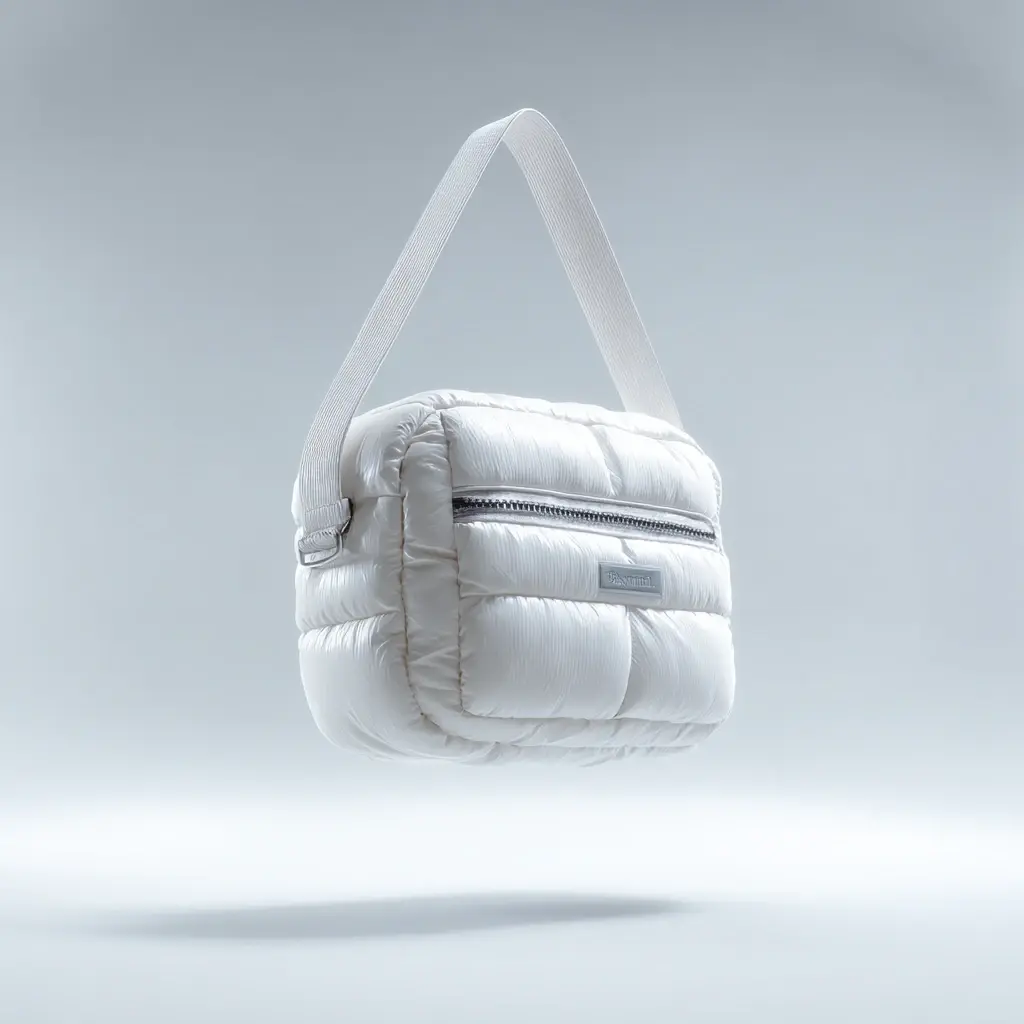
The strap is where a crossbody fails. It carries the whole load on two attachment points, it is adjusted every day, and it is the part a customer touches before they touch the leather. Every item below is a specification line, not a preference.
- Adjustable range 110-130 cm, measured end to end including the hardware, tolerance +/- 10 mm. Below 110 cm the bag will not sit at the hip on a taller wearer, which is a returns reason.
- Slider rated to 5,000 adjustment cycles with no measurable wear on the webbing edge; a slider that slips is the most reported defect in the category.
- Two 15 mm D-rings, zinc alloy, set on a 30 x 30 mm reinforcement patch behind the body panel.
- Attachment tested to 180 N static for 60 seconds, with no stitch elongation beyond 2 mm at the join.
- Stitch density 9 per inch at the strap join, one step tighter than the 8 per inch used elsewhere, because this is the joint that carries load.
- Hardware finish 24 hours to first corrosion under ASTM B117, and nickel release compliant with REACH Annex XVII where the hardware contacts skin.
A handbag programme specialist will push back on one point here: a leather strap at 12 mm is weaker than a webbing core of the same width, and the usual fix is a webbing core with a leather wrap, which keeps the look and takes the load. It adds one operation and about 0.4 m of material per unit, and it removes the most common field failure in the category. Where the shoulder and tote comparison spends its tolerance on strap comfort, the crossbody spends it on strap strength, because the load path is longer.
Checklist: Closure and Everyday Security
Security is the reason customers give for choosing this shape, and it is the reason they return it if it fails. A crossbody is worn across the body with the opening facing forward, so the closure is both a function and a trust signal.
- Main closure
- No. 5 nylon coil zip, 200 mm across the top panel
- Zip test
- ASTM D2061 style cycle test, 500 open and close cycles
- Puller
- Branded zinc puller optional, 28 mm, with a mould charge
- Secondary closure
- Magnetic flap at 15 mm, 1.5 kg pull, where a flap is specified
- Lining
- 190T polyester at 52 gsm, 2.6 m per unit
- Interior pocket
- One 160 x 110 mm zip pocket, No. 3 coil
- Thread
- Bonded nylon Tex 40, 8 stitches per inch, 10 mm seam allowance
- Edge finish
- Turned and topstitched, 8 mm turn, two rows
One trade-off is worth naming. A No. 5 coil zip is lighter and cheaper than a metal zip at the same length, and it is what most of the category uses, but it is also the part a customer inspects first when judging price. Moving to a metal zip adds about 40 g and one plating item, which pushes the unit out of the lightest freight band. For a first run, the coil is correct; for a premium second season, the metal zip is the upgrade that reads as one.
Checklist: Photography and Listing Hygiene
Online, the listing is the product. This category converts on five images and three lines of copy, and the checklist below is what separates a 2 percent conversion from a 4 percent one at the same traffic.
- One scale image with a measurable reference. A phone or a card in frame, so the 220 mm body is unambiguous.
- One worn image at the 110 cm and 130 cm strap settings, because the adjustable range is the feature most buyers cannot picture.
- One interior image with the pockets visible, which is the image that answers the will my things fit question.
- Dimensions in the title line and in the first bullet, written as 22 x 16 x 7 cm rather than as small or compact.
- Strap range stated as a number, 110-130 cm, not as adjustable.
Checklist: Packaging and Returns Prevention
Returns in this category run 18-30 percent on marketplaces, and most of them are preventable with three packaging decisions that cost cents. The strap is the part that arrives creased, and a creased strap photographs badly on resale, which is what turns a return into a write-off.
- Stuff the body with 25 gsm tissue, not with paper, so the 70 mm gusset holds its shape without creasing the panel.
- Coil the strap and secure it with a 40 mm paper band, so it arrives flat rather than folded at a 90 degree angle.
- Ship in a 260 x 200 x 90 mm inner carton with a 3 mm corner clearance, so the zip puller cannot press into the panel in transit.
- Include a 90 x 55 mm care card with the strap adjustment instruction printed on it; a strap that looks stuck is a returns reason.
- Pack 60 units per export carton with carton marks on two sides, which is the density that keeps the freight line down.
The economics are simple: 0.30 USD of tissue and a paper band against a 6-9 USD return cost. At a 25 percent return rate on 500 units, cutting returns by a third returns more cash than most material negotiations do, and it is entirely within the buyer's control rather than dependent on the production run.
Checklist: Compliance Before the Carton Ships
Nothing in this category is exotic, but four documents are asked for routinely by marketplaces and by retail buyers, and asking for them after the cartons are packed is too late. Request them at brief stage and file them with the purchase order.
- REACH Annex XVII test report covering chromium VI, azo dyes, nickel release and phthalates on the leather and the coated trim.
- Proposition 65 review of hardware and coated components for California, where the destination is the US.
- CPSIA documentation where a bag is marketed to children, including lead content in coatings and substrates.
- BSCI or Sedex / SMETA audit reference for the validated partner factory, which retail buyers ask for by name.
- GRS transaction certificate where a recycled lining or webbing is claimed, and Leather Working Group tannery traceability where hides are sourced that way.
What the Checklist Costs and Returns
At 500 pcs per style / colourway, a crossbody at 0.42 sq ft of hide per unit uses about 250 sq ft of leather for the run, which is 14-16 hides in one dye lot. That is a small material buy, and it is why the category is the cheapest place to test a colour: a failed colour costs 500 units, not 500 units of a larger bag. Sampling runs 6-10 working days, bulk 35-50 days, inspection at AQL 2.5 under ISO 2859-1, and the shipment leaves FOB Xiamen with CIF or DDP available.
The return on the checklist is concentrated in three lines: the strap slider, the stated dimensions and the packaging. Those three account for most of the difference between a category that returns 30 percent and one that returns 18 percent, and none of them require a more expensive bag. What they require is a specification written in millimetres and newtons rather than in adjectives, which is the same discipline the tote first-category analysis applies to a larger panel.
The Unit Economics of a 500-Piece Crossbody Drop
The category earns its place on contribution per unit of freight, and the arithmetic is worth running once because it explains why a crossbody can be priced below a tote and still carry the better margin. Take 500 pieces in one colourway at a FOB Xiamen price of 9.80, packed 60 to a carton and shipped by sea. Freight lands near 0.38 a unit at that density, duty near 1.05, packaging with a dust bag and tissue near 0.85, inspection at AQL 2.5 under ISO 2859-1 near 0.34, and a returns reserve near 0.55. Landed cost settles at about 12.97, against 17.60 for a tote in the same material.
| Line | Per unit | Total at 500 pcs |
|---|---|---|
| FOB Xiamen | 9.80 | 4,900 |
| Ocean freight and surcharges | 0.38 | 190 |
| Duty on customs value | 1.05 | 525 |
| Packaging, dust bag and tissue | 0.85 | 425 |
| Inspection at AQL 2.5 | 0.34 | 170 |
| Returns reserve | 0.55 | 275 |
| Landed cost | 12.97 | 6,485 |
| Retail at 49 less an 18 per cent channel fee | 40.18 net | 20,090 |
| Contribution after landed cost | 27.21 | 13,605 |
The multiple is 3.8 times landed cost against roughly 2.4 on a medium tote, and the gap is not the leather. It is freight, which runs 6-9 per cent of landed cost on a dense carton against 14-19 per cent on a tote, plus a return rate that sits lower because the size is easy to picture. A crossbody is therefore the right place to test a colourway and the wrong place to carry the whole margin of a range.
One Specification Sheet for a Crossbody Style
Eight lines are enough to specify the category, and each one is a number rather than an adjective. Write them into the tech pack before sampling starts and the first sample will be close enough that one round closes the programme. The two lines most often left out are the needle size and the interlining: without the first, a thick thread through a thin hide puckers at 8 per inch; without the second, a soft body collapses in the photograph and the listing is blamed for it. The wear positions these dimensions serve are set out in crossbody dimensions and wear positions.
| Element | Specification | Why the number matters |
|---|---|---|
| Shell | 1.0-1.2 mm hide or 0.9-1.1 mm coated | +/- 0.1 mm; thicker pushes the unit past 380 g |
| Lining | 190T polyester at 52 gsm, 2.6 m per unit | Heavier linings add 30-45 g and defeat the weight target |
| Interlining | 1.5 mm foam on the front panel only | Holds the panel flat in a photograph without a board |
| Thread | Bonded nylon Tex 40 | Tex 60 puckers at this thickness; Tex 30 fails at the strap join |
| Needle | #14/90 for shell, #11/75 for lining | A wrong point size cuts the weave and the seam slips |
| Stitch density | 8-9 per inch, 10 mm seam allowance | 9 at the strap join, which carries the whole load |
| Webbing | 12 mm at 1.1 mm, slider to 5,000 cycles | Narrower reads as a strap, wider reads as a shoulder bag |
| Plating | Nickel-free, 8-12 microns, 24 h to first corrosion | Tested to ASTM B117; a flash plating fails inside a season |
Five Field Failures and the Line That Fixes Each
Returns in this category are concentrated in five failure modes, and all five are visible on a pre-production sample if someone knows what to look for. None of them needs a more expensive bag; each is closed by one line of specification written before bulk. The last of the five is the one that costs the most, because it is not a defect in the bag at all. It is a difference between the bag and the photograph that made the sale.
| Failure | Symptom in the field | Cause | Specification fix |
|---|---|---|---|
| Strap slip | Drop lengthens through the day | Slider tooth wear under a 340 g load | Slider rated to 5,000 cycles, webbing 12 mm at 1.1 mm |
| Zip waver | Tape ripples at the mouth | No stabiliser behind a 200 mm No. 5 coil | 10 mm binding behind the tape, 500-cycle test |
| Corner baldness | Base panel abrades in 3 months | No feet on a structured base | Four studs, 8 mm by 5 mm, set back 12 mm |
| Lining tear | Pocket mouth splits | 52 gsm taffeta under a phone | Move to 210D at 68 gsm on the pocket panel |
| Listing mismatch | Not the colour in the picture | No retained reference card | Delta E 1.5 or better under D65, card held with the lot file |
The Colourway and Reorder Calendar
The category sells fast enough that the reorder, not the first order, is where the money is made, and the reorder has to be planned before the first carton is unpacked. On one colourway at 500 pcs the calendar runs about 55-80 days from signed brief to goods with a forwarder, then 18-28 days of sea transit to the US West Coast or 5-8 days by air. The trigger to reorder is a number rather than a feeling: at 60 per cent sold, or at week six of the selling season, whichever comes first, because a second run needs the same 55-80 days and the audience does not wait.
| Stage | Days | Decision that protects it |
|---|---|---|
| Brief and quotation | 1-3 | Dimensions, strap range and target retail in the first email |
| Sampling | 6-10 working days | One round if the eight specification lines are written |
| Review and revision list | 3-6 | Numbered, with units; returned inside three days |
| Deposit and slot booking | 1-2 | Booked with the deposit, not after sample approval |
| Bulk production | 35-50 | Material released day 0-3, cutting day 3-8 |
| Inspection and handover | 1-2 | AQL 2.5 under ISO 2859-1, report issued to the buyer |
| Transit | 18-28 sea, 5-8 air | Booked before the vessel, not after the report |
| Reorder trigger | Week 6 or 60 per cent sold | Same specification, sampling often skipped |
Specify a crossbody run in millimetres
Send body dimensions, strap range, closure choice and a target retail price. A private label coordinator will return a spec-checked quote at MOQ 500 pcs per style / colourway, 6-10 working days for sampling and 35-50 days for bulk. Get a quote.
Frequently Asked Questions
Why do crossbody bags sell better online than other handbag types?
Because they remove the measuring problem. At 220 x 160 x 70 mm a buyer can picture the size, at about 340 g the unit ships in the lowest fee band, and at 0.42 sq ft of hide it lands inside an impulse price. Low deliberation cost per unit is what makes a category grow online.
What size should a private label crossbody bag be?
220 mm wide, 160 mm high and 70 mm deep, with a tolerance of plus or minus 2 mm. State the internal clear dimensions as well, about 205 x 145 x 58 mm, because buyers measure the inside. A 165 mm phone in a case must lie flat on the base panel.
How long should a crossbody strap be?
Adjustable from 110 cm to 130 cm measured end to end including the hardware, with a tolerance of plus or minus 10 mm. Below 110 cm the bag will not sit at the hip on a taller wearer, which is one of the most common reasons for a size-related return.
How much leather does one crossbody bag use?
About 0.42 sq ft per unit including the strap and trim. A 500-piece run therefore consumes roughly 250 sq ft of finished leather, which is 14-16 average bovine hides in a single dye lot, making it the cheapest category in which to test a new colourway.
What hardware specification prevents strap failures?
Two 15 mm D-rings set on a 30 x 30 mm reinforcement patch, a slider rated to 5,000 adjustment cycles, stitch density raised to 9 per inch at the join, and an attachment tested to 180 N of static load for 60 seconds with no elongation beyond 2 mm.
Which closure should a first crossbody run use?
A No. 5 nylon coil zip across the 200 mm top panel, cycle tested to 500 open and close operations. It is light, cheap and keeps the unit at about 340 g. A metal zip adds about 40 g and a plating item and pushes the bag out of the lightest freight band.
How many units fit in an export carton?
About 60 crossbody units per standard export carton against roughly 24 for a tote at 360 x 300 x 110 mm. That is two and a half times the units per cubic metre, and the difference lands directly in the freight line of the quotation rather than in the marketing budget.
What causes crossbody returns and how can they be reduced?
Most returns are size or condition issues rather than quality issues: the buyer misjudged the body, or the strap arrived creased. Stating dimensions in the listing, showing the strap at both settings, stuffing with 25 gsm tissue and banding the strap flat typically moves a 30 percent return rate toward 18 percent.
Which compliance documents does this category need?
A REACH Annex XVII report covering chromium VI, azo dyes, nickel release and phthalates; a Proposition 65 review for California; CPSIA documentation where a bag is marketed to children; and BSCI or Sedex audit references for the validated partner factory. GRS and Leather Working Group traceability apply where recycled or traced materials are claimed.
How long does a crossbody programme take?
6-10 working days for sampling, 3-6 days for review and revision, 35-50 days for production 35-50 days for inspection and handover. That is 55-80 days from signed brief to goods with your forwarder, plus 18-28 days of transit to the US West Coast or 5-8 days by air.
Is a crossbody a good first category for a new brand?
It is a good second category. It is the cheapest to land and the fastest to sell, but it supports a lower retail multiple than a tote, so it generates velocity rather than margin. Most labels run a tote first for the multiple and add a crossbody second for the volume.
People Also Ask
Why is the crossbody tolerance tighter than on a tote?
Because 70 mm of gusset is the difference between a phone plus a cardholder fitting and not fitting. A tote at 110 mm has slack; a crossbody at 70 mm does not, so the tolerance is +/- 2 mm rather than +/- 3 mm.
Should the strap be leather or webbing?
A webbing core with a leather wrap. A 12 mm leather strap alone is weaker than a webbing core of the same width, and the wrap keeps the look while the core takes the load for about 0.4 m of extra material per unit.
Does a branded zip puller make sense on a first run?
Usually not. It needs a mould and a plating run, and on 500 units that fixed cost dominates. A branded woven label set below the top edge gives the same recognition for a fraction of the tooling cost.
How many pockets should a crossbody have?
Two: a 150 x 100 mm slip pocket and a 160 x 110 mm zip pocket. A third pocket pushes the gusset past 70 mm, which moves the bag out of the lightest freight band and changes the whole specification.
Sources and further reading
Every figure on this page is either our own programme data or attributed below. Open the originals before you write them into a specification.
- REACH — chemical substances regulationEuropean Commission Annex XVII restricts the substances that may appear in finished leather and coatings.
- SATRA — technical services for leather, footwear and accessoriesSATRA Independent leather, hardware and accessories testing protocols.
- Leather Working Group — environmental auditing for tanneriesLeather Working Group Environmental audit protocol for tanneries and leather traceability.