Best Handbag Sketch Styles That Translate to Production
Which handbag sketch styles actually reach production? Five, in descending order of how reliably they convert: the dimensioned technical flat, the exploded construction view, the three-quarter form sketch, the interior layout plan and the detail blow-up sheet. A dimensioned flat is worth more than a beautiful perspective: one A3 sheet at 300 dpi with four orthographic views, dimensions in millimetres and a stated scale converts to a pattern in a single pass, where a rendered perspective without dimensions typically costs one extra sample round. Each style below comes with a checklist and the reason each item is on it.
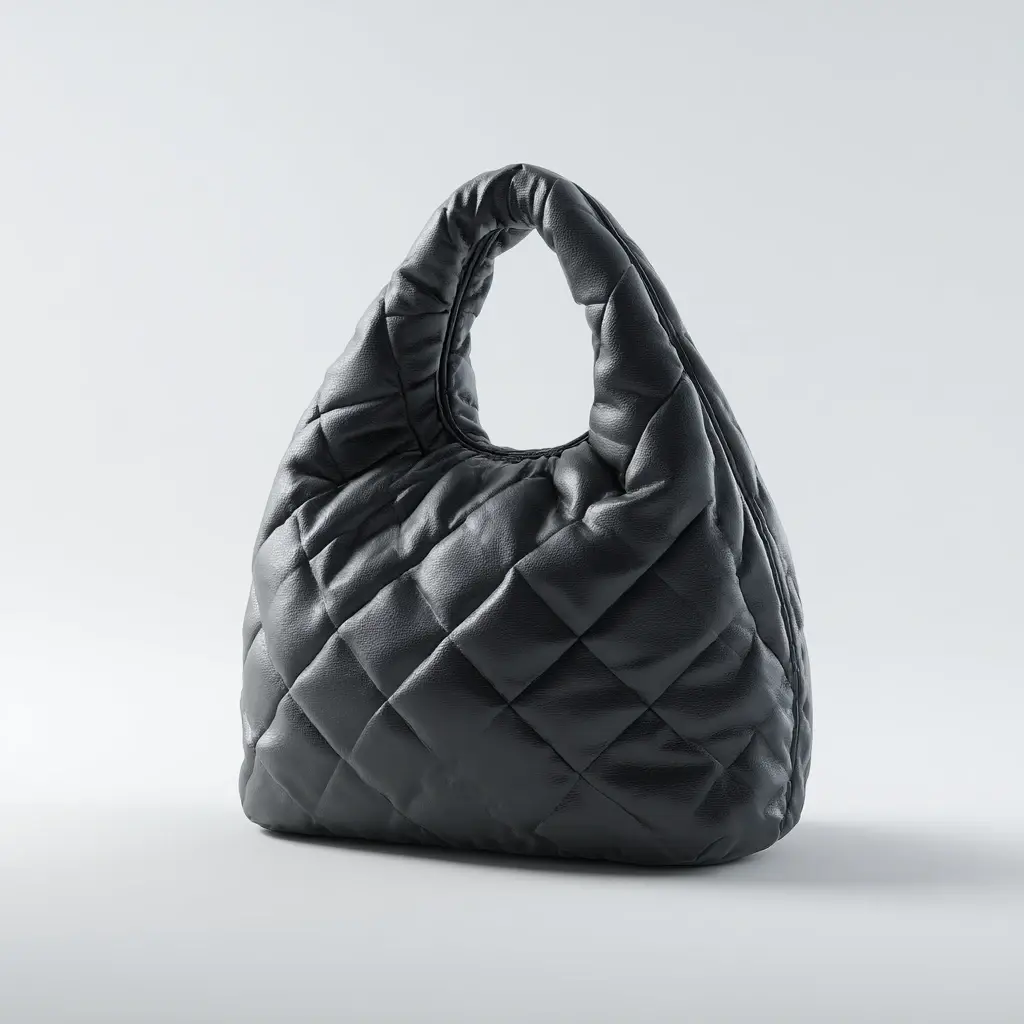
- The Five Sketch Styles, Ranked by Conversion
- Style One: Dimensioned Technical Flat
- Style Two: Exploded Construction View
- Style Three: Three-Quarter Form Sketch
- Style Four: Interior Layout Plan
- Style Five: Detail Blow-Up Sheet
- What Every Sketch Needs Regardless of Style
- What to Leave Out of a Production Sketch
- What a 3D Render Settles Before Any Leather Is Cut
- From Flat to Cost Estimate in One Afternoon
- The Handoff: What the Sample Room Opens First
- Range Grids: Sketching Three Silhouettes as One Family
Which handbag sketch styles actually reach production? Five, in descending order of how reliably they convert: the dimensioned technical flat, the exploded construction view, the three-quarter form sketch, the interior layout plan and the detail blow-up sheet. A dimensioned flat is worth more than a beautiful perspective: one A3 sheet at 300 dpi with four orthographic views, dimensions in millimetres and a stated scale converts to a pattern in a single pass, where a rendered perspective without dimensions typically costs one extra sample round. Each style below comes with a checklist and the reason each item is on it.
Sketch styles and what each one is for
The Five Sketch Styles, Ranked by Conversion
Ranked by how reliably each one turns into a first sample that matches what the designer had in mind. The ranking is not about artistic quality; a sketch that looks impressive and cannot be measured ranks below one that looks plain and can.
| Rank | Style | What it settles | Typical cost of omission |
|---|---|---|---|
| 1 | Dimensioned technical flat | Every external dimension and panel break | One full sample round, 6-10 working days |
| 2 | Exploded construction view | Layer order and seam sequence | Wrong interlining, wrong drape |
| 3 | Three-quarter form sketch | Whether the proportion is attractive | An ugly bag, made correctly |
| 4 | Interior layout plan | Pocket positions and device clearance | A fit claim that is not true |
| 5 | Detail blow-up sheet | Stitch density, edge finish, hardware setting | A finish that fails inspection |
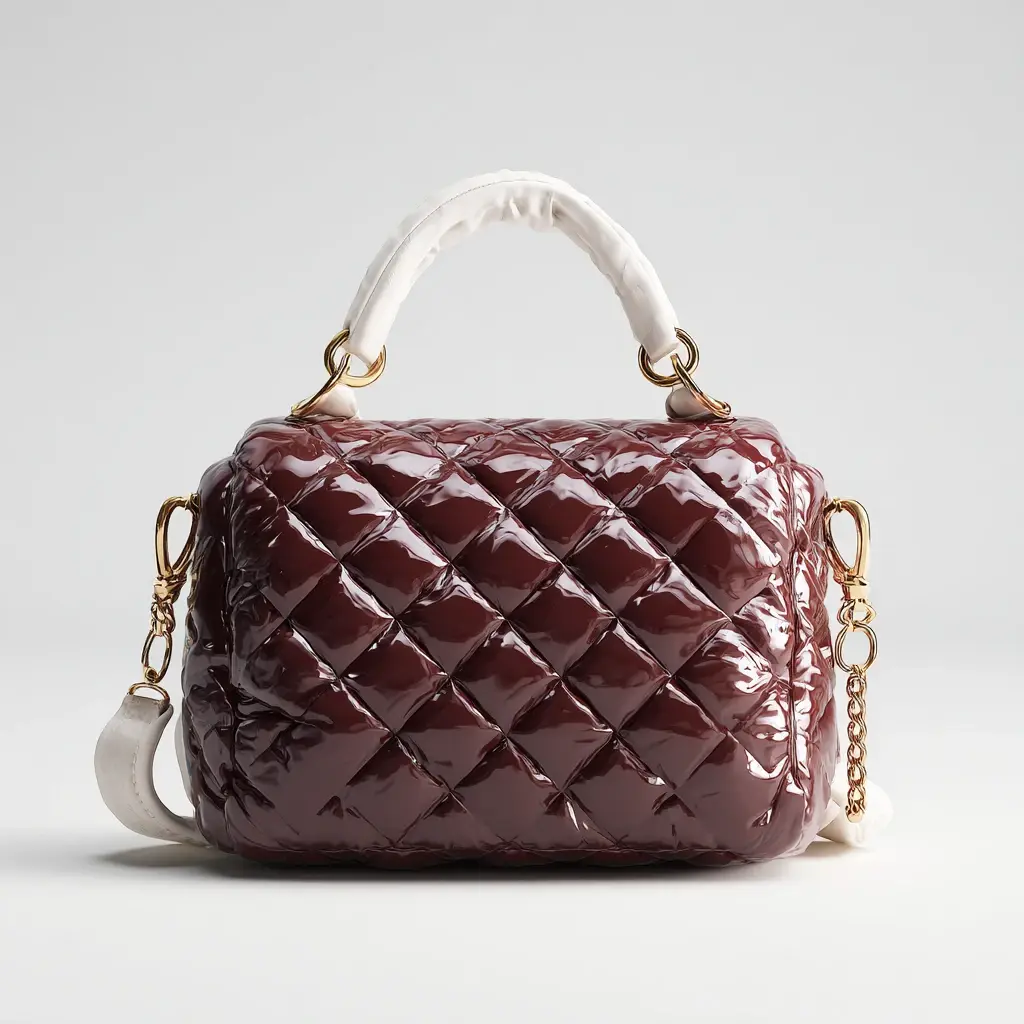
A buyer who sends only the third style receives a bag that looks right and measures wrong. A buyer who sends the first and the third receives a bag that measures right and looks right, which is the whole objective and takes about three hours longer to prepare.
Style One: Dimensioned Technical Flat
The workhorse. An orthographic drawing with no perspective and no shading, showing front, back, side and base views, with every dimension written in millimetres. It takes 15-20 minutes per view by hand and about half that in vector software, and it is the single highest-return document in the whole package.
- Four orthographic views, minimum: front, back, side and base. *Why it matters:* a side view is what reveals gusset depth, and a base view is what reveals whether the bag stands.
- Every dimension in millimetres, not centimetres and not a scale bar. *Why:* a bench reads millimetres directly, and 3.4 cm invites rounding.
- One stated datum per view, usually the base seam or centre front. *Why:* without a datum, every position becomes a judgement call.
- A stated scale, 1:1 or 1:2, printed on the sheet. *Why:* a printed sheet gets resized, and a scale note survives resizing.
- Line weights separated: 0.5 mm for outlines, 0.25 mm for detail. *Why:* it makes panel breaks readable at a glance on a printed A3.
- A revision letter and a date in the title block. *Why:* it stops last week's sheet being cut by mistake.
One thing to avoid on the flat: shading. A shaded flat reads as a claim about material behaviour, and material behaviour on a drawing is the most common source of the gap between render and sample. Keep the flat unshaded and put the material call-out in the tech pack instead, where it belongs.
Style Two: Exploded Construction View
A drawing that pulls the layers apart: shell, interlining, lining, reinforcement, and the order in which they are assembled. It is the document that prevents the most expensive class of first-sample error, which is a bag that measures correctly and feels wrong.
- Layer order, numbered from the outside in. *Why:* a 3 mm foam laminate on the wrong side of a 210D lining changes both drape and internal capacity.
- Interlining type and thickness per panel. *Why:* 8-10 mm of internal capacity disappears when interlining is added without being drawn.
- The seam sequence, numbered. *Why:* two bags with identical panels can be assembled in different orders, and only one of them closes cleanly.
- Which seams are turned, bound or raw-edged. *Why:* this is decided from the drawing and is expensive to change after cutting.
- Reinforcement call-outs at strap ends and base corners. *Why:* those two joints carry most of the field failures.
The exploded view is also where yield gets discussed. A panel drawn with a clear grain direction and a stated nesting intent can improve hide yield from 25 percent loss to 18 percent, which is 5-9 percent off the largest cost line for no change in how the bag looks.
Style Three: Three-Quarter Form Sketch
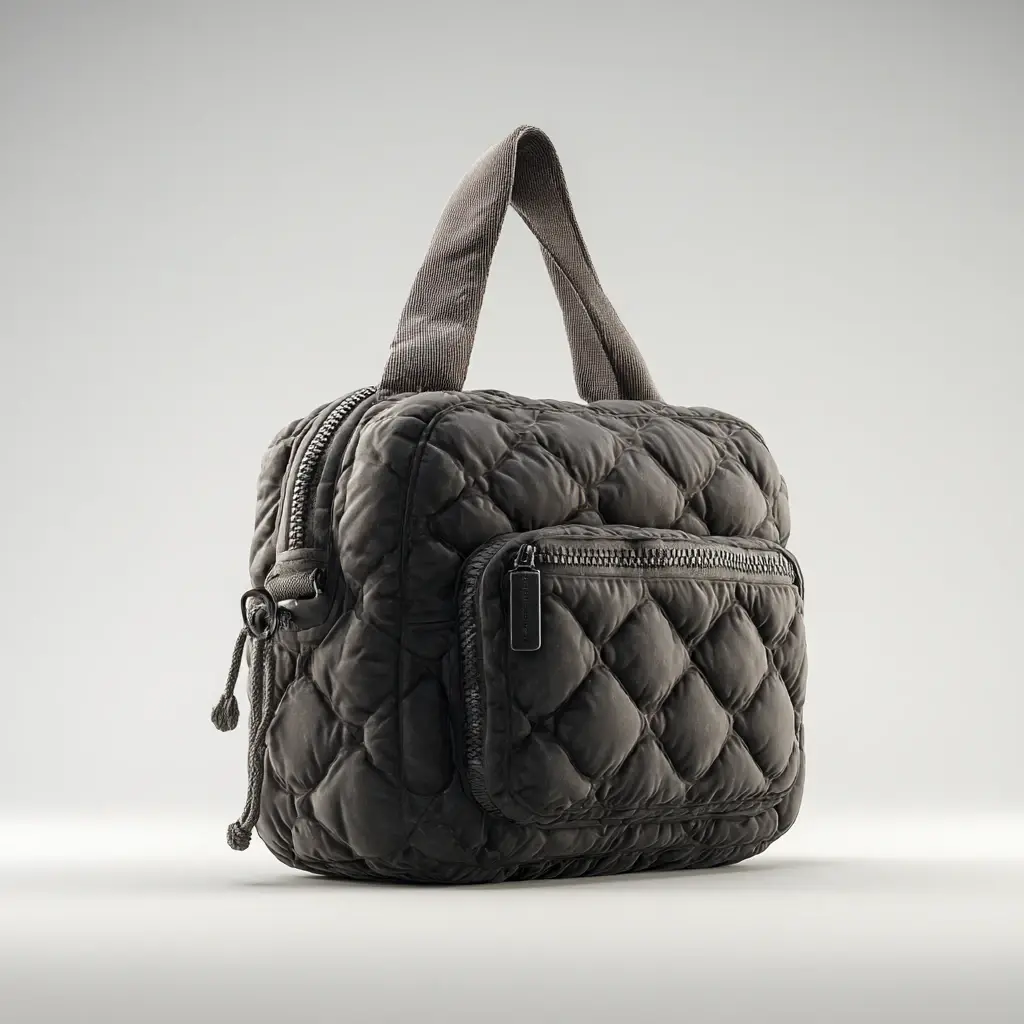
The persuasive one. A three-quarter view shows proportion and volume, which is what a buying committee responds to and what a flat cannot communicate. Its job is to settle whether the shape is desirable, and it should never be asked to carry dimensions.
- Drawn at a consistent 30-45 degree angle across the range. *Why:* varying the angle makes two silhouettes incomparable.
- Three values of tone, no more. *Why:* tone implies material behaviour, and a three-value sketch stays honest about being a shape study.
- A consistent human reference in range drawings. *Why:* a tote drawn at 34 cm and one drawn at 42 cm look identical without one.
- Never dimensioned on the same sheet as the flat. *Why:* two sets of numbers on one sheet will eventually disagree.
- One silhouette per sheet, or a clearly labelled range grid. *Why:* it prevents the wrong style being sampled.
This is the style to put in front of a wholesale buyer or a crowdfunding audience, and the style to keep out of the production package. Mixing the two audiences on one sheet produces a document that is too pretty to measure and too dense to sell with.
Style Four: Interior Layout Plan
A cross-section or open-flat drawing of the inside, showing pocket positions, divider positions, sleeve clearance and the datum each is measured from. It is the sheet that makes a fit claim true rather than aspirational.
- Pocket positions in millimetres from a stated datum. *Why:* centred is not a dimension, and a pocket 6 mm off-centre is visible in a photograph.
- Device sleeve clearance with stated ease. *Why:* a 13-inch device at 330 by 230 mm needs 6 mm of ease to be a truthful claim.
- Lining seam positions. *Why:* a lining seam inside a sleeve is what stops a device sliding in.
- Zip garage, key clip and elastic positions. *Why:* these are the small parts most often placed by improvisation.
- A note on which interior panels are load-bearing. *Why:* a pocket hanging off a non-reinforced panel sags within weeks.
Interior plans are the most commonly omitted sheet and the second most commonly regretted omission, after the dimensioned flat. A bag with no interior plan is a bag whose interior is designed on the bench, which is a reasonable process if the designer is happy with whatever the bench decides.
Style Five: Detail Blow-Up Sheet
Enlarged drawings of the details that decide whether a bag passes inspection: stitch notation, edge finish, hardware setting and branding position. Drawn at 2:1 or 5:1, depending on the part.
- Stitch notation: a dashed line with 7-9 stitches per inch stated, plus a 10 mm seam allowance. *Why:* this is the first thing an inspector counts and the first thing that drifts without a drawing.
- Edge finish: turned, bound, painted or raw, with the paint build in millimetres. *Why:* an edge that cracks at 300 cycles is a finish decision, not a material one.
- Hardware setting: hole size, washer, and whether it is set by hand or against a jig. *Why:* hand-set hardware introduces positional spread that exceeds a 3 mm tolerance.
- Branding position in millimetres from a datum, with emboss depth or stitch count. *Why:* a logo 4 mm out of position is the most common rejection at final inspection.
- Thread weight and colour code: Tex 40, with a colour reference. *Why:* the wrong thread weight on a load-bearing seam fails earlier than anything else.
Detail sheets are also where compliance is recorded. A hardware blow-up should carry the plating code and the expectation of 24 hours to first corrosion under ASTM B117, because that is the number that decides whether a shipment survives a season near salt air.
What Every Sketch Needs Regardless of Style
Eight items, and a sheet missing any one of them will generate a clarification email before the pattern is cut. The list is short enough to check in two minutes, which is roughly what it costs to save three days.
- A title block with style name, season, revision letter and date.
- A stated scale and, on printed sheets, a printed scale bar as a backup.
- A stated unit: millimetres, and millimetres only.
- One datum per view, named in words rather than implied.
- A material call-out per panel, referencing a swatch number rather than a description.
- A colour reference: Pantone TCX for soft goods, a plating code for metal.
- A revision letter that matches the one on the tech pack and the BOM.
- A file format that survives: PDF for print, AI or SVG for editing, at 300 dpi minimum.
The seventh item causes the most trouble. Three documents carrying three different revision letters means three different versions of the same bag in circulation, and the version that gets cut is whichever one arrived last rather than whichever one is correct. Number once, in one master list, and reference that number everywhere.
What to Leave Out of a Production Sketch
Three things, all of which appear in most first-time packages and all of which cost time.
- Shading and texture on a dimensioned drawing. It reads as a claim about drape and hand feel, and it will be judged as one.
- Mood imagery on the specification sheet. A lifestyle photograph belongs in the brief, not in the package the bench cuts from.
- Implied tolerances. A dimension written as 340 is a nominal, not a tolerance; write 340 mm plus or minus 3 mm or expect the loosest interpretation.
The third one is worth restating, because it is the quietest source of dimensional disputes. A nominal without a tolerance is an invitation, and the invitation is always accepted in the direction that is easiest to make.
Once the package is complete, the rest of the sequence is fixed: sampling at 6-10 working days, then the bulk run at 35-50 days and inspection at AQL 2.5 under ISO 2859-1, which sets how many units are drawn from a lot of your size and how many defects of each class trigger a pass, a fail or a re-sort. A sourcing partner working to ISO 9001 will attach REACH Annex XVII and Proposition 65 documentation with the report, and the tech pack contents guide sets out how sketches and pack are kept in step. The handbag private label process reference shows the whole sequence, and the tooling round-up for 2026 covers which software produces these sheets fastest.
What a 3D Render Settles Before Any Leather Is Cut
A render is not a sixth sketch style; it is a filter applied to the first one. A dimensioned flat fed into a 3D model shows drape, volume and proportion in photorealistic images before the first cut is made, and what it replaces is the round usually spent discovering that a 30 cm body with an 11 cm gusset looks bulbous. A render set takes 2-4 days and costs a fraction of a physical round at 6-10 working days. It cannot replace the flat, because a model is only as dimensioned as the drawing behind it, and it cannot show hand feel or weight. The digital sampling workflow covers the sequence in full.
- Volume errors. A bulbous gusset found in a render costs 2-4 days; the same discovery in a sample costs 6-10 working days.
- Colourways. Five rendered colourways cost roughly the same as one; physical colourways each need their own dye lot.
- Listing imagery. Renders double as placeholder photography while the sampling window runs.
- The limit. Hand feel, weight and closure action stay with the physical sample; the render never approves those.
From Flat to Cost Estimate in One Afternoon
A dimensioned flat is also a costing document, because every number on it maps to a quantity somebody can price. Panel areas give material consumption in square feet, the seams and fittings visible in the drawing give a line-time estimate, and the hardware call-outs give the trim list. A buyer who runs this arithmetic before sending the package comes within 10-15 percent of the eventual quotation and spends the sampling window improving the bag rather than renegotiating its price. On a 34-42 cm tote the working figures are 1.4-1.9 sq ft of hide per unit at a nesting yield of 78-88 percent, 24-30 operations at 25-40 seconds each, and one hardware set.
- Material. Sum the panel areas, divide by the nesting yield, and price against the stated cost per square foot.
- Labour. Count visible seams and fittings; each is an operation at 25-40 seconds of line time.
- Trim. Every drawn fitting is a part with a price, and every drawn bar-tack implies a 2-3 cm reinforcement patch.
- Sanity band. The estimate should land within 10-15 percent of the returned quote; a wider gap is a specification gap.
The Handoff: What the Sample Room Opens First
A package that arrives as eleven attachments gets read in whatever order somebody chooses; a package that arrives as three files gets read in the right order. The sample room opens the dimensioned flat first, the bill of materials second, and everything else afterwards, because the flat decides whether the bench can start at all. A one-page cover sheet naming the build file, the revision letter and the date the clock starts is what turns receipt into a start. Without it, the 6-10 working day window begins after a clarification email has gone out and come back.
- File one: the flat. Four views, millimetres, one datum; the bench cannot begin without it.
- File two: the bill of materials. Swatch numbers rather than adjectives, and hardware stated as a plating code.
- File three: the brief. Quantity per colourway, target retail price, and the one non-negotiable dimension.
- Cover sheet. Names the build file and the start date; 30 minutes to write and saves 1-3 days of ambiguity.
Range Grids: Sketching Three Silhouettes as One Family
A first line is rarely one bag, and the sketch package is where the range either starts reading as a family or does not. A range grid draws every silhouette at the same scale, on the same sheet, with the same human reference, and it forces the decisions that let three styles share one hardware set and one lining. Drawn separately, three silhouettes drift apart: a 20 mm strap on one and a 25 mm strap on another quietly doubles the trim list. Drawn on one grid, the shared components are visible while they are still free to align.
- Same scale. All silhouettes at 1:4 on one A3 sheet, so a 34 cm tote and a 22 cm crossbody are comparable at a glance.
- Shared symbols. One hardware symbol across the range means one plating bath and one salt-spray test at the stated hours.
- Proportion ladder. Keep 8-12 cm between body widths so the styles read as distinct on the same shelf.
- One strap family. 20 mm or 25 mm across the range, not both; the second width is a second trimming set and a second tooling line.
Send sketches, get a dimensioned package back
Send your sketch or reference photographs. A private label coordinator will return a dimensioned flat and a tech pack, then sampling at 6-10 working days, bulk at 35-50 days and inspection at AQL 2.5 under ISO 2859-1. Get a quote.
Frequently Asked Questions
Which handbag sketch style is most useful for production?
The dimensioned technical flat. Four orthographic views, every dimension written in millimetres, one stated datum and one stated scale. It takes 15-20 minutes per view and is the single highest-return document in the package, because it converts to a pattern in one pass rather than after a round of clarification.
Should a technical flat be shaded?
No. Shading on a dimensioned drawing reads as a claim about drape and hand feel, and it will be judged as one. Keep the flat unshaded and orthogonal, and put material call-outs in the tech pack, where they can reference an approved physical swatch instead of an impression.
How many views does a production sketch need?
Four at minimum: front, back, side and base. The side view is what reveals gusset depth and the base view is what reveals whether the bag stands unaided. An interior layout plan is the fifth sheet most packages omit and later regret, because without it the interior is designed on the bench.
What scale and resolution should a sketch sheet be?
A3 at 300 dpi minimum, with the scale stated in the title block, 1:1 or 1:2 for flats and 2:1 or 5:1 for detail blow-ups. Print a scale bar as well, because a printed sheet will be resized at some point and a stated scale survives that while a measurement does not.
What is an exploded construction view for?
It shows the layer order from the outside in, the interlining type and thickness per panel, and the seam sequence. It prevents the most expensive class of first-sample error, which is a bag that measures correctly and feels wrong because a 3 mm foam laminate sat on the wrong side of the lining.
Why does a three-quarter sketch matter if it carries no dimensions?
Because proportion and volume are what a buying committee responds to and what a flat cannot communicate. Its job is to settle whether the shape is desirable. Draw the range at a consistent 30-45 degree angle with a consistent human reference, and keep dimensions on the flat.
What should an interior layout plan include?
Pocket and divider positions in millimetres from a stated datum, device sleeve clearance with stated ease, lining seam positions, and a note on which interior panels are load-bearing. A 13-inch device at 330 by 230 mm needs at least 6 mm of ease for the fit claim to be true.
What belongs on a detail blow-up sheet?
Stitch notation at 7-9 stitches per inch with a 10 mm seam allowance, edge finish with the paint build in millimetres, hardware setting including hole size and whether a jig is used, branding position from a datum, and thread weight such as Tex 40 with a colour reference.
Why must every position be measured from a datum?
Because centred, near the top and about halfway are not dimensions, and each one will be interpreted differently by a pattern cutter and by a sewer. A datum named in words, usually the base seam or centre front, lets two people on opposite sides of the world arrive at the same number.
What is the most common mistake on a first sketch package?
Writing a nominal without a tolerance. A dimension written as 340 is an invitation, and the invitation is always accepted in whichever direction is easiest to make. Write 340 mm plus or minus 3 mm, and the number becomes enforceable at inspection.
How should revisions be labelled across documents?
One revision letter, in one master list, referenced identically on the sketch, the tech pack and the BOM. Three documents carrying three different letters means three versions of the same bag in circulation, and the version that gets cut is whichever arrived last rather than whichever is correct.
Does a better sketch change the sampling time?
It removes rounds rather than shortening them. Sampling stays at 6-10 working days, rising to 12-15 for framed or woven constructions, but a complete package usually needs one or two rounds instead of two or three, which is where the 6-10 working days per round are actually saved.
People Also Ask
Can I send photographs instead of sketches?
Yes, as reference, but not instead of a dimensioned flat. Three photographs plus a one-page dimension sheet is the minimum usable package; photographs alone leave every dimension to be guessed.
Do I need a sketch for every colourway?
No. One dimensioned flat per silhouette, with colourway noted as a material call-out referencing an approved swatch. Colour changes do not change the pattern.
Is hand drawing acceptable?
Yes, provided it is dimensioned in millimetres, drawn to a stated scale and scanned at 300 dpi. Legibility matters more than medium, and a clean hand-drawn flat beats an unlabelled vector file.
Should the sketch show the branding?
Yes, on the flat, with position in millimetres from a datum and the method stated: emboss depth, woven-label size, embroidery stitch count or hardware logo. A logo 4 mm out of position is a common final-inspection rejection.
Sources and further reading
Every figure on this page is either our own programme data or attributed below. Open the originals before you write them into a specification.
- REACH — chemical substances regulationEuropean Commission Annex XVII restricts the substances that may appear in finished leather and coatings.
- SATRA — technical services for leather, footwear and accessoriesSATRA Independent leather, hardware and accessories testing protocols.
- Incoterms rulesICC The rules that decide where cost, risk and insurance transfer.