Best Emerging Bag Silhouettes to Watch Next Season
Which emerging bag silhouettes are actually worth sampling next season? Six of them, and the way to find them is not a trend list but a five-question filter run in a fixed order: is the shape bought on replacement logic or on mood, can it be built at 500 pcs per style / colourway without losing the thing that made it interesting, does it survive a second season, where does the brand mark physically sit, and what does it cost if the answer turns out to be no. Shapes that fail the second question are the expensive ones, because a silhouette that depends on a construction detail no line can hold at 500 pieces looks right in a sample and wrong in a carton. This page runs the six shapes worth watching through that filter, gives working dimensions for each, and shows how to test one on a 500-piece drop against a 60 per cent in 30 days sell-through gate before committing a whole season to it.
- Start With the Decision, Not the Trend List
- Question One: Is It Bought on Replacement or on Mood?
- Question Two: Can It Be Built at 500 Pieces?
- Question Three: Does It Survive a Second Season?
- Question Four: Where Does the Brand Mark Sit?
- Question Five: What Does It Cost If You Are Wrong?
- The Six Shapes That Clear All Five Questions
- Matching Each Shape to a Channel and a Price Band
- How to Sample a New Shape Without Committing the Season
- What to Take Out of the Range to Make Room
- Six Shapes on One Calendar
Which emerging bag silhouettes are actually worth sampling next season? Six of them, and the way to find them is not a trend list but a five-question filter run in a fixed order: is the shape bought on replacement logic or on mood, can it be built at 500 pcs per style / colourway without losing the thing that made it interesting, does it survive a second season, where does the brand mark physically sit, and what does it cost if the answer turns out to be no. Shapes that fail the second question are the expensive ones, because a silhouette that depends on a construction detail no line can hold at 500 pieces looks right in a sample and wrong in a carton. This page runs the six shapes worth watching through that filter, gives working dimensions for each, and shows how to test one on a 500-piece drop against a 60 per cent in 30 days sell-through gate before committing a whole season to it.
The filter and the numbers behind it
Start With the Decision, Not the Trend List
A trend list tells you what is being photographed. It does not tell you what you should make. Those are different questions, and confusing them is how a brand ends up with a sample room full of shapes that look current and a warehouse full of units that do not sell. The decision you actually need is narrower: of everything appearing now, which shapes can your programme produce at volume, at your price band, with a specification you can defend eighteen months from now.
So the order matters. Run the five questions below in sequence and stop at the first no, because a shape that fails question two does not need to be assessed against question three. In practice this filter eliminates most of what appears in a season: shapes that depend on a single hand-finishing step, shapes whose identity comes from a colour rather than a construction, and shapes that only read correctly in one size. What survives is a small, boring-looking list, and that list is where the money is.
Question One: Is It Bought on Replacement or on Mood?
This is the branch that decides the size of the bet. A replacement buy is purchased because the old one wore out: the shopper knows what she needs before she arrives, buys on dimensions and durability, and will buy the same shape again in two years. A mood buy is purchased because it looks current: the shopper did not know she needed it, buys on appearance, and may well not buy the same shape again. Replacement shapes get a full range commitment. Mood shapes get a test drop and nothing more.
- Replacement signal: the shape has a clear job - work carry, everyday carry, travel - and shoppers describe it in dimensions rather than in adjectives.
- Mood signal: the shape is described by its reference point, a decade, a colour or a detail, and shoppers struggle to say what job it does.
- Mixed signal: a familiar shape with one new detail, usually a proportion change or a hardware placement, which is the safest category to invest in.
- Order size rule: replacement shapes take 500 pcs in three colourways; mood shapes take 500 pcs in two and are judged at the 30-day gate.
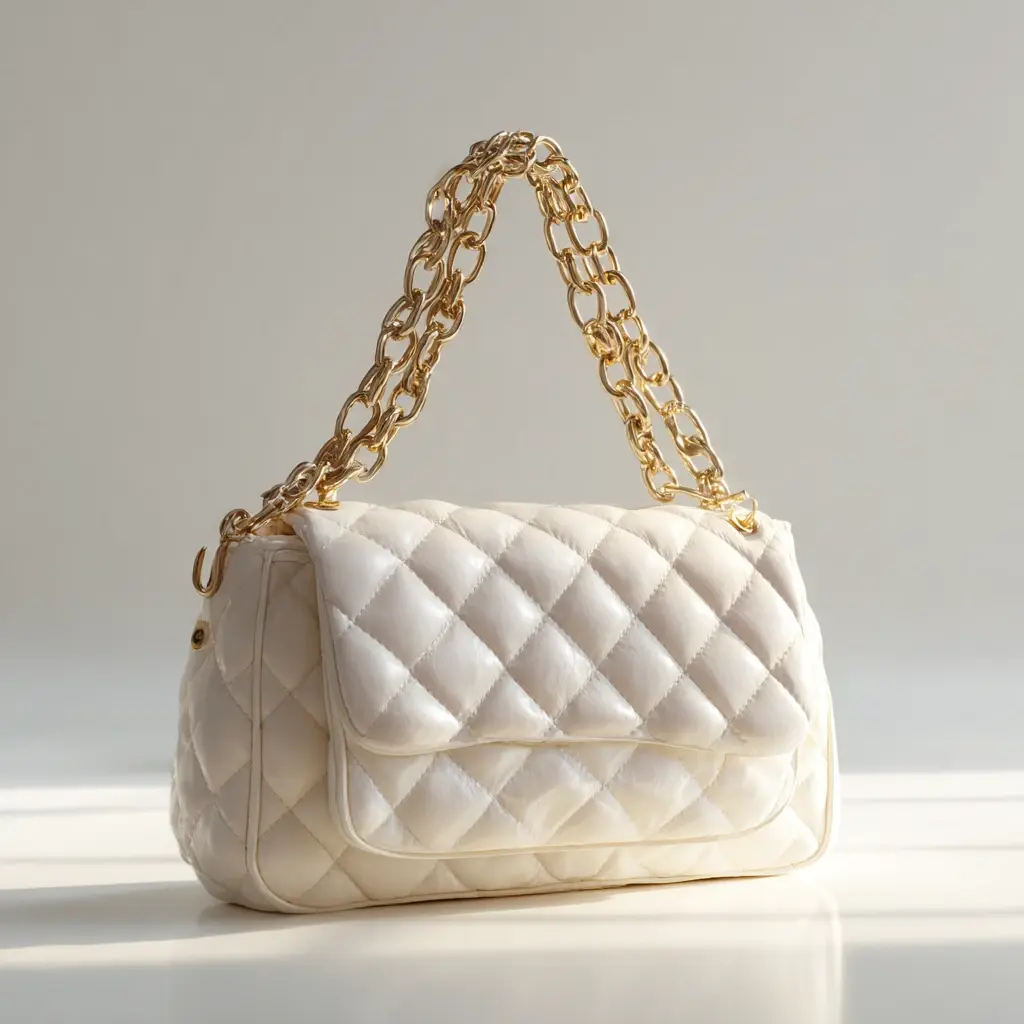
The mixed-signal row is worth dwelling on, because nearly every shape that has sustained a second season in the last decade sat there. The east-west shoulder is a current example: it is an ordinary shoulder bag with its proportions pushed sideways, so it photographs as new while still doing a job the shopper already understands. That is a very different proposition from a shape whose entire identity is a surface treatment, which how quickly a viral shape can turn over examines from the demand side.
Question Two: Can It Be Built at 500 Pieces?
This is the question that kills most emerging shapes, and it is almost never asked early enough. A silhouette that gets its character from a hand-set detail - a turned edge that has to be eased rather than folded, a gusset that only sits correctly if the panel is cut on a specific bias, a strap that needs to be skived to 0.8 mm along its whole length - can be made once and cannot be made 500 times consistently. The sample will be beautiful and the carton will be inconsistent.
The test is to ask what holds the shape up. If the answer is a pattern, a stiffener, a seam position or a hardware placement, the shape is buildable and repeatable. If the answer is an operator's judgement at any step, it is not, and no amount of inspection will fix it. This is also where the 6-10 working days of sampling window earns its keep: a shape that can be sampled cleanly in that window, without a second or third round, is usually a shape whose geometry does the work rather than whose finishing does.
Question Three: Does It Survive a Second Season?
A shape earns a second season when it can be re-issued with a change that costs almost nothing - a new colourway, a new hardware finish, a 2 cm proportion shift - and still read as the same product. That is a design test, not a demand test, and it should be applied before sampling rather than after the first drop sells. Ask what the second version looks like. If the honest answer is that there is no second version, because the shape only works in exactly this form, then the shape is a one-season item and should be priced and ordered as one.
- Write the second-season version of the shape before you sample the first one, including the one detail that changes.
- Check that the tooling and pattern work is reusable across both versions; new tooling per season destroys the economics at 500 pcs.
- Confirm the material is available in at least three colourways across two seasons, not one colourway for one season.
- Decide the exit: if the shape fails the 30-day gate, does the pattern convert into another shape or is it dead cost?
Step four sounds pessimistic and is not. Knowing the exit in advance is what allows a brand to run more tests, because a failed test that converts into another shape is cheap and a failed test that becomes dead inventory is expensive. It is also the argument for keeping patterns shared across shapes: a body panel used by two silhouettes means either one can fail without the pattern investment being written off.
Question Four: Where Does the Brand Mark Sit?
Every private label shape needs a surface where the brand can put something recognisable, and on several emerging shapes that surface does not exist. A slouchy shape with no flat panel, a rounded shape with no front face, or a shape whose whole interest is an unusual closure all leave a brand with nowhere to put its mark except a hanging tag, and a hanging tag is removed on the first day of use. If the only option is a heat-stamped patch on the lining, the brand is paying for advertising that nobody sees.
The practical requirement is a flat or gently curved area of at least 40 x 25 mm on the exterior, positioned where a hand does not naturally cover it, plus a hardware option for a second mark. On a minimal shape this often means adding a strap tab or a base panel purely to carry branding, which is an acceptable design compromise and a far better one than discovering the problem after the first 500 pieces have been made.
Question Five: What Does It Cost If You Are Wrong?
The last question puts a number on the downside, and the number is rarely the unit cost. A failed 500-piece drop costs the landed cost of the units, but it costs more in the return handling, the markdown required to clear them, and the shelf space occupied while the right shape was not there. Those three are usually two to three times the value of the goods themselves, which is why the decision should be made on downside rather than on upside.
| Failure mode | When it shows up | Cost per unit | How to catch it earlier |
|---|---|---|---|
| Gusset collapse under load | Week two of carry | USD 8-14 return and write-off | Load the sample to 3 kg for 48 hours |
| Strap creep at the adjustment | Week six | USD 6-11 | Mark the holes and re-measure after 500 flexes |
| Edge coating cracking at the fold | First cold month | USD 5-9 | Fold test at 5 degrees centigrade |
| Hardware plating wear | Week ten | USD 7-12 | 24-hour salt spray on the plating batch |
| Colour drift between panels | At goods-in | USD 0.35-0.60 re-sort | Split colour lots before packing |
Every one of those five is catchable during the 6-10 working days of sampling window, and every one costs ten to thirty times more to fix after landing. The discipline is to treat sampling as a destructive test rather than an approval ritual: the sample exists to be loaded, flexed, chilled and pulled, not to be photographed. Pre-shipment inspection at AQL 2.5 under ISO 2859-1 catches what is left, but it cannot catch a geometry problem, because the units will match the approved sample perfectly and still fail in the second week of use.
The Six Shapes That Clear All Five Questions
Run through the filter in that order and six silhouettes survive for the coming season. All six are replacement-driven or mixed-signal, all six are held up by pattern rather than by operator judgement, all six have a branding surface, and all six have an obvious second-season version. The dimensions below are working dimensions - the ones that have been sampled and produced cleanly - rather than runway dimensions.
| Silhouette | Working dimensions (W x H x D) | What holds the shape | Realistic retail band |
|---|---|---|---|
| East-west shoulder | 32 x 18 x 11 cm | Base stiffener plus a 8 cm gusset return | USD 69-119 |
| Soft slouch hobo | 34 x 26 x 12 cm | Panel cut on the bias, 26 cm strap drop | USD 59-99 |
| Half-moon shoulder | 30 x 20 x 9 cm | Curved top seam with a taped seam allowance | USD 79-129 |
| Elongated vertical tote | 28 x 38 x 14 cm | Two internal side stays at 4 mm | USD 89-149 |
| Mini structured backpack | 24 x 30 x 12 cm | Foam laminated back panel, 18 mm webbing | USD 69-119 |
| Flat sling worn crossbody | 22 x 15 x 7 cm | Single-piece folded body, 12 mm D-ring | USD 39-69 |
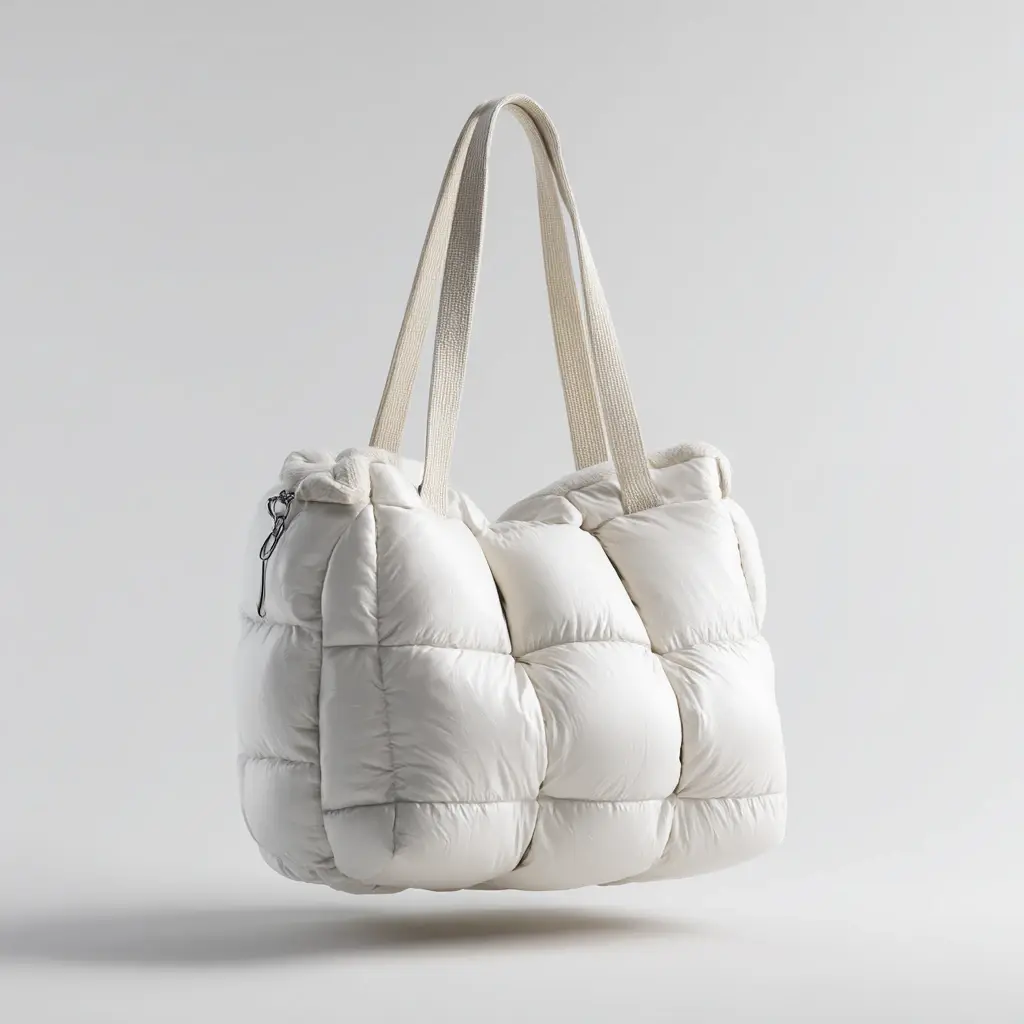
Two of those six are worth a first commitment and four are worth a test drop. The elongated vertical tote and the flat sling are the safest: both are pure replacement buys, both reuse patterns already in common use, and both sit in retail bands where volume is reliable. The other four - east-west shoulder, slouch hobo, half-moon, mini backpack - are mixed-signal and should be tested in two colourways before widening. Which of these have shelf proof at the value end is covered in the value-tier shape list for 2026.
Matching Each Shape to a Channel and a Price Band
A shape that is right for a boutique is often wrong for a marketplace, and the mismatch is usually about how the shopper judges without touching. In a boutique the shopper handles the bag, so construction quality and material feel carry the decision. On a marketplace she does not, so the shape has to read in a photograph at thumbnail size, which favours strong proportion over subtle detail.
- Boutique, USD 89-149: elongated vertical tote and half-moon shoulder, where material and finishing are visible on the shelf.
- Marketplace, USD 39-79: flat sling and mini structured backpack, where proportion reads in a photograph and specifications are written out.
- Department or chain, USD 69-119: east-west shoulder, which photographs well and still passes a handling test.
- Own-channel or subscription, USD 59-99: soft slouch hobo, where repeat purchase depends on comfort rather than on appearance.
There is a timing dimension to the same decision, because a shape that is right in one channel can be wrong in one month. Launching a mood-driven shape into the peak week for replacement buying wastes the shape's short attention window, and launching a replacement shape into a dead month wastes its reliability. The month-by-month picture is set out in when each bag type peaks across the retail calendar.
How to Sample a New Shape Without Committing the Season
The cheapest way to be wrong about a new shape is to be wrong about 500 pieces rather than 5,000. A test drop at the 500 pcs per style / colourway minimum, in two colourways, is large enough to be a real read on demand and small enough that a failure costs weeks rather than a season. The gate is a sell-through number agreed in advance, and 60 per cent in 30 days is the one that works: below it the shape is not failing badly enough to be obvious, but it is not selling fast enough to justify a second drop.
- Write the gate before the drop ships: 60 per cent sold in 30 days, measured at stock keeping unit level rather than at style level.
- Run two colourways only, and make one of them a core colour so a failed test leaves sellable stock.
- Hold the sampling window to 6-10 working days; if the shape needs a third sample round, that is the answer to question two.
- Book bulk at 35-50 days and confirm the landing date backwards from the launch week, with six days of slack.
- Reorder only on the gate, and widen to three colourways only on the second drop.
Step two is the one that saves the most money. Making the second colourway a core colour means that if the shape fails, half the drop is still saleable at full price, which turns a total loss into a partial one. It is a small decision made at sampling stage that halves the downside of every test a brand runs, and it costs nothing.
What to Take Out of the Range to Make Room
A new shape only creates value if something leaves. Ranges grow by addition and die by dilution: every style added without one removed spreads the buy across more units, lowers the average order per style below what a line can schedule efficiently, and leaves the brand with more shapes each selling less. The removal rule should be explicit and applied at the same meeting where the addition is approved.
- Remove by job, not by performance: if two shapes do the same job, the newer one stays only if it sells at a different price or into a different channel.
- Remove the shape with the deepest markdown: markdown depth is a better signal than sell-through, because it shows what the shopper would actually pay.
- Remove the shape with the highest return rate: a shape returning at 12 per cent is consuming more margin than its sell-through suggests.
- Remove the shape with no second version: every surviving shape should have a written second-season variant, and one that does not is already finished.
Everything above runs on the same calendar, and the calendar is what makes a six-shape programme possible rather than aspirational: 6-10 working days to sample, 35-50 days to produce, AQL 2.5 inspection under ISO 2859-1 before loading, FOB Xiamen. Every unit described here is made by our validated partner factory Quanzhou Yingming Bags, which has run export programmes since 2014 across 7 production lines and about 200,000 pcs per month, and the full sequence is laid out in the private label handbag programme overview.
Six Shapes on One Calendar
Six shapes do not need six calendars. Sampled in parallel and produced in two consolidated slots, a six-shape programme fits inside a season without six separate sampling windows, because the sampling round is build time rather than elapsed time and three patterns can be on the bench at once. What decides the plan is when the shapes have to land, and everything else is counted backwards from that.
| Stage | Days | What runs in parallel | What slips it |
|---|---|---|---|
| Specification and artwork | 1-3 per shape | All six specifications written together | An unmeasured sketch |
| Sampling | 6-10 | Three to four patterns on the bench at once | A third round on any single shape |
| Review and revision | 2-4 | Numbered lists per shape | A narrative review |
| Pre-production pieces | 3-6 | One piece per shape | Bulk materials not yet released |
| Bulk, slot one | 35-50 | Three shapes consolidated | A late change request |
| Bulk, slot two | 35-50 | Three shapes consolidated | The first slot overrunning |
| Inspection and loading | 3-6 | One visit covering both slots | Carton count not finalised |
- Sample in parallel, produce in two slots. Parallel sampling keeps the window at 6-10 working days for the whole set rather than per shape.
- Consolidate the container. Three shapes in each slot reach the container threshold without deepening any single bet.
- Count backwards from the launch week and hold six days of slack; that is the difference between a planned drop and an air-freight bill.
Get a Quote → /contact-quote/ — send a sketch, a reference photo or just the working dimensions, and the team will return a pattern feasibility read, a landed cost per piece and a sampling date.
Frequently Asked Questions
How many new bag silhouettes should a brand sample in one season?
Six is a workable ceiling if four of them are test drops rather than full commitments. Beyond that the buy spreads too thin, average order per style falls, and no shape gets enough units to read demand properly against a 60 per cent in 30 days gate, which is the only gate worth using.
What is the safest new silhouette to invest in for the coming season?
The elongated vertical tote at 28 x 38 x 14 cm is the safest. It is a pure replacement buy, reuses common pattern work, holds shape with two 4 mm internal side stays, and sits at USD 89-149 where volume is reliably strong across boutique and department channels.
Why do some emerging shapes fail only after the first bulk order?
Because their geometry depends on operator judgement rather than on pattern. A sample made once by a skilled hand looks correct, while the same shape at 500 pieces varies, so the failure appears in week two of carry rather than at pre-shipment inspection, where every unit still matches the approved sample exactly.
How big should a test drop be for a new bag shape?
500 pcs per style / colourway, in two colourways, with one colourway being a core colour that stays saleable at full price. That is large enough to read real demand and small enough that a failed test costs weeks rather than a whole season of margin.
What sell-through rate justifies reordering a new silhouette?
Sixty per cent sold within 30 days, measured at stock keeping unit level rather than at style level. Below that the shape is not failing obviously, but it is not selling fast enough to justify a second drop or a third colourway on the following season.
How long does it take to sample and produce a new bag shape?
Sampling runs 6-10 working days, or 12-15 working days for complex builds, and bulk production runs 35-50 days FOB Xiamen, inspected at AQL 2.5 under ISO 2859-1. A shape needing a third sample round is usually telling you it cannot be built consistently at volume.
Where should a brand put its logo on a minimal silhouette?
On a flat or gently curved exterior area of at least 40 x 25 mm, positioned where a hand does not naturally rest, with a hardware option for a second mark. If no such area exists, add a strap tab or base panel, because a lining stamp is never seen after the first day of use and a hanging tag is removed within hours in practice.
Which silhouettes suit a marketplace listing rather than a boutique shelf?
Flat sling and mini structured backpack. Both read clearly at thumbnail size because proportion carries them, while subtle construction quality is invisible online and wasted, so the shaping has to work in a photograph before it works in the hand on a boutique shelf, and in a marketplace listing the shopper never touches the bag at all.
What is the most expensive way to be wrong about a shape?
Discovering a geometry problem after landing. Colour drift costs USD 0.35-0.60 per piece to re-sort, but gusset collapse costs USD 8-14 per unit in returns and write-off, and pre-shipment inspection at AQL 2.5 will not catch it at all, because every unit still matches the approved sample exactly on the line.
How do you decide which existing style to drop when adding a new one?
Remove by job and by markdown depth. If two shapes do the same job at the same price in the same channel, one must go, and the one with the deepest markdown is the weaker candidate regardless of the headline sell-through it reports on paper each season.
Can an emerging shape be tested without a full season commitment?
Yes. A 500-piece drop in two colourways with one core colour, gated on 60 per cent sold in 30 days, gives a genuine demand read while leaving half the stock saleable at full price if the shape fails that gate, which is the whole point of running the test.
People Also Ask
What bag shapes are trending for next season?
Six clear a five-question filter: east-west shoulder, soft slouch hobo, half-moon shoulder, elongated vertical tote, mini structured backpack and flat sling. Two are safe full commitments and four should be tested first.
How do I know if a new bag shape will sell?
Check whether it is a replacement buy or a mood buy, then test it on a 500-piece drop in two colourways against a 60 per cent in 30 days sell-through gate agreed in writing before the drop ships.
What size should a new season handbag be?
Working dimensions matter more than trend ones. Current production-ready sizes run from 22 x 15 x 7 cm for a flat sling up to 28 x 38 x 14 cm for an elongated vertical tote.
Should a brand follow every new bag trend?
No. Follow shapes whose geometry is held by pattern rather than by hand finishing, and which have a written second-season version. Trends dependent on surface treatment or a single colour rarely survive one season.
Sources and further reading
Every figure on this page is either our own programme data or attributed below. Open the originals before you write them into a specification.
- Accessories Council — accessories industry bodyAccessories Council Accessories industry body tracking handbag category direction.
- FashionUnited — fashion industry news and dataFashionUnited Industry news and company data for the fashion sector.
- Womens Wear Daily — fashion business newsWWD Fashion business news, retail results and category direction.