Gender Neutral Bags: A Growing Category for Modern Brands
What does a gender neutral bag actually cost to build? About USD 15.45 per piece landed FOB Xiamen at 500 pcs per style / colourway, and that figure breaks into seven lines which all behave differently: body material at USD 7.20, hardware at USD 2.40, cut and make at USD 3.10, lining and internals at USD 1.80, packaging at USD 0.60, compliance testing at USD 0.35, and the balance in overhead and inland freight to port. Three variables move the total more than the rest: strap hardware, because a unisex range needs one strap that genuinely fits everybody rather than three sized straps; colourway count, because neutral ranges sell in fewer shades but each shade has to be right first time; and panel count, because a shape that reads as neither feminine nor masculine carries one fewer decorative seam and one more structural one. This page opens up the number line by line, shows what each line buys, and gives the launch arithmetic for a first drop.
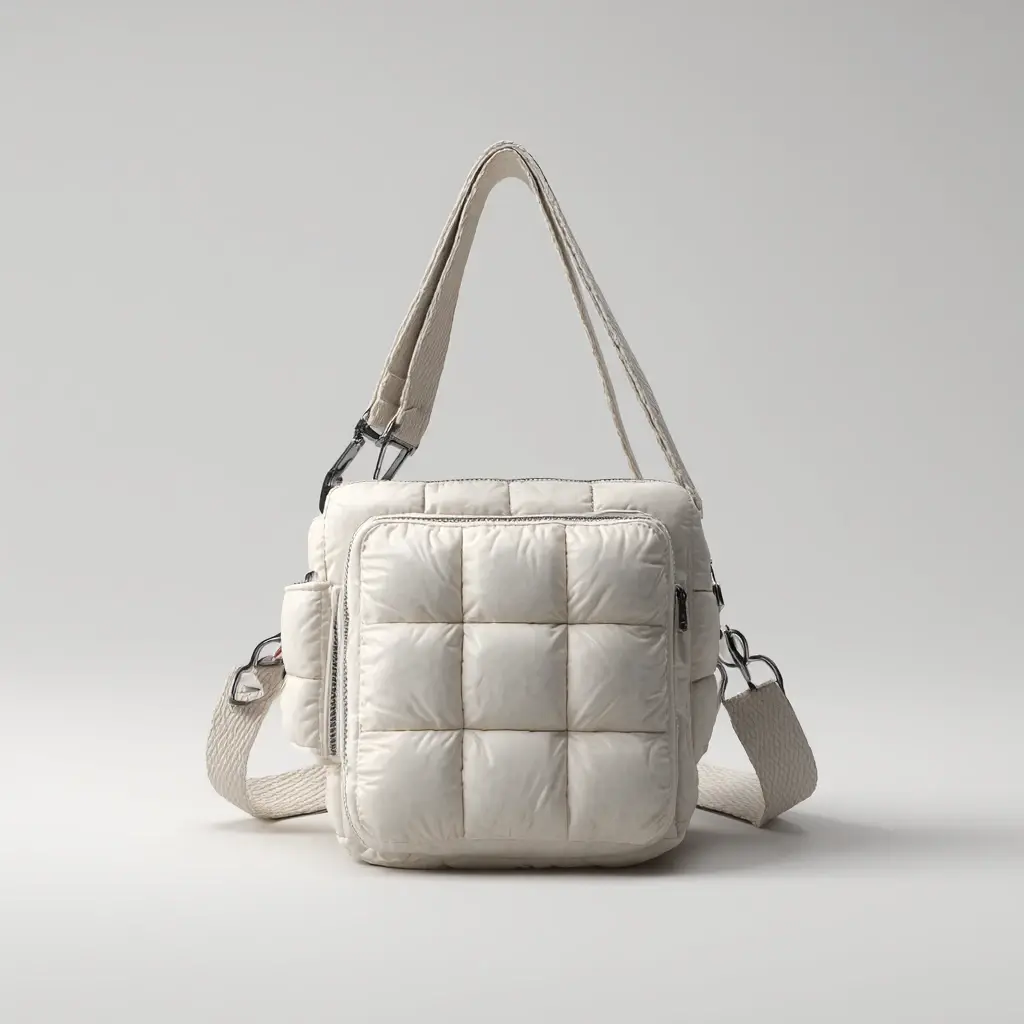
- What a Gender Neutral Bag Costs to Build, Piece by Piece
- The Three Variables That Move That Number
- Why One Strap Costs More in Sampling and Less in Bulk
- Hardware and Colour: Where the Neutral Spec Gets Expensive
- What the Category Costs to Launch at 500 Pieces
- How the Neutral Spec Changes Reorder Economics
- Where Brands Overspend on a Unisex Range
- Which Numbers to Track in Month One
- What to Lock Before the First Sampling Round
What does a gender neutral bag actually cost to build? About USD 15.45 per piece landed FOB Xiamen at 500 pcs per style / colourway, and that figure breaks into seven lines which all behave differently: body material at USD 7.20, hardware at USD 2.40, cut and make at USD 3.10, lining and internals at USD 1.80, packaging at USD 0.60, compliance testing at USD 0.35, and the balance in overhead and inland freight to port. Three variables move the total more than the rest: strap hardware, because a unisex range needs one strap that genuinely fits everybody rather than three sized straps; colourway count, because neutral ranges sell in fewer shades but each shade has to be right first time; and panel count, because a shape that reads as neither feminine nor masculine carries one fewer decorative seam and one more structural one. This page opens up the number line by line, shows what each line buys, and gives the launch arithmetic for a first drop.
The build-up of a USD 15.45 unisex handbag
What a Gender Neutral Bag Costs to Build, Piece by Piece
Start with the number, because every design argument in this category is really a cost argument wearing different clothes. The table below is a working build-up for a medium unisex shoulder bag at 500 pcs per style / colourway, one colourway, FOB Xiamen. It is not a quotation; it is the shape of one, and the shape is what matters, because it tells you which decisions are expensive and which are cheap.
| Cost line | Per piece, USD | What moves it | Typical range |
|---|---|---|---|
| Body material | 7.20 | Fabric weight, coating and recycled content | 5.40-9.80 |
| Hardware | 2.40 | Finish type and whether pulls are branded | 1.60-4.20 |
| Cut and make | 3.10 | Panel count and total seam length | 2.60-4.40 |
| Lining and internals | 1.80 | 210D against brushed tricot | 1.20-2.60 |
| Packaging | 0.60 | Polybag against printed box | 0.28-2.10 |
| Compliance screening | 0.35 | Scope of the REACH and Prop 65 screen | 0.18-0.70 |
| Overhead and inland freight | 0.35 | Order size and consolidation | 0.22-0.55 |
| Total landed FOB Xiamen | 15.45 | Order size and colourway count | 12.80-21.40 |
Two things are worth noticing immediately. First, body material and hardware together are USD 9.60 of the USD 15.45, which means design decisions about fabric and fittings are where the cost actually lives; everything else is rounding by comparison. Second, the spread on those same two lines is far wider than on the rest: material ranges from USD 5.40 to 9.80 and hardware from USD 1.60 to 4.20, so the same bag can be built anywhere between USD 12.80 and USD 21.40 without changing a single seam. That four-dollar band is the entire commercial decision in this category.
The retail side is equally narrow. A unisex bag at USD 15.45 landed supports a realistic retail band of USD 49-89, which is a 3.2 to 5.8 times markup on paper but closer to 2.8 to 3.6 times once marketplace commission, returns handling and a promotional allowance are taken out. Brands that launch this category expecting premium pricing usually end up discounting into the same band anyway, so it is better to design to the band from the start than to design above it and markdown into it.
The Three Variables That Move That Number
Of everything in the build-up, three lines account for most of the variance between one quotation and another. They are worth understanding separately because they respond to different decisions, and because two of the three are decided in the first week of development rather than at the pricing stage.
- Strap hardware, USD 1.60-4.20: a fixed strap is the cheapest option and the wrong one here. A unisex range needs an adjustable strap running 60-130 cm with a slider that does not creep, and a decent slider assembly costs about USD 1.10 more than a riveted strap end.
- Colourway count, 2 or 3 against 6: neutral ranges sell on shade accuracy rather than on shade choice. Three colourways at 500 pcs each is 1,500 pieces; six is 3,000, and the extra three rarely sell enough extra units to justify the working capital.
- Panel count, 6 against 11: a shape carrying one fewer decorative seam and one more structural one costs about USD 0.70-1.10 less to make and, more importantly, holds tolerance better across a run.
The second variable is the one that surprises people. Conventional wisdom says a wider colour offer sells more, and in a fashion-led range it does; in a neutral range it does not, because the shopper is not choosing between shades, she is checking whether the one shade she wants is correct. Black has to be black rather than near-black, olive has to read as olive under store lighting rather than khaki, and stone has to resist showing dirt for at least a season. Getting three shades right is harder and more valuable than offering six approximate ones.
Why One Strap Costs More in Sampling and Less in Bulk
A unisex strap is an engineering problem disguised as a strap. It has to carry a 25 mm webbing width comfortably on a small frame without the slider digging in, and it has to extend far enough to be worn crossbody on a large frame without the adjuster sitting at the very end of its travel. That is a 60-130 cm usable range, tested on both extremes, and it takes a sample round to get right: expect the 6-10 working days of sampling window to be used fully on the first build, and 12-15 working days if the strap is integrated into the body rather than attached with hardware.
- Set the usable adjustment range in the specification: 60 cm minimum, 130 cm maximum, measured end to end including hardware.
- Specify the slider by friction, not by appearance: it must hold position under a 5 kg static pull for 60 seconds without moving more than 3 mm.
- Test at both extremes of the range on the sample, not at the middle setting, which is where every strap passes and where nobody wears it.
- Specify the webbing at 25 mm and 1.4 mm thickness; narrower webbing rolls on the shoulder and thinner webbing creeps in the slider.
- Confirm the strap attachment takes the full load: bar-tacked and tested to 15 kg rather than stitched and tested to 10 kg.
Once the strap is right, it gets cheaper than the alternative. Three sized straps means three sets of hardware, three cutting patterns and three inventory lines, each below an efficient quantity. One engineered strap means one line at 500 pcs or more, one pattern, and one inspection. The saving is not in the unit cost, it is in the complexity that disappears - fewer lines to forecast, fewer components to hold, and a single failure mode to test rather than three.
Hardware and Colour: Where the Neutral Spec Gets Expensive
Neutral ranges push cost into hardware in a way that fashion ranges do not. When a shape is pared back, there is nowhere for a decorative detail to hide a cheap fitting, so the fittings become the visible quality signal and they have to be good. That usually means a plated finish tested to 24 hours of salt spray rather than an untested one, a zipper with a stated cycle life rather than a generic tape, and sliders and D-rings that match in finish across the whole build.
The cost of that discipline is not large: moving from an untested to a tested plating adds about USD 0.40-0.70 per piece, and specifying a named zipper tape adds roughly USD 0.30-0.55. What it buys is a returns profile. Hardware is the second-largest return cause in this category after handle attachment, and a plating failure appears around week ten of daily carry - which is long after the return window has closed at the retail end and well within the window in which a brand's reputation is decided. It is also where compliance bites: nickel release under REACH Annex XVII entry 27, California Prop 65 substances, and CPSIA limits on any item marketed to younger buyers all apply to the fittings specifically.
What the Category Costs to Launch at 500 Pieces
The arithmetic for a first unisex drop is simple once the landed cost is known. Three styles - one shoulder, one tote, one backpack - at 500 pcs per style / colourway in two colourways each is 3,000 units. At USD 15.45 landed that is USD 46,350 in goods. Add sampling at 6-10 working days per style, pre-shipment inspection at AQL 2.5 under ISO 2859-1, and inland freight to port, and the programme lands somewhere near USD 49,000 before any marketing spend.
| Line | Amount | Note |
|---|---|---|
| Goods, 3,000 units at USD 15.45 | USD 46,350 | Two colourways per style, 500 pcs each |
| Sampling, three styles | USD 480-760 | Covers 6-10 working days per style |
| Pre-shipment inspection | USD 220-320 per man-day | AQL 2.5 under ISO 2859-1 |
| Compliance screening | USD 540-1,050 | REACH, Prop 65 and CPSIA scope |
| Freight to port and documentation | USD 610-980 | FOB Xiamen terms |
| Total before marketing | USD 48,200-49,460 | Roughly 16 per cent of retail value |
At a USD 69 average retail that 3,000 units is USD 207,000 of retail value, so the goods represent about 22 per cent and the whole programme about 24 per cent of retail. That is a healthy ratio, and it is the reason a neutral range is attractive to a brand without a large development budget: the range is narrow, the shade count is low, and the shapes are repeatable, so the working capital per style is lower than a fashion-led equivalent for the same number of units. Which shapes are currently clearing the sampling filter for this kind of range is tracked in the emerging silhouette shortlist for next season.
How the Neutral Spec Changes Reorder Economics
Reordering is where a unisex range quietly outperforms a gendered one. Because the shapes are not tied to a season's decorative detail, a reorder twelve months later is a reorder of the same product rather than a development project: the pattern exists, the material is repeatable, and the hardware is a standard line item. The practical effect is that a reorder can be placed in the same 500 pcs per style / colourway quantity without a new sampling round, which removes 6-10 working days and the sample cost from every repeat.
It also changes the shape of the risk. In a fashion range, a reorder decision is a bet on a trend continuing. In a neutral range it is a bet on a replacement cycle continuing, which is a much safer bet and one that can be made on sell-through alone. The gate most brands use is 65 per cent sold in 45 days, and in this category it is worth holding to strictly, because the downside of a slow neutral shape is not a write-off - it is a very slow two-year sell-through that ties up capital without ever failing dramatically.
Where Brands Overspend on a Unisex Range
Four places, and all four are avoidable at specification stage rather than at negotiation stage. They are listed in descending order of how much they cost, because the most expensive one is also the least obvious.
- Branded hardware before volume justifies it: custom pulls and etched sliders carry tooling and minimums that only make sense above about 3,000 units per line. Below that, a standard fitting in a matched finish reads just as well for USD 1.20-1.90 less per piece.
- Premium lining nobody sees: brushed tricot adds roughly USD 0.80 per piece over 210D and is invisible in a closed bag. Spend it on the strap and the handle attachment instead, where failures actually happen.
- Six colourways on a first drop: the extra three colours consume working capital and rarely sell proportionately. Launch on two, prove the shades, widen to three on the reorder.
- Printed rigid packaging at the value tier: a printed box costs USD 1.50-2.10 against USD 0.28-0.45 for a polybag, and a unisex shopper at USD 49-69 does not keep the box.
The common thread is that all four spend money on things the shopper cannot perceive at the point of decision, while the things she does perceive - how the strap sits, whether the handle is attached convincingly, whether the zipper runs - are the cheapest lines on the build-up. Getting that inversion right is most of what separates a profitable neutral range from an unprofitable one. Buyers arrive with their own checklist as well, and the documentation buyers now expect on an eco range covers that side in detail.
Which Numbers to Track in Month One
A launch generates a lot of data and most of it is noise. Four numbers are worth tracking weekly for the first month, because each one maps to a decision you can still make rather than one you can only explain afterwards.
- Sell-through at stock keeping unit level, not style level: a style selling 60 per cent overall can hide a colourway at 30 per cent and another at 90 per cent, and only the split tells you what to reorder.
- Return rate by stated reason: anything above 8 per cent in month one points at a specification problem rather than at demand, and the reason field tells you which line to fix.
- Strap adjustment complaints specifically: in a unisex range this is the category-specific signal. Above about 2 per cent of units it means the 60-130 cm range or the slider friction is wrong.
- Colour accuracy complaints: if shoppers say the olive reads khaki, the shade is wrong, and no amount of photography correction will fix it before the reorder.
Track those four and ignore everything else until the second month. Sell-through tells you what to reorder, return reason tells you what to re-specify, and the two category-specific signals tell you whether the neutral proposition itself is working. A range that passes all four by week six is ready to widen from two colourways to three; one that fails either of the last two needs a specification change before it needs more units.
What to Lock Before the First Sampling Round
The cheapest moment to change a specification is before it is written down, and the second cheapest is during sampling. Everything after that is a negotiation. So the first sampling round should not begin until six things are fixed: the usable strap range, the slider friction requirement, the colourway list with a physical shade reference for each, the panel count, the hardware finish and its test requirement, and the compliance scope.
That list is short on purpose. It is the set of decisions that cannot be made later without cost, and everything else - packaging artwork, swing tag copy, internal pocket layout - can be changed during the 35-50 day bulk window at little or no penalty. Brands that lock the wrong things early and the right things late are the ones that spend the season re-sampling. Every unit described here is produced by our validated partner factory Quanzhou Yingming Bags, running export programmes since 2014 across 7 production lines and about 200,000 pcs per month, and the sequencing from sampling through to inspection is set out in the private label handbag programme overview.
Get a Quote → /contact-quote/ — send the styles, the colourway list and the target retail band, and the team will return a line-by-line landed cost, a sampling date and a bulk delivery date.
Frequently Asked Questions
How much does a gender neutral bag cost to produce?
About USD 15.45 per piece landed FOB Xiamen at 500 pcs per style / colourway, broken into body material at USD 7.20, hardware at USD 2.40, cut and make at USD 3.10, lining at USD 1.80, packaging at USD 0.60 and compliance at USD 0.35.
Why is a unisex strap more expensive than a standard strap?
Because it has to span 60-130 cm and hold position under load at both extremes, which requires a quality slider assembly costing about USD 1.10 more than a riveted strap end, plus a dedicated sample round to tune the friction. That is why the first build typically uses the full 6-10 working day window.
How many colourways should a neutral range launch with?
Two, widening to three on the reorder. Neutral ranges sell on shade accuracy rather than on shade choice, so two correct shades consistently outperform six approximate ones while consuming roughly a third of the working capital and considerably less forecasting risk. Launch narrow, prove the shades, then widen on the reorder.
What retail price suits a gender neutral handbag?
USD 49-89 is the realistic band for a bag landing at USD 15.45. That is 3.2 to 5.8 times landed on paper, but closer to 2.8 to 3.6 times once commission, returns handling and promotional allowance are deducted, so designing above the band just means discounting into it.
What is the minimum order for a unisex handbag range?
500 pcs per style / colourway. A three-style launch in two colourways each is therefore 3,000 units, roughly USD 46,350 in goods and about USD 49,000 in total programme cost once sampling, pre-shipment inspection at AQL 2.5 under ISO 2859-1 and freight are added.
How long does it take to develop a unisex bag style?
Sampling runs 6-10 working days, or 12-15 working days where the strap is integrated into the body, and bulk production runs 35-50 days FOB Xiamen. Reorders of an unchanged shape skip the sampling round entirely, which removes the cost and the delay from every repeat.
Where do brands waste money on a unisex range?
Most often on branded hardware below 3,000 units per line, brushed tricot lining nobody sees, six colourways on a first drop, and printed rigid packaging at the value tier. All four are invisible at the point of purchase, while strap comfort and handle attachment remain cheap.
Which hardware test matters most on a neutral bag?
A 24-hour salt spray test on the plating, because a pared-back shape has nowhere to hide a cheap fitting. Plating failure appears around week ten of daily carry, long after the retail return window closes, and a named zipper tape with a stated cycle life matters nearly as much.
What return rate is acceptable for a new unisex range?
Below 8 per cent in month one. Above that the problem is usually a specification issue rather than demand, and the stated reason field tells you which cost line to fix. Track it weekly, split by reason, and treat any single reason above 3 per cent as actionable.
How do you know if a unisex shape is working badly?
Watch strap adjustment complaints specifically. Above about 2 per cent of units it means the 60-130 cm range or the slider friction is wrong, and it is a category-specific signal no general sell-through number reveals. Colour accuracy complaints are the second signal, pointing at the shade.
Do compliance rules apply differently to unisex bags?
No, they apply identically. REACH Annex XVII entry 27 on nickel release, California Prop 65 substances and CPSIA limits all bite hardest on the fittings, which is why hardware should be specified with a test requirement. Screening costs about USD 0.35 per piece, which is trivial against a recall or a delisting.
People Also Ask
Are gender neutral bags a growing category?
Yes. The category grows because neutral shapes are bought on replacement logic rather than on trend, so they reorder without a new development round and hold a narrow colour offer that needs less working capital per style.
What makes a handbag unisex?
A 60-130 cm adjustable strap that genuinely fits both extremes, a reduced panel count with structural rather than decorative seams, and a narrow shade range where each colour is accurate rather than numerous.
How much should a unisex tote cost to make?
Around USD 15.45 landed FOB Xiamen at 500 pcs, with body material and hardware accounting for USD 9.60 of that. The same bag can be built between USD 12.80 and USD 21.40 without changing a single seam.
Is a unisex range cheaper to run than a gendered one?
Usually yes, because a reorder twelve months later repeats the same product instead of starting development. That removes 6-10 working days and the sample cost from every repeat order on the range.
Sources and further reading
Every figure on this page is either our own programme data or attributed below. Open the originals before you write them into a specification.
- REACH — chemical substances regulationEuropean Commission Annex XVII restricts the substances that may appear in finished leather and coatings.
- Proposition 65 list of chemicalsOEHHA The official list that decides whether a California warning is required.
- FashionUnited — fashion industry news and dataFashionUnited Industry news and company data for the fashion sector.