Best Budget Friendly Bag Trends for 2026 Boutique Buyers
What are the budget friendly bag trends actually worth stocking in 2026? Twelve shapes, all landing between USD 9.20 and USD 16.80 per piece FOB Xiamen and retailing between USD 29 and USD 79, and the ones that work share a property that has nothing to do with price: they look considered rather than cheap. That distinction is physical rather than stylistic. A value bag reads as cheap when its strap is too narrow for the body, its lining too light for the load and its hardware too light for its size, and it reads as considered when those three are right even at a lower material cost. Boutique buyers who get it right run a 3.1-4.2 times markup on a 500 pcs per style / colourway drop and clear 68 per cent of it inside eight weeks; buyers who get it wrong are discounting at 30 per cent by week twelve. This page answers the nine questions a buyer really asks, in the order they tend to get asked.
- What Counts as Budget Friendly in 2026?
- Which Shapes Give the Most Margin Under USD 79?
- How Do You Keep a Low Price From Looking Cheap?
- Where Does the Money Actually Go at This Price?
- How Many Units Should a Boutique Commit On the First Drop?
- What Sells Out First and What Sits?
- How Do You Reorder Without Over-Buying?
- Which Details Can Be Cut and Which Cannot?
- What Should a Buyer Check Before Signing Off a Sample?
What are the budget friendly bag trends actually worth stocking in 2026? Twelve shapes, all landing between USD 9.20 and USD 16.80 per piece FOB Xiamen and retailing between USD 29 and USD 79, and the ones that work share a property that has nothing to do with price: they look considered rather than cheap. That distinction is physical rather than stylistic. A value bag reads as cheap when its strap is too narrow for the body, its lining too light for the load and its hardware too light for its size, and it reads as considered when those three are right even at a lower material cost. Boutique buyers who get it right run a 3.1-4.2 times markup on a 500 pcs per style / colourway drop and clear 68 per cent of it inside eight weeks; buyers who get it wrong are discounting at 30 per cent by week twelve. This page answers the nine questions a buyer really asks, in the order they tend to get asked.
The value-tier arithmetic for 2026
What Counts as Budget Friendly in 2026?
Budget friendly is a band, not a mood, and in 2026 the band has moved. Two tiers now matter to boutique buyers: an opening tier at USD 29-49 retail on a landed cost of USD 9.20-12.60, and a working tier at USD 49-79 on a landed cost of USD 12.60-16.80. Below USD 29 the specification cannot be defended at a 500-piece minimum and the returns will cost more than the margin; above USD 79 the shopper starts comparing against branded product and the value proposition stops being about value.
The band also carries a margin structure, and understanding it is what separates a profitable value range from a busy one. Both tiers support a 3.1-4.2 times markup on landed cost, which is higher than the 2.6-3.4 times available at mid-tier price points, because the shopper at USD 39 is not comparing against much. That higher markup is the compensation for a thinner specification, and it only survives if the returns stay low - which brings us to the question that actually decides everything at this price. It is also why why the handbag ticket compresses in a soft year matters more to a value range than to any other band.
Which Shapes Give the Most Margin Under USD 79?
Twelve shapes work in the band, and they are not evenly profitable. The table below ranks them by what is left after returns and markdown rather than by headline markup, because at this price the two diverge sharply: a shape returning at 11 per cent can wipe out the margin advantage the band was supposed to deliver.
| Shape | Landed cost | Retail | Typical return rate | Verdict |
|---|---|---|---|---|
| Flat sling | USD 9.20-11.40 | USD 29-45 | 4-6 per cent | Best opener; lowest risk in the band |
| Mini backpack | USD 12.60-15.20 | USD 45-69 | 5-7 per cent | Strong second buy; commuter and student |
| Basic tote, open top | USD 10.80-13.60 | USD 39-59 | 4-7 per cent | Highest volume; watch handle attachment |
| Crossbody, webbing strap | USD 11.20-14.40 | USD 39-59 | 5-8 per cent | Reliable; the safest gift-tier shape |
| Shoulder, single compartment | USD 12.40-15.80 | USD 49-69 | 6-9 per cent | Good margin; needs a decent lining |
| Bucket, drawcord | USD 11.60-14.80 | USD 45-65 | 7-10 per cent | Seasonal; do not over-commit |
| Half-moon shoulder | USD 13.20-16.80 | USD 55-79 | 6-9 per cent | Fashion-forward; two colourways only |
| East-west tote | USD 12.80-16.20 | USD 49-79 | 6-9 per cent | Photographs well; good for marketplaces |
| Sling with outer pocket | USD 10.40-13.20 | USD 35-55 | 5-7 per cent | Adds function at almost no cost |
| Fold-over shoulder | USD 12.20-15.60 | USD 45-69 | 7-11 per cent | Closure wear is the failure point |
| Structured mini top-handle | USD 14.60-16.80 | USD 59-79 | 8-11 per cent | Occasion only; keep the drop small |
| Quilted shoulder | USD 13.80-16.80 | USD 55-79 | 8-12 per cent | Highest return risk in the band |
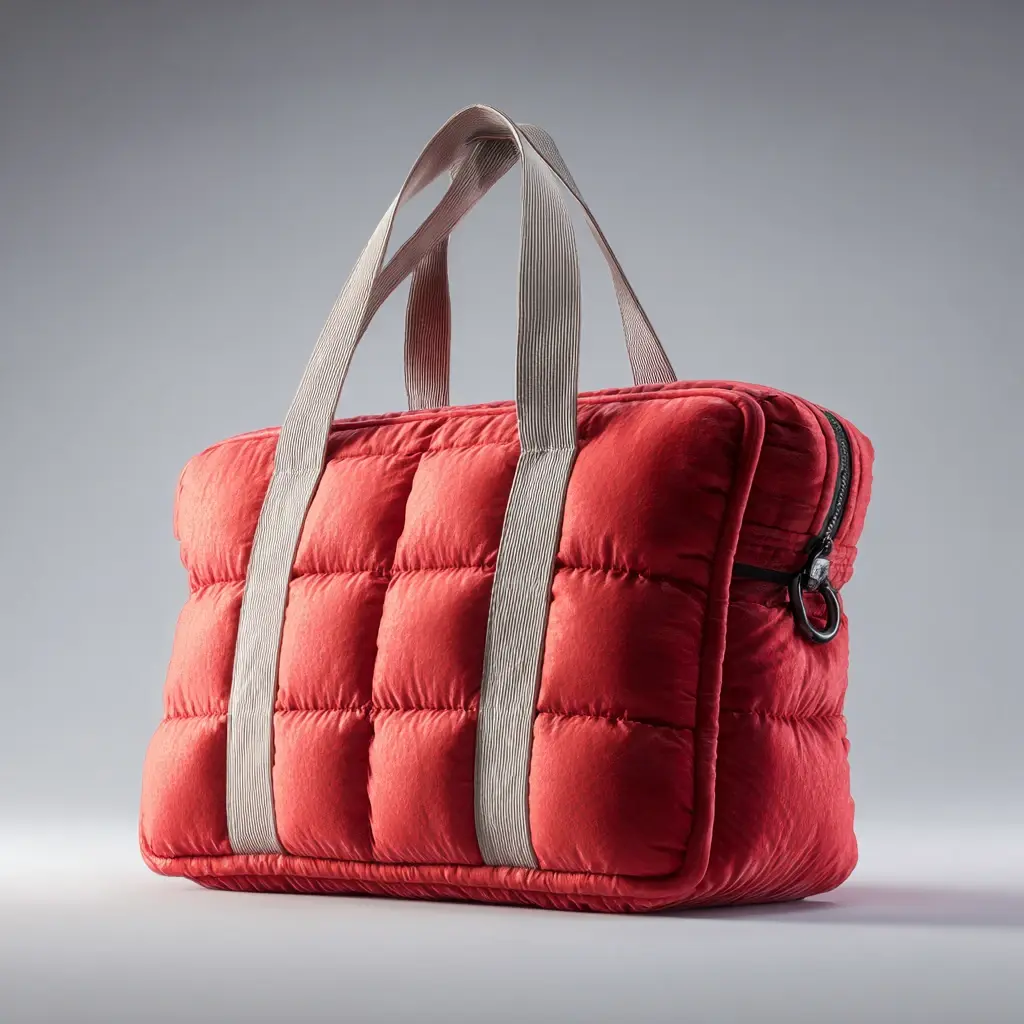
The bottom three rows are where boutique buyers lose money. Quilted construction at this price tends to fail at the seam intersections, fold-over closures wear at the fastening within about ten weeks, and a structured mini top-handle needs an interlining that costs more than the band comfortably allows. None of the three should be dropped entirely - they earn shelf credibility - but each should be ordered at 500 pcs in one colourway rather than at depth.
How Do You Keep a Low Price From Looking Cheap?
Three physical decisions, and they cost very little. The first is strap width: a body wider than 28 cm should carry a strap of at least 18 mm, because narrower webbing looks like a sample and rolls on the shoulder. The second is lining weight: 210D is the floor, and anything lighter shows the seam allowance through the body within weeks. The third is hardware weight relative to size - a zipper that is too light for the bag is the single most visible cheapness signal at this price, because the shopper feels it in the pull.
- Strap width: 18 mm minimum on any body over 28 cm wide; 25 mm where the bag is carried loaded.
- Lining: 210D minimum, with a seam allowance of at least 8 mm so it does not tear at the stitch line.
- Zipper: a #5 tape on any opening longer than 30 cm; a #3 on a large bag reads as under-specified immediately.
- Edge finishing: two thin coats rather than one thick one, because a thick coat cracks at the fold in cold weather.
- Base: a flat base panel or two side stays, because a bag that will not stand up looks cheap however good the material is.
All five together add roughly USD 0.90-1.60 per piece over the cheapest possible build. On a bag landing at USD 11.40 and retailing at USD 39, that is about 4 per cent of landed cost and roughly 3 per cent of retail, and it is the difference between a shape that sells at full price and one that needs a 30 per cent markdown by week twelve. There is no better ratio anywhere in a value-tier range.
Where Does the Money Actually Go at This Price?
Buyers assume a value bag is mostly labour, and it is not. At USD 11.40 landed, material is typically USD 5.10-6.40, hardware USD 1.40-2.10, cut and make USD 2.40-3.20, lining and internals USD 0.90-1.40, packaging USD 0.28-0.45 and compliance screening USD 0.18-0.35. Material and hardware together are therefore about 62-70 per cent of the cost, which means the two decisions that matter most at this price are what the body is made of and what the fittings are.
This is also why the cheapest quotation is usually wrong in a specific way. A quotation that comes in USD 1.20 below the rest of the market has almost always come from the hardware line and the lining line, because those are the two a buyer does not see on a sample photograph - and they are the two that produce returns in weeks six to ten. A buyer comparing quotations should ask for the hardware specification and the lining weight in writing, because that is where the difference lives.
How Many Units Should a Boutique Commit On the First Drop?
Five hundred pieces per style / colourway is the minimum and, for a first drop, the right number. It is tempting to split that across more styles, and it is a mistake: two styles at 250 pcs each do not read demand reliably and do not schedule efficiently, so the resulting data is noise and the resulting cost is higher per unit. One style at 500 pcs in two colourways gives a clean read and an efficient run.
- Pick four shapes for a first season, not twelve: one sling, one tote, one crossbody and one backpack covers the opening and working tiers without spreading the buy.
- Two colourways each: one core shade and one accent, at 500 pcs per style / colourway, which is 4,000 units across the four shapes.
- Set the gate before the drop lands: 68 per cent sold in eight weeks, measured per stock keeping unit.
- Budget the downside explicitly: if the gate fails, the plan is a 30 per cent markdown in week twelve, and the margin has to survive that.
- Leave one shape untested: hold a fifth in reserve so a clear winner has something to be widened into.
Step five is unusual and worth defending. Most first-season plans allocate everything up front and then have no capacity left when one shape clearly outperforms. Reserving a fifth slot costs nothing - it is an intention, not a commitment - and it is the difference between being able to act on a winner and watching it sell out.
What Sells Out First and What Sits?
Across a value range the pattern is consistent enough to plan against, and it is not the pattern buyers expect. What sells out first is the plainest version of the most useful shape at the lower price: a flat sling at USD 29-39, an open tote at USD 39-49, a webbing crossbody at USD 39-59. What sits is the decorated version of the same thing at the higher end of the band, because at this price the shopper is not paying for decoration.
- Sells first: black, then tan, then chocolate; a core shade in a plain shape at the lower end of the band.
- Sells second: the same shapes in an accent shade, roughly three to five weeks later and in smaller quantities.
- Sits longest: quilted and structured shapes above USD 59, novelty hardware, and any shape whose interest is a surface treatment.
- Sits forever: the fourth colourway. Three shades is right for a value range; a fourth almost never earns its inventory.
The last row is the one that costs boutique buyers the most, because it is the easiest to argue for. A fourth colourway feels like a small addition - one more line on the order - and it is not: it is another 500 pcs of inventory in the shade least likely to sell, occupying the working capital that should have gone into a second drop of the black one. If a range needs a fourth shade, the honest answer is usually that it needs a fourth shape instead.
How Do You Reorder Without Over-Buying?
Reordering a value range is easier than reordering a fashion range, because the shape has not changed and the 6-10 working days of sampling window does not apply again. That advantage is also the risk: with no sampling delay and no new development, the temptation is to reorder everything that sold at all. The discipline is to reorder on rate rather than on volume - a shape that sold 400 of 500 in eight weeks is a very different proposition from one that sold 340 of 500 over sixteen.
The working rule is a rate threshold rather than a quantity one. Reorder at 500 pcs where sell-through hit 68 per cent inside eight weeks; reorder at nothing at all where it took sixteen weeks to reach the same number. That second shape is not a slow seller in the ordinary sense - it is a shape the shopper will buy eventually but will not seek out, and a second drop of it will sit for a season. Reorder size stays at 500 pcs rather than growing, because at this price the objective is turnover rather than depth.
Which Details Can Be Cut and Which Cannot?
Every value-tier build involves cuts, and the question is never whether to cut but where. The answer is consistent: cut what the shopper cannot perceive before she buys, and never cut what she will perceive after. That sounds obvious and is violated constantly, because the invisible items are the ones a buyer sees on a specification sheet and the visible ones are the ones she sees in a photograph.
| Line | Cut or protect | Saving or cost | Reason |
|---|---|---|---|
| Printed lining | Cut | Saves USD 0.55-0.80 | Invisible in a closed bag |
| Rigid printed box | Cut | Saves USD 1.50-2.10 | Discarded on day one |
| Branded zipper pull | Cut below 3,000 units | Saves USD 0.60-1.10 | Tooling minimums dominate |
| Fourth colourway | Cut | Saves 500 pcs of inventory | The worst-returning shade |
| Strap width | Protect at 18 mm | Costs USD 0.20-0.35 | Narrow webbing reads as cheap |
| Lining weight | Protect at 210D | Costs USD 0.30-0.50 | Lighter lining tears at the seam |
| Handle attachment | Protect at 15 kg | Costs USD 0.15-0.30 | The largest return cause |
| Pre-shipment inspection | Protect at AQL 2.5 | USD 220-320 per man-day | Cheaper than any re-sort |
The bottom four rows cost about USD 0.85-1.35 per piece in total and protect against the four failure modes that account for most returns in this band. Set against the top four rows, which save roughly USD 2.65-4.00, the net is a cheaper bag that does not look or fail like one - which is the entire objective.
What Should a Buyer Check Before Signing Off a Sample?
Sample approval is the last cheap moment in the whole process, and most buyers approve on appearance. Six checks take about twenty minutes and catch most of what will otherwise be discovered by customers in week six. They are listed in the order a buyer would naturally handle the sample, so they can be worked through without a checklist in hand.
- Load it: put 3 kg in the bag, hang it on a door handle for an hour, then check the handle attachment and the strap for any movement.
- Pull the zipper twenty times: not twice. A zipper that catches on the twentieth pull will catch on the hundredth too.
- Turn the lining out: check the seam allowance is at least 8 mm and that the stitch line does not run off the edge anywhere.
- Fold an edge: fold a strap or a flap hard and look for cracking in the edge coating, which is the cold-weather failure.
- Measure the strap: confirm the usable range, not the nominal one, and check the slider does not creep under a 5 kg pull.
- Smell it: a strong solvent odour at sample stage will still be there at goods-in and is a REACH and Prop 65 risk.
Those six checks sit inside the 6-10 working days of sampling window and cost nothing beyond attention. Everything after them costs more: bulk production runs 35-50 days, inspection at AQL 2.5 under ISO 2859-1 confirms the units match the approved sample rather than confirming the sample was right, and a failure discovered by a customer costs USD 8-14 per unit to process. Every unit described here is produced by our validated partner factory Quanzhou Yingming Bags, running export programmes since 2014 across 7 production lines and about 200,000 pcs per month. The full sequence is set out in the private label handbag programme overview, and which shapes are clearing the sampling filter is worth reading before the four shapes are chosen.
Get a Quote → /contact-quote/ — send the four shapes you want and the retail band, and the team will return a landed cost per piece, a sampling date and a bulk delivery date.
Frequently Asked Questions
What is a realistic landed cost for a budget friendly handbag?
USD 9.20-16.80 per piece FOB Xiamen, supporting a retail band of USD 29-79 at a 3.1-4.2 times markup. Below USD 9.20 the specification cannot be defended at a 500-piece minimum and returns cost more than the margin. Below that floor, returns cost more than the margin the band was supposed to deliver.
Which value shapes have the lowest return rates?
Flat sling at 4-6 per cent, open tote and mini backpack at 4-7 per cent, and webbing crossbody at 5-8 per cent. Quilted shoulder and structured mini top-handle run 8-12 per cent and should be ordered in one colourway only. Order the two riskier shapes at 500 pcs in one colourway and no more than that.
How do you stop a cheap bag from looking cheap?
Three physical decisions: an 18 mm minimum strap width on any body over 28 cm, a 210D minimum lining with an 8 mm seam allowance, and a zipper heavy enough for the opening. Together they add roughly USD 0.90-1.60 per piece. On a bag landing at USD 11.40, that is roughly 4 per cent of landed cost and about 3 per cent of retail.
How many units should a boutique order on a first drop?
500 pcs per style / colourway, across four shapes in two colourways each. Splitting the same quantity across more styles produces unreliable demand data and a higher unit cost, so depth beats breadth at this price. Depth on one style gives a clean read; breadth across many gives noise and a higher unit cost.
What sell-through rate justifies a reorder at this price?
Sixty-eight per cent sold within eight weeks, measured per stock keeping unit. A shape reaching the same number over sixteen weeks should not be reordered at all, because the shopper will buy it eventually but will not seek it out. Reorder size stays at 500 pcs rather than growing, because the objective here is turnover rather than depth.
Which colourways sell best in a value range?
Black first, then tan, then chocolate. A fourth colourway almost never earns its inventory and consumes working capital that should have gone into a second drop of the black one instead. If a range genuinely needs a fourth shade, the honest answer is usually that it needs a fourth shape instead.
What can be cut from a value handbag specification?
Printed lining, a rigid printed box, branded zipper pulls below 3,000 units and any fourth colourway. Those four save roughly USD 2.65-4.00 per piece and are all invisible at the point of purchase decision. All four are invisible at the point of purchase, which is exactly why they are the right things to remove.
What must never be cut from a value handbag specification?
Strap width at 18 mm, lining at 210D, handle attachment tested to 15 kg, and pre-shipment inspection at AQL 2.5. Those four cost about USD 0.85-1.35 per piece and protect against the main return causes. Those four protect against the failure modes that account for most returns anywhere in this price band.
How long does a value-tier handbag order take?
Sampling runs 6-10 working days and bulk production runs 35-50 days FOB Xiamen. A reorder of an unchanged shape skips the sampling round entirely, which is the main scheduling advantage of staying in this band. Skipping the sampling round is the main scheduling advantage of staying inside the value band for reorders.
Why is the cheapest quotation usually wrong?
Because the saving almost always comes from the hardware line and the lining line, the two a buyer cannot see in a sample photograph and the two that generate returns in weeks six to ten. Always ask for both in writing. A written hardware specification and lining weight are worth more than any price comparison table can show you.
Should a boutique stock structured or quilted shapes at this price?
In small quantities only. Both carry 8-12 per cent return rates because the interlining and the seam intersections are where a value build fails, so keep each to 500 pcs in one colourway for shelf credibility. Both earn shelf credibility, but neither should be ordered at depth in a value-tier range at any point.
People Also Ask
What handbag price point sells best in boutiques?
USD 29-79, on a landed cost of USD 9.20-16.80. Two tiers matter: an opening tier at USD 29-49 and a working tier at USD 49-79, both supporting a 3.1-4.2 times markup.
How do boutiques choose which bag shapes to stock?
Rank by what survives returns rather than by headline markup, pick four shapes to start - sling, tote, crossbody, backpack - and hold a fifth slot in reserve for a clear winner to widen into.
Are cheap handbags worth stocking?
Yes, if the invisible items are cut and the visible ones protected. Cutting printed lining and rigid boxes while protecting strap width, lining weight and handle attachment produces a cheaper bag that neither looks nor fails like one.
What is the minimum order for budget friendly handbags?
500 pcs per style / colourway. A four-shape first season in two colourways each is 4,000 units, which gives a clean demand read per stock keeping unit and an efficient production run.
Sources and further reading
Every figure on this page is either our own programme data or attributed below. Open the originals before you write them into a specification.
- Accessories Council — accessories industry bodyAccessories Council Accessories industry body tracking handbag category direction.
- FashionUnited — fashion industry news and dataFashionUnited Industry news and company data for the fashion sector.
- China Briefing trade and manufacturing analysisChina Briefing Trade, tax and compliance analysis for sourcing from China.