Handbag MOQ Explained: Why 500 Pieces Is the Practical Floor
Why is 500 pieces the practical minimum for a private label handbag? Because four costs are fixed no matter how many units are made: the dye or coating lot, the trimming and hardware lots, the plating bath and the line changeover. Below roughly 500 units those four dominate the unit price — one programme quoted 120 pieces at USD 26.80 per unit against USD 15.40 at 500 and USD 13.90 at 2,000, and the difference was not profit, it was spread. The floor is therefore an arithmetic threshold rather than a policy, and the answer to it is usually a test with stock followed by a 500-piece return with evidence.
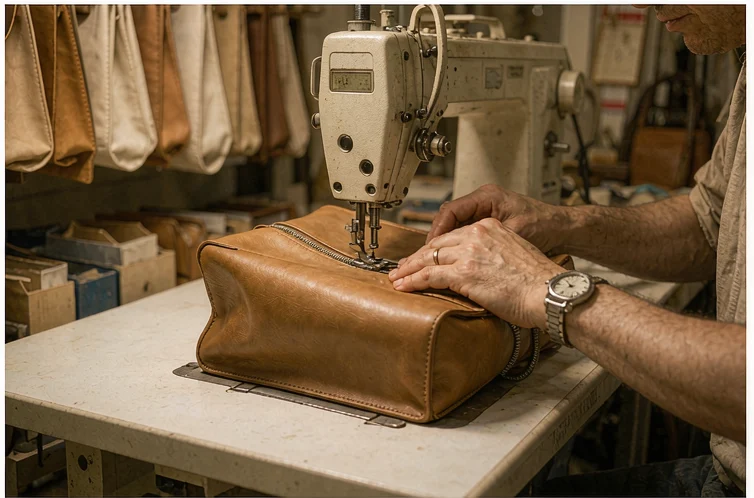
- One Hundred and Twenty Pieces, Quoted Three Ways
- What the Fixed Costs Actually Are
- Why Each Colourway Is Its Own Run
- The Price Curve at 500, 1,000 and 2,000
- Four Ways to Reach 500 Without Overbuying
- When a Lower Minimum Is Genuinely Available
- What to Ask Before Accepting a Low Minimum
- The Repeat Order: Why the Floor Stops Mattering
Why is 500 pieces the practical minimum for a private label handbag? Because four costs are fixed no matter how many units are made: the dye or coating lot, the trimming and hardware lots, the plating bath and the line changeover. Below roughly 500 units those four dominate the unit price — one programme quoted 120 pieces at USD 26.80 per unit against USD 15.40 at 500 and USD 13.90 at 2,000, and the difference was not profit, it was spread. The floor is therefore an arithmetic threshold rather than a policy, and the answer to it is usually a test with stock followed by a 500-piece return with evidence.
The minimum, in numbers
One Hundred and Twenty Pieces, Quoted Three Ways
A direct-to-consumer label in Melbourne asked for 120 units of a waxed canvas sling for a winter capsule, in one colourway, with a branded brass plate. The brief was good: dimensioned drawing, material specified, target retail price stated. The quotation came back at USD 26.80 per unit, roughly USD 8 above the ceiling the range could carry. The same specification came back at USD 15.40 at 500 pieces and USD 13.90 at 2,000.
Nothing about the bag changed between those three numbers. Same canvas, same lining, same plate, same stitch density, same line. What changed was the divisor. The dye lot for the canvas, the plating bath for the brass plate, the zip chain minimum and the 45-90 minutes of line changeover each cost what they cost, and at 120 units they were divided by 120 rather than by 500.
The label went another way: a stock test of 60 units in a near-identical silhouette, priced to learn rather than to earn, followed by a 500-piece return in two colourways once sell-through data existed. The second order landed inside the target margin and, more usefully, arrived with knowledge of which colour sold. The 120-piece version would have been both more expensive per unit and less informed.
What the Fixed Costs Actually Are
Four costs sit above the unit and do not scale down with it. Understanding them individually matters, because each has a different workaround and a generic request for a lower minimum addresses none of them.
| Fixed cost | What it is | Why it does not scale down |
|---|---|---|
| Dye or coating lot | A minimum run of coloured material | The lot is produced at a set quantity whether 120 or 500 bags are cut from it |
| Trimming and hardware lots | Zip chain, webbing, closures, feet | Supplied in set lot sizes, typically hundreds of metres or pieces |
| Plating bath | The chemical bath for branded metal parts | Costs the same for 300 or 3,000 pieces; the bath is filled either way |
| Line changeover | Setting jigs, thread, tension and stations | 45-90 minutes per pattern, spread across however many units follow |
There is a fifth that is semi-fixed and often forgotten: the marker. Cutting yield improves when more units allow a better layout, and on a tote panel set a 5 percent yield improvement is worth more per unit than most negotiation. At 120 units there is no incentive to re-work the marker; at 500 there is.
Why Each Colourway Is Its Own Run
The most common misunderstanding of the minimum is that 500 pieces covers a style. It does not: it is 500 per style and per colourway, because each colourway is a separate dye or coating lot with its own minimum. Two colours of one style is therefore 1,000 pieces, not 500 split in half, and three colours is 1,500.
- One style, one colourway: 500. The standard first order, and the cheapest way to test a silhouette.
- One style, two colourways: 1,000. Each colour is its own lot, each with the same minimum.
- Three styles, one colourway: 1,500. Three pattern setups, one material buy, one set of branding tooling.
- Two styles, two colourways: 2,000. Four lots; this is where most second-season programmes land.
The practical guidance follows from that arithmetic. Launch with one colourway per style and add the second on the repeat, when sell-through data says which one earned it. A brand that launches three styles in two colours has committed to 3,000 pieces before knowing whether any of them sells, and the capital tied up in the wrong colourway is the most common reason a second season never happens.
The Price Curve at 500, 1,000 and 2,000
Unit price does not fall linearly; it falls steeply to about 500 and then flattens. That shape is the whole argument for the floor. The steep part is the fixed costs being spread; the flat part after it is genuine volume leverage on materials, and it is much smaller than most buyers expect.
| Quantity | Unit price | Improvement vs previous tier |
|---|---|---|
| 120 | USD 26.80 | Baseline |
| 500 | USD 15.40 | 43 percent better |
| 1,000 | USD 14.60 | 5 percent better |
| 2,000 | USD 13.90 | 5 percent better |
| 5,000 | USD 13.20 | 5 percent better |
The lesson is that the jump from 120 to 500 is worth chasing and the jump from 2,000 to 5,000 usually is not. Going from 2,000 to 5,000 saves 5 percent per unit and ties up two and a half times the capital, plus the carrying cost of inventory that may not sell for a year. The right quantity is the one that clears, not the one with the lowest unit price. Phasing is covered in the order phasing guide.
Four Ways to Reach 500 Without Overbuying
Most brands that cannot sell 500 of one colourway can still reach the floor, and four routes do it without sitting on dead stock. Each trades something — variety, exclusivity, or time — for the spread that makes the unit price work.
- One style, one colourway, 500 units. Concentrate the whole buy on the single silhouette most likely to sell. Least variety, best price.
- Three styles, one colourway, 500 each. Reads as a line, shares one material buy and one set of branding tooling; total 1,500.
- Two colourways of a proven style at 500 each. Only after sell-through data exists; total 1,000 on evidence rather than on hope.
- Test with stock at 60-150 units, then return at 500. Priced to learn rather than to earn, and the second order arrives informed.
The fourth route deserves a caution: a stock test should be short and deliberate, with a written end date and a defined question. A brand that tests for two seasons has not tested anything; it has avoided the decision. Sixty to 150 units over eight to ten weeks answers whether a silhouette and a price band work, which is exactly the evidence the 500-piece order needs.
When a Lower Minimum Is Genuinely Available
Lower minimums do exist, and they are legitimate in three situations. Understanding which one is being offered tells a buyer what they are actually buying, because a lower minimum is always paid for somewhere.
- Stock or near-stock silhouettes. An existing pattern with an existing material, branded. No dye lot, no new tooling, no pattern development; 200-300 is realistic.
- Shared material runs. A colourway that another programme is already running, so the lot minimum is met across two buyers.
- Simplified specification. No branded hardware, stock lining, standard zip. Removing the plating bath removes one of the four fixed costs entirely.
Note what the three have in common: each removes a fixed cost rather than arguing with it. A minimum offered below 500 without any of those three applying is worth examining closely, because the cost has not disappeared — it has usually been moved into the unit price, into a tooling charge, or into a material substitution that will appear in the second order.

What to Ask Before Accepting a Low Minimum
Five questions, and the answers should all be documents or numbers. A low minimum is not a favour and should not be treated as one; it is a commercial arrangement with terms, and the terms are what a buyer should read before committing.
- What is the unit price at 120, 500 and 1,000? Ask for all three in one quotation, so the shape of the curve is visible.
- Is the material the specified one, or a substitute? A lower minimum paired with a lighter lining or a thinner interlining is not a lower cost.
- Is branded hardware included or excluded? Removing the plating bath is a legitimate saving; quietly removing the branded plate is not.
- What happens to the price on the repeat? A low first price that resets upward at 500 is a different offer from one that holds.
- Is inspection still at AQL 2.5? A smaller run still needs a standard, and ISO 2859-1 sets the sample size from the lot size.
The last one is frequently skipped. A 120-piece lot sits at code letter F under general inspection level II, meaning 20 units are drawn at AQL 2.5 with one defect accepted and two rejected. That is a workable inspection, but only if it is in the purchase order; a small run inspected by looking at three bags has no standard at all.
The Repeat Order: Why the Floor Stops Mattering
The minimum matters most on the first order and progressively less afterwards, because a recorded programme removes three of the four fixed costs on the repeat. The pattern exists, so there is no development. The tooling is paid for and retained, so it amortises a second time. The dye lot reference exists, so colour matching restarts from a standard rather than from three lab dips.
- No pattern development. The pattern is stored, so sampling can often be skipped entirely, removing 6-10 working days.
- Retained tooling. The embossing die and any hardware mould are already paid for, which lowers the unit price.
- Recorded colour reference. The approved swatch and lot number mean colour work restarts from a standard.
- Reserved capacity. Above roughly 5,000 pieces across a season, a slot on 7 production lines can be held and a price held for the season.
That is the practical answer to the minimum: it is a gate to pass once, and passing it well leaves assets behind. A buyer who treats the first 500 as an investment in a stored specification, retained tooling and a colour reference will find the second order cheaper, faster and more predictable than the first. The process reference sets out where those assets are recorded, and the cost driver breakdown shows which lines to work on once the quantity is settled.
See the price curve for your specification
Send the silhouette, material direction and target retail price, and a private label coordinator will return unit prices at 120, 500 and 1,000 pieces so the shape of the curve is visible before any commitment. Bulk runs 35-50 days. Get a quote.
Frequently Asked Questions
Why is the handbag minimum 500 pieces rather than 100?
Because four costs are fixed regardless of quantity: the dye or coating lot, trimming and hardware lots, the plating bath for branded metal parts, and the 45-90 minute line changeover. At 100 units those four are divided by 100 instead of by 500, which is what produces a unit price roughly 40-70 percent higher.
Does 500 pieces cover two colourways of the same style?
No. Each colourway is a separate dye or coating lot with its own production minimum, so two colours of one style is 1,000 pieces and three is 1,500. The practical guidance is to launch with one colourway per style and add the second on the repeat once sell-through data exists.
How much does unit price improve from 500 to 2,000 pieces?
About 10 percent in total, and the curve flattens as quantity rises. On the case specification the price moved from USD 15.40 at 500 to USD 14.60 at 1,000 and USD 13.90 at 2,000, so roughly 5 percent per tier after the initial step change from 120 to 500.
What is the cheapest way to reach the minimum without overbuying?
Concentrate on one silhouette in one colourway at 500 units, or run three silhouettes in one shared colourway at 500 each. Both share one material buy and one set of branding tooling. Alternatively test with 60-150 stock units for eight to ten weeks and return at 500 with evidence.
When is a minimum below 500 genuinely available?
In three situations: a stock or near-stock silhouette with an existing pattern and material, a colourway being shared with another programme so the lot minimum is met jointly, or a simplified specification that removes branded hardware and therefore the plating bath.
What should be asked before accepting a low minimum?
Five things: the unit price at 120, 500 and 1,000 in one quotation; whether the material is the specified one or a substitute; whether branded hardware is included; what happens to the price on the repeat order; and whether inspection is still at AQL 2.5 under ISO 2859-1.
How many units are inspected on a 120 piece order?
Twenty. A lot of 91 to 150 pieces sits at code letter F under ISO 2859-1 general inspection level II, giving a sample size of 20 with one defect accepted and two rejected at AQL 2.5. Small runs still need a written standard in the purchase order.
What is a dye lot minimum and why does it matter?
It is the smallest quantity of coloured material that will be produced in one run. It matters because the run costs the same whether 120 or 500 bags are cut from it, so below the minimum the buyer pays the whole lot divided by a small number of units.
Does a test order with stock count as a real programme?
It counts as a market test, which is different and useful. Sixty to 150 units over eight to ten weeks answers whether a silhouette and price band work. The test should have a written end date and a defined question, or it becomes an avoided decision rather than an experiment.
What changes on the second order?
Three of the four fixed costs are already covered: the pattern exists so there is no development, the tooling is paid for and retained so it amortises again, and the approved colour reference means matching restarts from a standard. Sampling can often be skipped, removing 6-10 working days.
Can capacity be reserved for a large programme?
Yes. Above roughly 5,000 pieces across a season, a slot on 7 production lines can be reserved and a price held for the season rather than for the single order, on the basis of monthly output of about 200,000 pcs across the programme book.
Is the minimum negotiable on a first order?
Rarely, and usually at a cost moved elsewhere. Because the floor is arithmetic rather than policy, a lower number without a stock pattern, a shared dye lot or a simplified specification normally means the fixed cost has been moved into the unit price, a tooling charge, or a material substitution.
People Also Ask
Is 500 pieces per style or per order?
Per style and per colourway. Three styles in one shared colourway is 1,500 pieces; one style in three colourways is also 1,500. The difference is three pattern setups versus three dye lots.
Why does a branded brass plate push the minimum up?
Because a plating bath costs the same for 300 or 3,000 pieces. Removing branded hardware removes one of the four fixed costs entirely, which is the cleanest legitimate route to a lower minimum.
Should a first order include multiple colourways?
No. Launch with one colourway per style and let sell-through decide the second. Capital tied up in the wrong colourway is the most common reason a second season never happens.
How long should a stock test run?
Eight to ten weeks with 60-150 units, with a written end date and a defined question. Longer than that is not a test, it is a deferred decision.
What is the single most useful number in a quotation?
Three prices rather than one. Seeing unit price at 120, 500 and 1,000 in a single quotation makes the shape of the curve visible and shows whether a low minimum is real or whether a fixed cost has been relocated.
Sources and further reading
Every figure on this page is either our own programme data or attributed below. Open the originals before you write them into a specification.
- FashionUnited — fashion industry news and dataFashionUnited Industry news and company data for the fashion sector.
- REACH — chemical substances regulationEuropean Commission Annex XVII restricts the substances that may appear in finished leather and coatings.
- SATRA — technical services for leather, footwear and accessoriesSATRA Independent leather, hardware and accessories testing protocols.