Handbag Cost Drivers: Material Stitch Density and Hardware
What actually drives the cost of a handbag? Three variables, in this order: material, which is 45-60% of an ex-works price; stitch density, which sets both the labour minutes and the quality a buyer perceives in the first ten seconds; and hardware, which is 8-18% and is priced almost entirely by plating hours rather than by the weight of the metal. Two quotations for the same silhouette, one at 19 and one at 32, nearly always differ on four measurable things: hide thickness and grade, stitches per inch, plating thickness and salt-spray hours, and the number of operations the pattern puts on the line. The tree below runs in that order because it is the order in which each variable stops being negotiable: material is fixed when the specification is written, stitch density can still be revised at sampling, hardware can be swapped until the deposit is paid, and the operations count is decided by the pattern itself and only becomes obvious once the line is running.

- Read the Quote in This Order
- Step One: Which Material Tier the Bag Sits In
- Step Two: How Much Material the Pattern Eats
- Step Three: Stitch Density, Not the Seam
- Step Four: Plating Hours Decide the Price
- Step Five: The Operations Count Nobody Quotes
- Three Upgrades That Pay for Themselves
- What to Take Out When the Quote Is Too High
- Writing a Spec Two Quotes Can Be Compared On
- The Interior Stack: Lining, Interlining and Foam by Cost
- Edge Finishing: The Hand-Work Line Nobody Itemises
What actually drives the cost of a handbag? Three variables, in this order: material, which is 45-60% of an ex-works price; stitch density, which sets both the labour minutes and the quality a buyer perceives in the first ten seconds; and hardware, which is 8-18% and is priced almost entirely by plating hours rather than by the weight of the metal. Two quotations for the same silhouette, one at 19 and one at 32, nearly always differ on four measurable things: hide thickness and grade, stitches per inch, plating thickness and salt-spray hours, and the number of operations the pattern puts on the line. The tree below runs in that order because it is the order in which each variable stops being negotiable: material is fixed when the specification is written, stitch density can still be revised at sampling, hardware can be swapped until the deposit is paid, and the operations count is decided by the pattern itself and only becomes obvious once the line is running.
The four drivers, in decision order
Read the Quote in This Order
A quotation is a stack of line items, and reading it from the top down is the slow way to understand it. Read it as a decision tree instead, because the four drivers have different deadlines and therefore different amounts of room to move. Material is decided when the specification is written and cannot be changed once cutting starts. Stitch density is visible in the sample and is the cheapest of the four to revise. Hardware can be substituted right up to the moment the deposit moves, which is roughly when the plating slot is booked. The operations count is a property of the pattern and is the only driver that becomes clear once the line is running rather than before it.
- Material first. The largest share and the least flexible once the cutting table is loaded.
- Stitch second. It moves cost and first impression together, and it can still be revised during the 6-10 working days of sampling window.
- Hardware third. Substitute it before the deposit; after that the plating bath is scheduled and the cost is sunk.
- Operations last. Count them before approving the sample, because they set the labour minutes on every single unit.
Step One: Which Material Tier the Bag Sits In
Material is not one decision, it is three: substrate, thickness and grade. Full-grain bovine at 1.2-1.4 mm sits at the top of the ladder; corrected grain at 1.0-1.2 mm sits in the middle; bonded or split-backed constructions at 0.8-1.0 mm sit at the bottom and are the usual reason a bag looks right in a photograph and wrong in the hand. Polyurethane at 0.8-1.2 mm and recycled polyester at 600D or 900D are the non-leather options, and a recycled content claim needs a Global Recycled Standard transaction certificate to survive a retail compliance review. Where hides are used, Leather Working Group tannery traceability is the document that answers the question buyers now ask first.
| Tier | Thickness | Cost signal | What to watch |
|---|---|---|---|
| Full-grain bovine | 1.2-1.4 mm | Highest hide cost, lowest finishing cost | Thickness variance inside a single hide |
| Corrected grain | 1.0-1.2 mm | Mid; coating hides surface defects | Coating can crack at fold lines after 6-12 months |
| Split-backed or bonded | 0.8-1.0 mm | Low material cost | Edge paint adhesion and peel at the strap joint |
| PU or TPU coated | 0.8-1.2 mm | Stable, low, consistent between dye lots | Hydrolysis in humid storage; check 24-month ageing |
| Recycled polyester | 600D or 900D | Low to mid | GRS transaction certificate per lot |
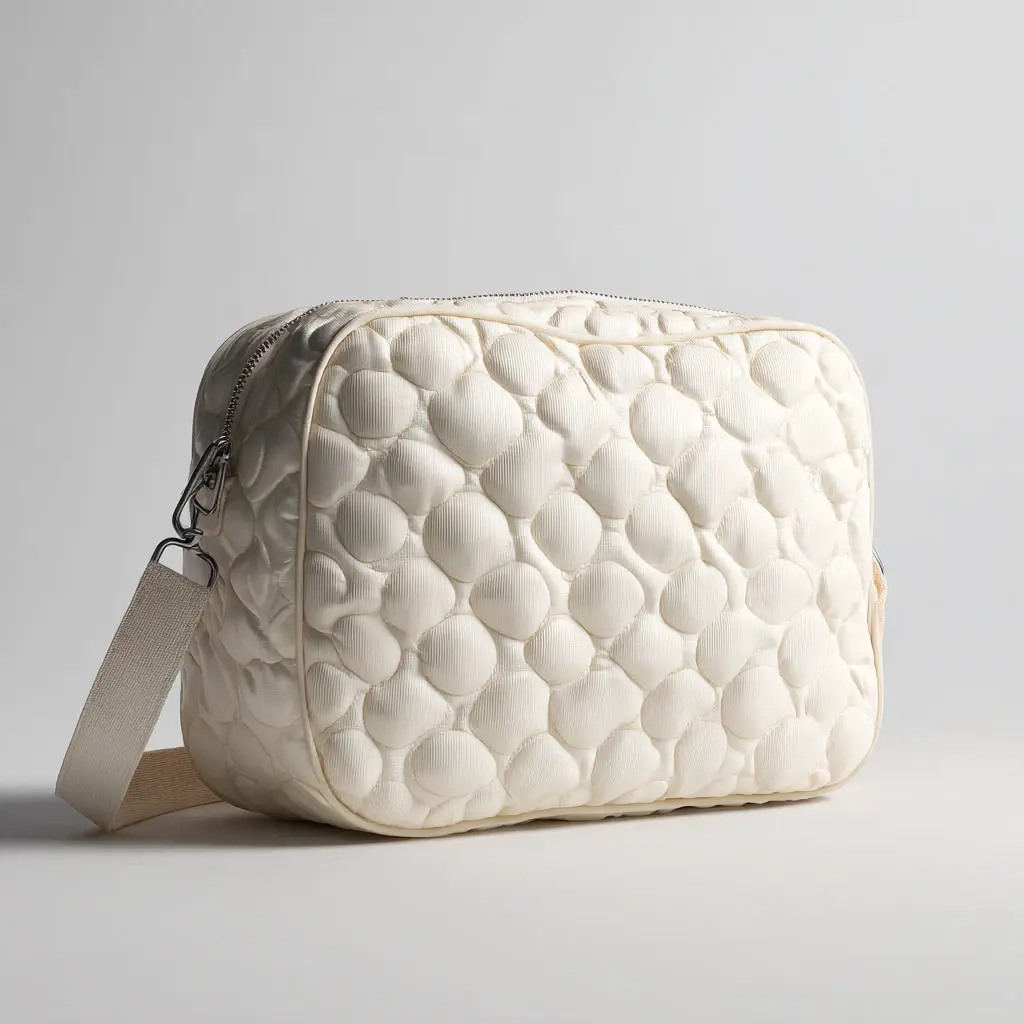
Step Two: How Much Material the Pattern Eats
Two bags of the same external size can use very different amounts of hide, and the difference is yield. A hide of 45-55 sq ft is not a rectangle: it has shoulders, a belly and edges, and the area usable for a panel that must be clean on both faces is typically 78-88% of what was bought. A tote at 34-42 cm wide with an 8-12 cm gusset consumes roughly 1.4-1.9 sq ft of hide. A structured satchel with a separate base panel and a wrapped handle consumes 2.2-2.8 sq ft. Waste is the other half of the equation, and it is where a surprisingly large part of the material cost hides: nesting loss on the cutting table plus the 12-18% of a bovine hide that cannot be used for face panels at all.
- Ask for consumption in sq ft per unit, not for a material cost per bag that cannot be checked.
- Ask what yield percentage the figure assumes, and whether it was measured on the table or estimated.
- Ask whether the lining is 210D or 420D; a heavier lining adds grip and grams and adds cost.
- Ask what waste assumption is built in, commonly 12-18% on bovine hides and 6-10% on coated synthetics.
- Ask whether the hide is bought by the panel or by the lot, because a lot buy shifts the price risk onto you.
Step Three: Stitch Density, Not the Seam
Stitch density is the cheapest quality signal in a specification and the one most often left blank. Seven to nine stitches per inch with Tex 40 bonded nylon and a 16/100 needle is the working standard for a bag that will carry weight. Five to six stitches per inch reads loose at the seam and removes time from every unit on the machine, which is exactly why a thin quotation quietly uses it. A 10 mm seam allowance with the stitch line 8 mm from the cut edge gives an inspector something to measure; a 6 mm allowance leaves too little material to hold a loaded strap. Tex 60 thread on heavy seams and an 18/110 needle where four layers are stacked are the two upgrades that stop skipped stitches.
| Parameter | Working standard | What it changes |
|---|---|---|
| Stitch density | 7-9 stitches per inch | Labour minutes per unit and seam strength |
| Thread | Tex 40 bonded nylon | Abrasion life; Tex 60 for load-bearing seams |
| Needle | 16/100 body, 18/110 stacked seams | Hole size and skipped stitches |
| Seam allowance | 10 mm, stitch line 8 mm from edge | Rework margin and burst resistance |
| Reinforcement | Box-stitch or rivet at strap roots | Field failure rate at the joint |
| Backtack | 3-4 stitches at each end | Seam opening under load |

The same logic runs through the rest of the construction. Edge paint applied in two coats with inter-sanding at 400 grit holds a folded edge far better than one heavy coat. An interlining of 0.8-1.0 mm foam holds a panel's shape without adding the weight a board would add. A 210D lining instead of a 190D one costs cents and removes the tearing that shows up in reviews after three months. None of these appear in a listing photograph; all of them appear in a returns rate, which is the only number that matters twice.
Step Four: Plating Hours Decide the Price
Hardware is priced by the bath, not by the metal. A zinc-alloy casting is cheap; what costs money is the number of plating baths, the thickness of the deposit in microns, and the hours the finish survives in a salt-spray cabinet. Twenty-four hours to first corrosion under ASTM B117 is the working minimum for a bag sold into a humid market, and 48 hours is where a premium line sits, typically adding 15-25% to the hardware bill. Solid brass and stainless fittings skip the plating question altogether and cost more per piece, which is why they turn up on small runs where a plating lot cannot be amortised across enough units.
| Option | Test standard | Add-on | Best used when |
|---|---|---|---|
| Zinc alloy, nickel plate | ASTM B117 24 h | Baseline | Runs above 1,000 pcs where the bath is amortised |
| Zinc alloy, heavy plate | ASTM B117 48 h | +15-25% | Humid markets and coastal retail |
| Solid brass | No plating needed | +40-70% | Low volume or heritage positioning |
| Stainless steel | No plating needed | +60-90% | Nickel-restricted markets under REACH |
| PVD coating | ASTM B117 48-96 h | +80-120% | Gunmetal and colour-matched finishes |
Two compliance checks sit behind every hardware decision. Nickel release is restricted under REACH Annex XVII for items in prolonged contact with skin, and California Proposition 65 requires a warning where a listed substance is present above a safe-harbour level. Both are testable, and both should arrive as a report with a date and a laboratory name rather than as a sentence in an email. CPSIA documentation is added where a bag is marketed to children, and a BSCI or Sedex audit reference covers the social-compliance question retail buyers ask separately.
Step Five: The Operations Count Nobody Quotes
The fifth driver is invisible on a quotation: how many times a unit is handled. A plain tote runs at 24-30 operations. A framed satchel with a wrapped handle, a magnetic closure, an interior zip pocket and a packed dust bag runs at 38-52. At a takt of 25-40 seconds per operation, that is the difference between roughly 12 and roughly 30 minutes of line time per bag, and line time is what the labour share of the price is made of. This is also the reason two bags of identical size and identical material can be quoted 30% apart without anybody doing anything wrong.
- Ask for the operations count on the pattern, or for the number of workstations it occupies.
- Ask which operations are hand work; edge painting and adhesive work are hand work and cost more per minute.
- Ask whether the lining is set by machine or by hand, because a hand-set lining adds minutes and fixes corners better.
- Ask what packing includes, since marketplace prep is an operation too and it is never free.
Three Upgrades That Pay for Themselves
Most specifications have room for three changes before the price moves out of the band. These are the three that consistently return more than they cost, measured in returns avoided rather than in units sold.
- Stitch density from 6 to 8 stitches per inch. Minutes per unit and the first thing a reviewer notices on a close-up.
- Box-stitch or rivet at the strap roots. Fewer field failures than any other single change on the pattern.
- Hardware from 24 h to 48 h salt spray. Roughly 15-25% more on the hardware line, which is far less than one return wave.
What to Take Out When the Quote Is Too High
When a quotation lands above the ceiling, the instinct is to downgrade the material. That is usually the wrong move, because material is the driver buyers can see and feel. Take out operations and finishes first, and keep the substrate.
- Reduce the panel count before reducing the material. Fewer panels means fewer operations, fewer seams and less waste.
- Move from a wrapped handle to a flat webbing or tape handle where the design language allows it.
- Use a stock hardware finish instead of a colour-matched PVD, which in some programmes is 80-120% of the hardware line.
- Drop from 420D to 210D lining only where the bag is not load-bearing.
- Consolidate colourways, because each colourway is its own dye or coating lot with its own minimum.
Writing a Spec Two Quotes Can Be Compared On
The cheapest way to compare two quotations is to force both of them to answer the same four numbers. Without those four, two quotations for the same silhouette are not comparable, and the cheaper one is nearly always the one that specified less rather than the one that negotiated better. A specification that states thickness in millimetres with a tolerance, stitch density with the thread size, hardware finish with salt-spray hours and the standard, and the operations or workstation count will come back as two numbers that can actually be placed side by side.
- Material: substrate, thickness in mm, grade and finish standard.
- Construction: stitches per inch, thread size, seam allowance in mm, reinforcement method.
- Hardware: base metal, plating thickness in microns, salt-spray hours and the standard used.
- Colour: a Pantone TCX reference with a Delta E tolerance of 2.0 or better against an approved physical swatch.
- Compliance: REACH Annex XVII, Proposition 65, CPSIA where relevant, plus a BSCI or Sedex audit reference.
Once the four drivers are written down, the conversation changes shape: instead of asking for a lower price, you choose which driver to move, and each move has a visible consequence. The handbag production process reference shows which stage each driver belongs to. The MOQ floor at 500 pieces per style and colourway explains why the material driver behaves differently below that number, and the cutting and sewing line explained shows where the operations count comes from. Programmes that run through our validated partner factory Quanzhou Yingming Bags ship at AQL 2.5 under ISO 2859-1, across 7 production lines and about 200,000 pcs per month, with export experience since 2014.
The Interior Stack: Lining, Interlining and Foam by Cost
The inside of a bag is three separate material decisions that a thin quotation merges into one line, and they behave differently. A 210D polyester lining costs a few cents per unit against 420D at roughly double; a 240 gsm interlining on a structured panel adds weight and cost but is what keeps a satchel standing; and a 0.8-1.0 mm foam laminate in a back panel is priced by area, so it is cheap on a crossbody and noticeable on a 40 cm tote. Separating the three lines in a specification is what makes two quotations comparable on the interior of the bag, not only on its face.
- Lining. 210D as the working minimum, 420D where the bag carries weight; cents apart per unit, a returns rate apart in practice.
- Interlining. 240 gsm on structured panels; the difference between a satchel that stands and one that folds.
- Foam. 0.8-1.0 mm laminate priced by area; cheap on small panels, visible on a tote back panel.
- Screening. One lining reference across the range means one restricted-substance screening instead of one per style.
Edge Finishing: The Hand-Work Line Nobody Itemises
Edge finish is the one construction cost that scales with centimetres rather than with operations, because it is hand work priced by the metre of edge. A painted edge at two coats with inter-sanding at 400 grit takes 4-6 minutes per metre; a structured satchel carries 3-4 m of edge, which is 12-24 minutes of hand time on every unit. A turned edge halves the time and hides the cut, and a bound edge with a bias strip is faster still but reads as casual. This is why two bags at the same operations count can differ 10-15 percent on the labour line, and why the edge finish belongs in the specification with a method and a width, not as a finish to be decided on the line.
| Edge finish | Time per metre | Best on |
|---|---|---|
| Painted, two coats, 400 grit inter-sand | 4-6 minutes | Full-grain leather, premium lines |
| Turned and stitched | 2-3 minutes | Structured coated-fabric panels |
| Bound with bias strip | 1-2 minutes | Canvas and casual weekend styles |
| Raw, trimmed and cleaned | Under 1 minute | Interiors and hidden seams |
Send a spec, get four comparable numbers
Send the silhouette, material direction and target retail price. A private label coordinator will return hide thickness, stitch density, salt-spray hours and the operations count on one page, with sampling at 6-10 working days and bulk at 35-50 days. Get a quote.
Frequently Asked Questions
What are the main cost drivers in handbag production?
Material, stitch density, hardware and the operations count, in that order of influence. Material is 45-60% of an ex-works price, hardware is 8-18%, and labour and overhead are 15-25%. Within material, the three variables are substrate, thickness and grade; within hardware, the price is set by plating baths and salt-spray hours rather than by the weight of metal.
How much of a handbag's price is material?
Between 45% and 60% of an ex-works price for a leather bag, and a little less for a synthetic one where the substrate is cheaper but the interlining and structure cost the same. The figure moves with hide yield: a tote consumes roughly 1.4-1.9 sq ft of hide, a structured satchel 2.2-2.8 sq ft, and 12-18% of a bovine hide is unusable for face panels.
Why does stitch density change the price of a bag?
Because it is both a quality signal and a direct measure of machine time. Going from six to eight stitches per inch adds seconds to every seam on every unit, and a bag with 40 seams multiplies that across the run. It is also the cheapest driver to revise, since it can be changed at sampling within the 6-10 working day window rather than at quotation.
What stitch density should a handbag specification state?
Seven to nine stitches per inch with Tex 40 bonded nylon thread, a 16/100 needle for body panels and an 18/110 needle where four layers are stacked. Add a 10 mm seam allowance with the stitch line 8 mm from the cut edge, a 3-4 stitch backtack at each end, and a box-stitch or rivet reinforcement at the strap roots.
Why is hardware priced by plating hours rather than by metal weight?
A zinc-alloy casting is inexpensive; the cost sits in the number of plating baths, the deposit thickness in microns and the hours the finish survives a salt-spray cabinet. Twenty-four hours under ASTM B117 is the working minimum and 48 hours is premium, typically adding 15-25%. Below about 1,000 pieces the bath cannot be amortised, which is why brass or stainless is often cheaper on a small run.
What salt-spray rating should private label handbag hardware have?
At least 24 hours to first corrosion tested to ASTM B117 for a general market, and 48 hours for humid or coastal retail. Above that, PVD coatings reach 48-96 hours at a cost of 80-120% over a standard nickel plate. Whatever the target, ask for the report with the laboratory name, the hours and the standard, not for an assurance in an email.
How many operations does it take to make one handbag?
A plain tote runs at 24-30 operations and a framed satchel with a wrapped handle, magnetic closure, interior zip pocket and packed dust bag runs at 38-52. At a takt of 25-40 seconds per operation that is roughly 12 minutes of line time versus roughly 30, which is why two bags of the same size and material can be quoted 30% apart.
Which cost driver should I cut first when the quote is above my ceiling?
Cut operations and finishes before cutting material. Reduce the panel count, move from a wrapped handle to a flat webbing handle, use a stock hardware finish instead of a colour-matched PVD, drop from 420D to 210D lining where the bag is not load-bearing, and consolidate colourways. Material is the driver buyers can see and feel in the first ten seconds.
Is thicker leather always better for a handbag?
No. Thickness has to match the pattern: 1.2-1.4 mm full grain suits a structured panel, while a soft hobo at 1.6 mm or more becomes heavy and resists the slouch the design depends on. What matters more than the number is consistency inside the hide, which is why thickness should be specified in millimetres with a tolerance of plus or minus 0.1 mm.
How do I compare two quotations for the same handbag silhouette?
Force both to answer the same four numbers: hide thickness in millimetres with a tolerance, stitch density in stitches per inch with the thread size, hardware finish with salt-spray hours and the test standard, and the operations or workstation count. Add a Pantone TCX reference with a Delta E tolerance of 2.0. Without those four, the cheaper quote is usually the one that specified less.
Which compliance documents should come with the material and hardware?
Material test reports against REACH Annex XVII restrictions on chromium VI, azo dyes, nickel release and phthalates, a Proposition 65 review of hardware and coated trim for California, CPSIA documentation where a bag is marketed to children, a Global Recycled Standard transaction certificate for recycled content, and Leather Working Group traceability where hides are sourced that way.
People Also Ask
Which single cost driver has the biggest effect on price?
Material, at 45-60% of an ex-works price. Within that, the specification decisions that move the number most are the grade of hide, the thickness band and the yield the pattern achieves on the cutting table.
Can I lower the price without lowering the quality?
Yes, by removing operations rather than material. Fewer panels, a flat handle instead of a wrapped one, and a stock hardware finish instead of PVD will take 10-20% out of a quote while the visible material stays the same.
Does hardware really need a salt-spray test on a small first order?
Yes, because corrosion is a returns problem rather than a sampling problem. Twenty-four hours under ASTM B117 is a cheap test that prevents the most common hardware complaint, which appears after six to twelve weeks in a humid market.
Should the specification state the operations count?
It should state either the operations count or the number of workstations the pattern occupies. That number predicts both the labour cost and how stable the line will be, and it is the driver most often missing from a first specification.
Sources and further reading
Every figure on this page is either our own programme data or attributed below. Open the originals before you write them into a specification.
- REACH — chemical substances regulationEuropean Commission Annex XVII restricts the substances that may appear in finished leather and coatings.
- Leather Working Group — environmental auditing for tanneriesLeather Working Group Environmental audit protocol for tanneries and leather traceability.
- SATRA — technical services for leather, footwear and accessoriesSATRA Independent leather, hardware and accessories testing protocols.