Custom Sling Bags: Compact Design and Hardware Guide
How do you specify a custom sling bag that survives daily carry? Nine decisions settle it: body envelope of 22-26 cm wide by 12-16 cm high with a 6-8 cm gusset, 25 mm webbing with a 700-1,300 mm adjustment range, 3 mm wire D-rings, a number 5 coil zipper on the main opening, 4-6 mm of closed-cell padding behind the phone panel, and a strap joint tested rather than eyeballed. A sling fails at the joints, not at the panels: the strap attachment, the slider bite and the zipper stop are the three places a warranty claim starts. Every number below is a specification line you can put in a tech pack, and a handbag programme specialist can quote against all nine in one pass.
- What a Sling Has to Do That a Tote Does Not
- The Compact Envelope: Sizing That Still Fits the Kit
- Hardware Map: Nine Components and Where They Fail
- Webbing, Sliders and the Adjustment Range
- Zippers and Openings on a Small Body
- Padding, Structure and Why a Sling Collapses
- The Checklist Before You Send the Brief
- Sampling, Testing and the Sign-Off Numbers
- Cost and Calendar: What a Sling Saves and Costs
- Wear-Testing a Sling Before Sign-Off
How do you specify a custom sling bag that survives daily carry? Nine decisions settle it: body envelope of 22-26 cm wide by 12-16 cm high with a 6-8 cm gusset, 25 mm webbing with a 700-1,300 mm adjustment range, 3 mm wire D-rings, a number 5 coil zipper on the main opening, 4-6 mm of closed-cell padding behind the phone panel, and a strap joint tested rather than eyeballed. A sling fails at the joints, not at the panels: the strap attachment, the slider bite and the zipper stop are the three places a warranty claim starts. Every number below is a specification line you can put in a tech pack, and a handbag programme specialist can quote against all nine in one pass.
Sling bag specification at a glance
What a Sling Has to Do That a Tote Does Not
A sling is worn against the body all day, opened one-handed, and loaded with hard objects: a phone, a set of keys, a card holder and a charging cable. That combination is harder on a bag than a week of office carry. The panel is small, so there is no spare room to absorb a mistake; the strap carries the full weight at an angle rather than straight down; and the opening is used far more often than the opening on any other bag in a range. A specification that would be generous on a tote is merely adequate on a sling.
A Lisbon streetwear label learned this on its first capsule. The sample looked right: 24 cm wide, clean lines, a matte black body with a webbing strap and a single exterior zip. Six weeks after launch the returns were running at 4.1 percent, and every one of them was the same three faults — the slider had crept out of adjustment, the zip stop had pulled away from the tape, and the strap attachment had begun to lift at the top corner. The panels were fine. The joints were not, and the joints are what a compact bag is made of.
- Wear angle. A crossbody strap loads its attachment at 30-45 degrees off vertical, so the reinforcement has to wrap the corner rather than sit flat on the panel.
- Opening frequency. A sling is opened dozens of times a day, which makes the zipper stop and the puller the highest-cycle parts on the bag.
- Hard contents. Keys and a phone corner abrade lining from the inside, so an abrasion-resistant lining matters more than a decorative one.
- Adjustment under load. A slider that holds on an empty bag can creep at 2 kg, and creep is what a customer notices as the bag sitting wrong.
The Compact Envelope: Sizing That Still Fits the Kit
Sizing a sling is a subtraction exercise. Start from what it must hold — a phone body up to 160 mm tall, a card stack, keys and a cable — then subtract the padding, the lining turn and the seam allowance, and the external envelope comes out on its own. Working the other way, from a look to a size, is how a sling ends up 10 mm too shallow and unusable with the phone inside a case.

| Dimension | Range | Tolerance | Driven by |
|---|---|---|---|
| Body width | 220-260 mm | ±2 mm | Phone width plus cable coil |
| Body height | 120-160 mm | ±2 mm | Phone height plus 20 mm clearance |
| Gusset depth | 60-80 mm | ±2 mm | Keys and a card stack, not a water bottle |
| Device pocket depth | 170 mm | ±3 mm | Largest phone body in a case |
| Strap length | 700-1,300 mm | ±10 mm | Crossbody on a 44 and a 56 size jacket |
| Webbing width | 25 mm | ±1 mm | Slider size and shoulder comfort at load |
Two numbers in that table cause the most rework. The device pocket depth should be the largest phone body in a case plus 20 mm of clearance, which in 2026 means roughly 170 mm, and it should be stated as an internal clear dimension rather than a cut dimension. The strap range should cover both a 44 and a 56 jacket size worn crossbody, which is why 700-1,300 mm appears so often; a strap specified as a single length is a strap that will not fit somebody.
Hardware Map: Nine Components and Where They Fail
A sling carries more hardware per gram of body than any other bag in a range. Nine components is typical, and each has a specification line and a failure mode. Specifying them individually is the difference between a bag that lasts a season and one that generates a warranty claim in month three.
| Component | Specification | Common failure | Test or check |
|---|---|---|---|
| Main zipper | Number 5 coil, reverse mount | Stop pulls off the tape | 500 open-close cycles |
| Puller | Zinc alloy, branded, 28-32 mm | Plating wear at the edges | ASTM B117, 24 h |
| Tri-glide slider | 25 mm, zinc alloy | Creep under load | 5 kg hold, 60 s |
| Ladderlock buckle | 25 mm, acetal or alloy | Tooth shear | ASTM D5034 grab test |
| D-rings | 3 mm wire, zinc alloy | Opening at the braze | Pull to 30 kg, 10 s |
| Swivel hook | 25 mm, 360 degree | Gate spring fatigue | 2,000 cycles |
| Magnetic snap | 18 mm, N42 grade | Pulls open at 2 kg | Force gauge, 25 N |
| Webbing end | Heat cut and folded back | Fraying after washes | Visual plus tug test |
| Bartack | At every strap joint | Joint lifts at the corner | Tex 40, 7-9 SPI |
The plating line matters as much as the alloy. Zinc alloy with a nickel undercoat of 6-8 microns and a 0.1-0.2 micron topcoat, salt spray tested to ASTM B117 for 24 hours to first corrosion, is a reasonable specification for a bag in the 60 to 180 dollar retail band. Anything thinner shows wear at the puller edges within a season, and the puller is the part a customer touches every time they open the bag.
Webbing, Sliders and the Adjustment Range
Webbing is the structural member of a sling, not a trim. At 25 mm wide and 1.4-1.6 mm thick in polyester, a good webbing has a breaking strength comfortably above 400 kg, which means the strap itself never fails; what fails is the bite of the slider against it and the stitching that anchors it. Specify both. A slider that is correct for 25 mm webbing but bought at 24 mm inside will hold an empty bag and creep at load.
- State the webbing inside width as well as the nominal size, with a tolerance of plus or minus 1 mm.
- State the adjustment range as a length range, not a single number, and test the slider at the extremes.
- Specify the return. The free end of the webbing should be folded back, bartacked, and either heat-cut or bound so it cannot fray.
- Specify the anchor. The fixed end should be box-stitched over a minimum 40 mm by 25 mm contact patch with a reinforcement patch behind it.
- Test the bite. Hold 5 kg on the strap for 60 seconds and measure the creep; anything over 3 mm means the slider is undersized.
Colour fastness on webbing is worth a line of its own. Dark webbing against a light garment transfers dye under friction, and the standard check is AATCC 8 for crocking at grade 4 or better dry and grade 3 or better wet. It costs nothing to specify and it removes the complaint that arrives as a photograph of a shirt collar.
Zippers and Openings on a Small Body
On a small bag the zipper is the most-used part and the shortest route to a return. A number 5 coil on the main opening and a number 3 on interior and exterior pockets is the normal split; metal chain reads more expensive and adds weight that a sling does not need. Reverse mounting, where the coil faces inward and only the puller shows, gives the clean line most brands want and moves the abrasion to the inside of the tape where it is not seen.
- Chain size and type: number 5 coil, reverse mount, on the main opening; number 3 on pockets.
- Puller: length 28-32 mm, branded with your mark, with the plating thickness stated in microns.
- Stops: two top stops and a bottom stop, each bar-tacked to the tape, because this is the part that fails first.
- Garage or zip guard at the top end, so the slider parks inside the body rather than at the edge.
- Cycle test: 500 open-close cycles on the sample before sign-off, which is roughly six weeks of real use.
The alternative opening is a magnetic snap under a flap, which is faster to use and slower to specify. An 18 mm snap at N42 grade holds roughly 25 N, which is enough for an empty bag and marginal for one carrying a phone and keys; where a flap closes over a loaded sling, pair the magnet with a mechanical catch or increase to two snaps. The hardware selection detail in the zinc alloy guide covers the plating and alloy choices behind both options.
Padding, Structure and Why a Sling Collapses
A sling with no structure is a pouch, and pouches are returned because they do not protect what is inside. The minimum is 4-6 mm of closed-cell foam behind the device panel, bonded rather than loose, plus a base insert of 1.0-1.2 mm board under the lining. That combination adds perhaps 40-60 g and is the difference between a bag that holds its shape on a body and one that sags at the gusset.
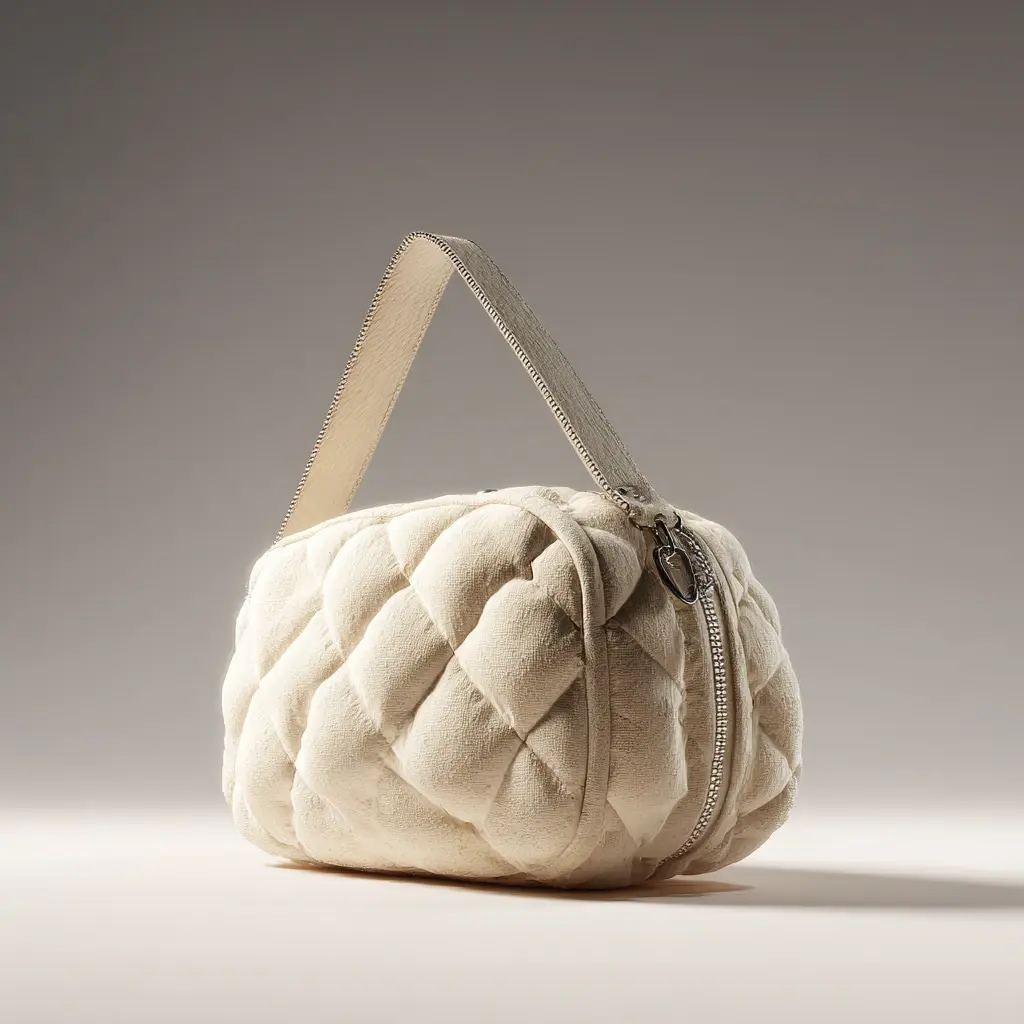
- Closed-cell foam, 4-6 mm, laminated to the lining panel so it cannot shift in the sleeve.
- Base insert of 1.0-1.2 mm board, cut 2 mm inside the base seam so it does not telegraph through the shell.
- Lining at 210D ripstop nylon, 60-70 gsm, because a plain taffeta lining abrades through at the key pocket in a season.
- Seam allowance of 10 mm on load-bearing joints, with Tex 40 thread at 7-9 stitches per inch.
- Edge finish stated: turned and topstitched, bound, or raw with edge paint; each reads differently at different price points.
The Checklist Before You Send the Brief
Ten lines, in the order a sampling bench reads them. If a line is blank, the first sample will fill it in for you, and the fill-in will cost 6-10 working days plus review. This is the list to keep open during a development call rather than the list to reconstruct afterwards.
- Body envelope in millimetres with tolerances, driven by the contents rather than by the look.
- Device pocket depth as an internal clear dimension, at least 170 mm for a large phone in a case.
- Strap webbing: width, thickness, material and the full adjustment range.
- Hardware set with alloy, plating thickness in microns and the salt spray hours.
- Zippers: chain size, mount direction, stop construction, puller length and finish.
- Padding and structure: foam thickness, base insert thickness, lining denier and gsm.
- Construction: thread, stitches per inch, seam allowance, and every reinforcement patch.
- Branding method and position measured in millimetres from a stated datum edge.
- Compliance: REACH Annex XVII, Proposition 65 for California, CPSIA where relevant, plus audit references.
- Quantity per colourway and an honest launch date, so the slot quoted is the slot needed.
Sampling, Testing and the Sign-Off Numbers
Sampling runs 6-10 working days for a conventional sling and 12-15 where the body is moulded, welded or built from a laminated shell. The sample should be tested rather than admired, and the tests are short: 500 zipper cycles, a 5 kg hold on the slider for 60 seconds, a 30 kg pull on each D-ring for 10 seconds, and a loaded carry for ten minutes on the body. Each test takes under a quarter of an hour and each one finds the fault that generates the return.
| Check | Threshold | Method | Why it matters |
|---|---|---|---|
| Zipper cycles | 500 without stop failure | Manual, sample bench | Roughly six weeks of real use |
| Slider creep | Under 3 mm at 5 kg | 60 second hold | The bag sitting wrong complaint |
| D-ring pull | 30 kg for 10 s | Force gauge | Strap anchor is the top field failure |
| Salt spray | 24 h to first corrosion | ASTM B117 | Plating thickness made checkable |
| Crocking | Grade 4 dry / 3 wet | AATCC 8 | Dye transfer onto a light garment |
| Bulk inspection | AQL 2.5 | ISO 2859-1 | Turns quality into a threshold |
At sign-off the sample becomes the standard: sealed, dated and held against the bulk lot. The full custom handbag programme reference sets out how that standard is written, and the style notes for first-time designers cover where a sling sits in a first range next to a tote and a shoulder bag.
Cost and Calendar: What a Sling Saves and Costs
A sling is cheaper per unit than a tote on materials and more expensive per unit on hardware: less leather or coated fabric, more components per bag, and a plating run that costs the same whether 300 or 3,000 pieces are made. At 500 pcs per style and colourway the hardware amortisation is visible in the unit price; at 2,000 pieces it largely disappears. That is the argument for keeping one hardware finish across a capsule rather than three.
The calendar does not change because the bag is small: sampling at 6-10 working days, revision at 3-6 days, bulk at 35-50 days, inspection at 1-3 days, and 18-38 days of transit by sea. Plan 55-80 days from a signed brief to goods handed to a forwarder at FOB Xiamen, with CIF and DDP available on request and payment by T/T. Programme work has run through our validated partner factory Quanzhou Yingming Bags since 2014, across 7 production lines and about 200,000 pcs per month, with BSCI and Sedex audit references and an ISO 9001 quality system reference available.
Wear-Testing a Sling Before Sign-Off
A sling fails on the body rather than on the bench, and the failures take a day of wear to appear. A structured wear protocol catches the three that matter, which are creep at the slider, a hot spot under the strap, and the body rotating away from the back. One tester, one day and two loads is enough to find all three before 500 units are cut.
| Stage | Load and duration | What to look for |
|---|---|---|
| Empty carry | 1 hour, walking and seated | Rotation away from the back and any strap twist |
| Light load | 1 kg for 3 hours across a working day | A hot spot under a 25 mm strap at the neck edge |
| Full load | 2 kg for 2 hours including stairs | Slider creep over 3 mm and shoulder dig |
| One handed access | 40 open and close cycles while worn | Puller reach and whether the body swings |
| Garment check | Against a light jacket and a dark one | Dye transfer from webbing at grade 4 dry or better |
Send the sling brief, get a costed specification back
Send a sketch, the body envelope and the quantity per colourway. A private label coordinator will return the ten-line checklist filled in, with hardware specified in microns, sampling at 6-10 working days, bulk at 35-50 days and inspection at AQL 2.5 under ISO 2859-1. Get a quote.
Frequently Asked Questions
How wide should a custom sling bag be?
Between 220 and 260 mm for most ranges, with a body height of 120-160 mm and a gusset of 60-80 mm. The width is driven by the contents rather than the look: a phone body in a case plus a cable coil sets the floor, and anything wider stops reading as a compact carry.
What size zipper should a sling bag use?
A number 5 coil zipper on the main opening and a number 3 on interior and exterior pockets. Coil rather than metal keeps the weight down on a small body, and a reverse mount hides the chain so only the branded puller shows on the outside.
How much padding does a sling bag need?
Four to six millimetres of closed-cell foam laminated to the device panel is the practical minimum, plus a base insert of 1.0-1.2 mm board under the lining. That combination adds about 40-60 g and is what stops a loaded sling from sagging at the gusset.
Why does a strap slider creep out of adjustment?
Because the slider inside width does not match the webbing. A slider bought at 24 mm inside for 25 mm nominal webbing holds an empty bag and creeps at load. Specify the inside width with a tolerance of plus or minus 1 mm and test with a 5 kg hold for 60 seconds.
What webbing specification should be written into a tech pack?
Width, thickness, material and adjustment range. Twenty-five millimetre polyester webbing at 1.4-1.6 mm thick, adjustable across 700-1,300 mm, covers both a 44 and a 56 jacket size worn crossbody. Add AATCC 8 crocking at grade 4 dry and grade 3 wet for dark webbing.
How is sling bag hardware plating specified?
State the alloy, the undercoat and the topcoat in microns plus a corrosion test. Zinc alloy with a nickel undercoat of 6-8 microns and a 0.1-0.2 micron topcoat, tested to ASTM B117 for 24 hours to first corrosion, suits a bag in the 60 to 180 dollar retail band.
Which joints fail first on a sling bag?
The strap attachment, the slider bite and the zipper stop, in that order. Each has a check: a 30 kg pull for 10 seconds on the D-ring anchor, a 5 kg hold for 60 seconds on the slider, and 500 open-close cycles on the zipper before sign-off.
What lining should a sling bag use?
A 210D ripstop nylon at 60-70 gsm rather than a plain taffeta. Keys and a phone corner abrade lining from the inside, and a taffeta lining in a pocket that carries keys will show wear inside a season of daily carry.
How long does a custom sling bag take to develop?
Plan 55-80 days from a signed brief to goods handed to a forwarder: 1-3 days for the brief, 2-4 for material confirmation, 6-10 working days for sampling, 3-6 for revision, 35-50 for bulk and 1-3 for inspection. Transit adds 18-38 days by sea depending on destination.
Is a sling cheaper to produce than a tote?
Cheaper on materials and more expensive on hardware. Less body material, but eight or nine components per bag and a plating run that costs the same at 300 pieces as at 3,000. Keeping one hardware finish across a capsule is the fastest way to lower the unit price.
What should be checked on the first sling sample?
Measure the envelope and the device pocket, then run the four short tests: 500 zipper cycles, a 5 kg hold on the slider for 60 seconds, a 30 kg pull on each D-ring for 10 seconds, and a ten-minute loaded carry on the body. Each takes under fifteen minutes.
Can a magnetic snap replace a zipper on a sling?
It can on an empty bag and it is marginal on a loaded one. An 18 mm N42 snap holds roughly 25 N, which is enough for a phone alone. Where a flap closes over a loaded body, pair the magnet with a mechanical catch or specify two snaps rather than one.
People Also Ask
What is the single most common sling bag return?
The zipper stop pulling away from the tape, followed by a strap slider that has crept out of adjustment. Both are specification faults rather than design faults, and both are caught by a 500-cycle test and a 5 kg hold.
Should a sling strap be detachable?
Detachable adds a swivel hook at each end, which adds two more failure points and two more plating runs. Unless the bag is meant to convert to a belt pack or a pouch, a fixed strap with an adjustment range is simpler and cheaper.
How many colourways should a first sling capsule carry?
One. MOQ is 500 pcs per style and per colourway, so two colours of one sling is 1,000 pieces and two hardware plating runs. Add the second colourway on the repeat once sell-through data exists.
Does a sling need a dust bag and hangtag?
Not structurally, but retail and marketplace channels often require barcode symbology and polybag warning text. Confirm packaging at brief stage, because it is ordered separately and arrives later than the bags more often than not.
Sources and further reading
Every figure on this page is either our own programme data or attributed below. Open the originals before you write them into a specification.
- SATRA — technical services for leather, footwear and accessoriesSATRA Independent leather, hardware and accessories testing protocols.
- FashionUnited — fashion industry news and dataFashionUnited Industry news and company data for the fashion sector.
- REACH — chemical substances regulationEuropean Commission Annex XVII restricts the substances that may appear in finished leather and coatings.