Handbag MOQ and Freight: Balancing Order Size With Shipping Cost
How do you balance handbag MOQ against freight cost? Freight per unit falls from about USD 0.71 on a 500-piece order to USD 0.58 at 1,000 and USD 0.38 at 3,000, because fixed per-shipment charges are spread over more cartons, and then flattens once a container is full. MOQ sits at 500 pcs per style / colourway, which means the first real freight saving is not a bigger order but a second or third colourway consolidated into the same booking: three colourways at MOQ is 1,500 units in 7.2 cbm on one bill of lading. This page builds the curve, shows where it stops helping, and separates freight from duty and handling, which behave differently as the order grows.
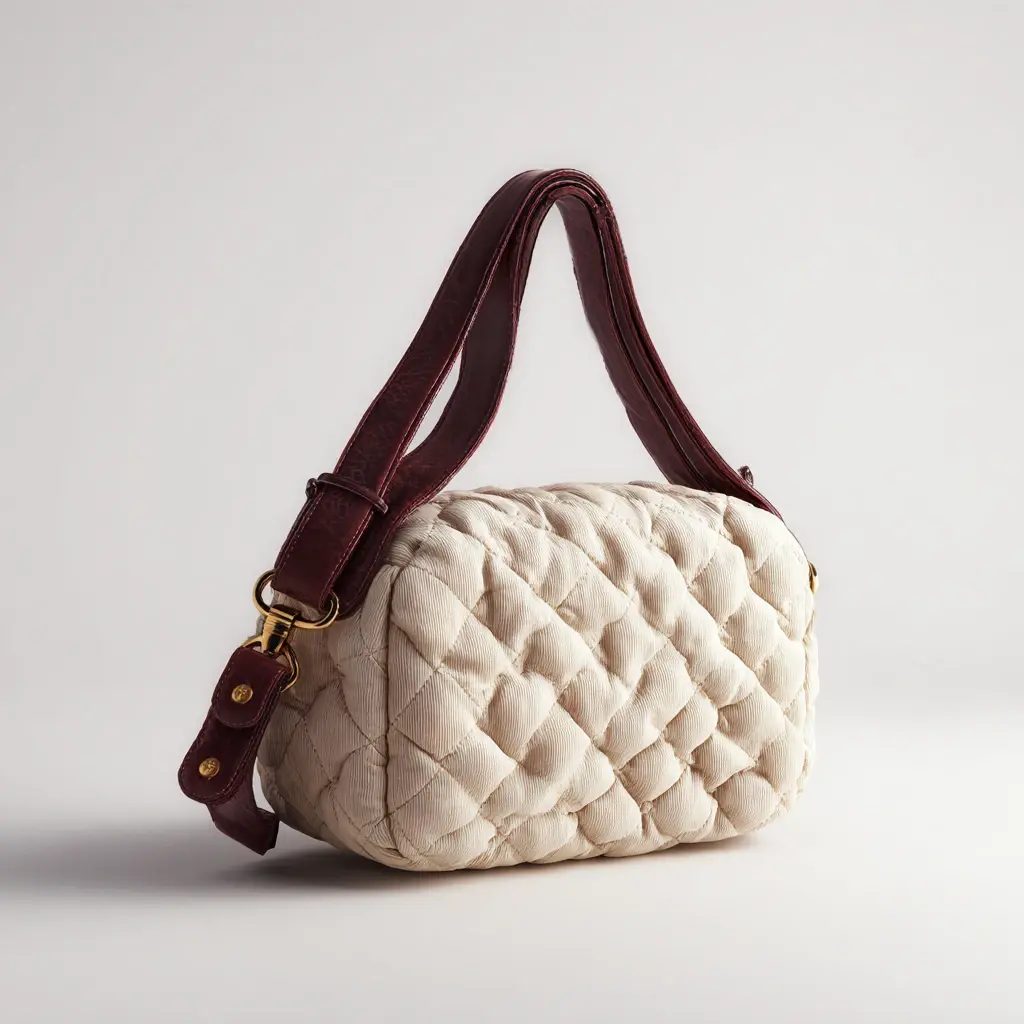
- What Freight Costs Per Unit at 500, 1,000 and 3,000 Pieces
- Why the Per-Unit Freight Curve Falls Fast Then Flattens
- A 500-Piece Order: What You Are Really Paying For
- Adding a Second Colourway Without Doubling the Freight
- Where MOQ Flexibility Exists, and Where It Does Not
- Carton Engineering: Cutting Cubes Before Cutting Price
- Duty and Handling Behave Differently From Freight
- The Order Size That Fits a First Season
- Reading the Numbers on Your Own Quote
- Why Bags Are Freighted by Cube, Never by Weight
- Air Freight: Buying Two Weeks Back
- The Charges That Do Not Shrink With the Order
- Insurance, Claims and the Day Nothing Arrives
How do you balance handbag MOQ against freight cost? Freight per unit falls from about USD 0.71 on a 500-piece order to USD 0.58 at 1,000 and USD 0.38 at 3,000, because fixed per-shipment charges are spread over more cartons, and then flattens once a container is full. MOQ sits at 500 pcs per style / colourway, which means the first real freight saving is not a bigger order but a second or third colourway consolidated into the same booking: three colourways at MOQ is 1,500 units in 7.2 cbm on one bill of lading. This page builds the curve, shows where it stops helping, and separates freight from duty and handling, which behave differently as the order grows.
Freight per unit across four order sizes
What Freight Costs Per Unit at 500, 1,000 and 3,000 Pieces
Take one construction and hold everything else constant: a structured tote, 20 units per 60 x 40 x 40 cm export carton, about 14.5 kg gross per carton, shipped from Xiamen to a West Coast destination. At 500 pieces the order is 25 cartons and about 2.4 cbm. At 1,000 it is 50 cartons and 4.8 cbm. At 3,000 it is 150 cartons and 14.4 cbm, which is close to half a 20-foot container.
Price those three as LCL, LCL and a part-filled 20-foot container respectively and the per-unit freight comes out around USD 0.71, USD 0.58 and USD 0.38. Those figures include ocean freight, documentation, origin handling and typical destination charges, because excluding the fixed charges is what makes a small order look cheaper than it is. The gap between the first and the third is roughly 46 per cent of freight cost per unit, which on a 3,000-piece programme is about USD 990.

Reporting in FashionUnited and Sourcing Journal has made the same point about freight economics for several seasons: on consumer goods of this type, the freight component of landed cost is usually small in absolute terms and large in volatility. A 33-cent movement per unit matters less than a rate spike or a missed sailing, which is why the curve is useful for planning rather than for squeezing.
Why the Per-Unit Freight Curve Falls Fast Then Flattens
Two different mechanics are at work. Below the container threshold, each shipment carries fixed charges — documentation at roughly USD 55-75, consolidation, a delivery order fee, terminal handling and a per-bill cargo handling fee. Those charges do not scale with cube, so doubling the order nearly halves their per-unit weight. That is the steep part of the curve.
Above the threshold the fixed charges stop mattering because a container carries one box rate regardless of how full it is. Per-unit freight then falls only as the container fills, and it stops falling entirely at capacity. A 20-foot container at about 28 cbm is full at roughly 5,800 units; beyond that, the next saving requires a 40-foot high cube at about 68 cbm, and the per-unit gain from that step is small.
| Order | Cube | Route | Freight per unit | What causes the change |
|---|---|---|---|---|
| 500 pcs | 2.4 cbm | LCL | USD 0.71 | Fixed charges spread over 25 cartons |
| 1,000 pcs | 4.8 cbm | LCL | USD 0.58 | Same fixed charges, twice the cartons |
| 3,000 pcs | 14.4 cbm | 20GP | USD 0.38 | Box rate replaces per-cbm freight |
| 5,500 pcs | 26.4 cbm | 20GP full | USD 0.22 | Container filled, curve flattens after this |
A 500-Piece Order: What You Are Really Paying For
An order at MOQ 500 pcs per style / colourway is not an inefficient order, it is an information purchase. The brand is buying a validated construction, a measured carton, a confirmed tariff line, a compliance file and a defect history, and the premium of roughly USD 0.33 per unit over a 3,000-piece order is the price of that. Framed that way, the question is not whether the per-unit freight is high but whether the information is worth USD 165.
It usually is, because the alternative is buying 3,000 units of an untested style. At FOB Xiamen prices of USD 11-16, the difference between 500 and 3,000 units is USD 27,500-40,000 of inventory committed against a design that has never sold. Freight saving of USD 990 does not come close to justifying that, which is why the sensible pattern is a small first order and a larger second one rather than a large first order.
Adding a Second Colourway Without Doubling the Freight
This is the most underused lever in the whole calculation. MOQ applies per style and per colourway, so three colourways at 500 each is 1,500 units — and critically, they can travel on one bill of lading in one consolidation. Freight does not triple; it grows by the cube and then stops growing per unit because the fixed charges are shared.
- One colourway at MOQ: 500 units, 2.4 cbm, about USD 0.71 per unit of freight.
- Two colourways at MOQ: 1,000 units, 4.8 cbm, about USD 0.58 per unit, one booking.
- Three colourways at MOQ: 1,500 units, 7.2 cbm, roughly USD 0.48 per unit, one booking.
- Six colourways at MOQ: 3,000 units, 14.4 cbm, roughly USD 0.38 per unit, and enough to price a container.
Two conditions have to hold. The production dates have to align closely enough that all colourways finish inside the same booking window, which usually means placing them as one order rather than three. And the packing list has to be colour-coded per carton, because a mixed carton forces the broker to declare a mixed entry and invites a full count during examination. Both are administrative rather than technical.

Where MOQ Flexibility Exists, and Where It Does Not
MOQ of 500 pcs per style / colourway is a production-economics number rather than a negotiating position, and understanding where it comes from is what makes the conversation productive. Cutting, dye lots and machine setup all carry fixed time, and a run shorter than roughly 500 units costs nearly as much line time as a full one while producing fewer units to absorb it.
| Item | Flexible? | What actually moves it |
|---|---|---|
| Units per colourway | Rarely below 500 | Consolidating colourways in one order |
| Number of colourways | Yes | More colourways share setup and freight |
| Material choice | Sometimes | Stock materials avoid a minimum dye lot |
| Hardware finish | Often | Stock plating avoids a custom plating minimum |
| Carton print | Yes | Plain cartons with a label, on small runs |
| Sampling rounds | Yes | A complete drawing reduces rounds needed |
The last row is the one worth internalising, because it is the cheapest flexibility available. A drawing with tolerances, stitch counts and a named light source for colour usually reduces the number of sample rounds from three to two, which at 6-10 working days each is over a week of calendar and a meaningful share of the sampling cost. It costs nothing but attention.
Carton Engineering: Cutting Cubes Before Cutting Price
Because freight on handbags bills on cube, the carton is a cost lever. Three changes are available and none requires a new product. Reduce the carton height by changing the nesting orientation, which on a tote often saves 3 to 5 cm per carton. Increase units per carton where the construction allows it. And specify a board that holds its shape, because a carton that bulges under stacking measures larger than it was designed.
- Nest the units in one consistent orientation and photograph it, so the packer can repeat it.
- Specify 350 gsm kraft on E-flute rated to 32 ECT, which survives four-layer stacking without measurable bulge.
- Re-measure one packed carton, multiply by the carton count, and use that figure rather than an estimate.
- Check whether an inner box is needed at all; removing it can cut cube by 8 to 12 per cent where the construction tolerates it.
On a 500-piece order, trimming 0.3 cbm from a 2.4 cbm shipment is roughly USD 20-30 at LCL rates. That is small in absolute terms and it is more than most brands achieve by negotiating the freight rate itself, which is the point: at this volume the controllable variable is the cube, not the price.
Duty and Handling Behave Differently From Freight
The instinct is to assume everything scales the same way. It does not. Freight per unit falls with volume because fixed charges are shared. Duty is a percentage of declared value, so it scales linearly with the order and improves per unit only if the unit price falls. Destination handling is mostly per shipment, so it behaves like freight. And inspection cost is per lot, which means splitting one order into three lots triples that line.
That last point has a practical consequence for inspection planning. Under AQL 2.5 with ISO 2859-1, a 500-piece lot and a 1,500-piece lot are both covered by one inspection visit and roughly one man-day. Splitting 1,500 units into three 500-piece lots and inspecting each is three visits for the same coverage. Consolidate the order and inspect it once, unless the colourways genuinely have different completion dates.
The Order Size That Fits a First Season
Three patterns cover most first seasons, and the right one depends on how much demand information the brand already has. Where the style is untested, one colourway at 500 units buys the maximum information for the minimum inventory. Where a similar style has already sold through, two or three colourways at 500 each improve freight per unit by 20 to 30 per cent while keeping each colourway at the minimum commitment.
Where the brand has a confirmed retail order, the calculation changes entirely and the constraint becomes the container rather than the MOQ: fill toward 5,500 units to reach the flat part of the curve. The mistake is applying that logic to an untested style, because the freight saving is small compared with the inventory risk, and because a first order that sells through creates the information that makes the second order the efficient one.
Reading the Numbers on Your Own Quote
Five checks, applied to any quotation, tell a brand whether the freight side has been built properly. They take about fifteen minutes and they surface the assumptions that later become disputes.
- Is the cube measured or estimated? Estimated cube understates by 20 to 40 per cent on handbags.
- Are destination charges included? On 2.4 cbm they run USD 180-320 and are the most commonly omitted line.
- Is the inspection counted once per order or once per lot? Three colourways on one order should mean one visit.
- Does the unit price fall at 1,000 and 3,000? If it does not, the material and setup economics have not been passed through.
- Is the transit figure a range? A single number is the optimistic end of an 18 to 38 day spread by lane.
Two follow-ons sit naturally beside this calculation. The mechanics of booking, cut-offs and the LCL to FCL break are covered in how a handbag shipment leaves Xiamen port, and the mode comparison for a small first import is in the freight options ranked for 2026. Where duty enters the same model, what importers should know about handbag duties covers the classification side. The full route sits in the handbag sourcing guide.
Why Bags Are Freighted by Cube, Never by Weight
Handbags are volumetric cargo, and every freight quotation for them bills accordingly. A 60 x 40 x 40 cm carton holding twenty structured totes measures 0.096 cubic metres and weighs about 14.5 kg gross. Under the revenue-ton convention used for less-than-container loads, one cubic metre is charged as one tonne, so a shipment weighing 0.36 tonnes and measuring 2.4 cubic metres is charged on the cube. The consequence is structural: a twenty-foot container fills long before it gets heavy.
- Weight never governs. Twenty-five cartons at 14.5 kg is 363 kg against 2.4 cbm, so the chargeable quantity is the cube by a factor of nearly seven.
- Space runs out first. A full container at about 28 cbm holds roughly 5,800 units of this size and around 4,200 kg, a fraction of the payload the box can carry.
- Compression beats negotiation. Removing 40 mm from one carton dimension saves about 18% of chargeable volume; arguing the rate rarely moves it by more than 5%.
- Weight matters once, later. Only the air side charges on weight, and even there the volumetric figure governs rather than the scale reading.
Air Freight: Buying Two Weeks Back
There is a point at which air freight is the cheapest option available, and it arrives near the launch date rather than anywhere near the product value. Transit falls from 18-28 days to 5-8, which buys two to three weeks of selling that no amount of ocean-rate negotiation can produce. The arithmetic has to be run per unit before the premium is rejected on principle, and it turns entirely on chargeable weight rather than on the actual weight.
| Element | Sea | Air |
|---|---|---|
| Chargeable quantity | 2.4 cbm | 400 kg volumetric, at the 6,000 divisor |
| Rate band | USD 0.71 per unit | USD 4.20-6.80 per kilogram chargeable |
| Total on 500 units | USD 355 | USD 1,680-2,720 |
| Transit | 18-28 days | 5-8 days |
| Cost of the time saved | Included | USD 2.65-4.73 per unit for roughly 16 days |
On a bag retailing at USD 89, spending USD 3.10 to protect three weeks of the selling season is usually correct; spending the same amount to advance a full reorder is not. The common answer is therefore neither extreme: air 80-120 units at the compressed rate to cover the launch, and let the balance travel by sea at USD 0.38-0.58 a unit. Splitting a shipment that way is covered in freight options for a small first import.
The Charges That Do Not Shrink With the Order
The steep part of the freight curve exists because a group of charges attaches to the shipment rather than to the contents. Documentation, a delivery order fee, terminal handling and cargo handling are billed once whether the shipment is two cartons or two hundred, and seasonal surcharges behave the same way. That structure is why the smallest order carries them most heavily, and why a 2026-style rate increase lands on a 500-piece buyer several times harder per unit than on one shipping 3,000.
| Order size | Chargeable quantity | Fixed charges per shipment | Per unit |
|---|---|---|---|
| 500 pcs | 2.4 cbm | USD 120-220 of documentation, order and handling | USD 0.24-0.44 |
| 1,000 pcs | 4.8 cbm | USD 120-220, unchanged by quantity | USD 0.12-0.22 |
| 3,000 pcs | 14.4 cbm inside a box rate | Largely absorbed by the container rate | Below USD 0.05 |
A peak season surcharge of USD 8-14 per revenue ton adds USD 19-34 to a 2.4 cbm shipment and nothing at all to a full container, so the same rate movement is a rounding error for one buyer and a week of argument for another. The cost that is never quoted is the missed sailing: a rolled booking during the autumn rush costs 7-10 days, which no per-unit saving has ever recovered.
Insurance, Claims and the Day Nothing Arrives
Under FOB terms risk passes when the goods are loaded, so from that moment a lost or damaged container is the buyer's exposure rather than anybody else's. Marine cargo insurance priced at roughly 0.12-0.35% of invoice value plus freight covers it, and on a first order the premium is smaller than most of the courier invoices. What actually costs money is reaching destination and discovering that nobody kept the evidence a claim requires.
- Cover before loading. A certificate at 110% of invoice value plus freight is the convention and costs USD 15-45 on USD 13,800 of goods.
- Visible damage window. Note damage on the delivery docket within three days and photograph cartons unopened; concealed damage usually allows about 30 days.
- Keep the carton count. A claim needs the packing list, the bill of lading and photographs carrying carton numbers; twenty-five cartons take ten minutes to record.
- Storage runs from gate-in. Demurrage and terminal storage accrue at roughly USD 75-165 a container a day while liability is still being argued.
Send us your style, colourway count and destination, and we will return the freight per unit at three order sizes and the carton spec that gets you there. Get a Quote → /contact-quote/
Frequently Asked Questions
What is the MOQ for a private label handbag order?
500 pcs per style and per colourway. It is a production-economics figure rather than a negotiating position: cutting, dye lots and machine setup carry fixed time, so a shorter run uses nearly the same line time for fewer units. Where flexibility is needed, add colourways to the same order rather than trying to reduce units below the minimum.
How much does freight add per unit on a handbag order?
Roughly USD 0.71 at 500 pieces, USD 0.58 at 1,000, USD 0.38 at 3,000 and USD 0.22 at 5,500, all-in including origin and destination charges. The fall comes from spreading fixed per-shipment charges over more cartons, and it flattens once a 20-foot container is full at about 5,800 units.
Is it better to order one colourway or three?
Three, if the demand case supports it, because MOQ applies per colourway but freight does not. Three colourways at 500 each is 1,500 units in 7.2 cbm travelling on one bill of lading, which brings freight to roughly USD 0.48 per unit against USD 0.71 for a single colourway. The condition is that all three finish inside one booking window.
When does it make sense to fill a whole container?
When demand is confirmed rather than assumed. A 20-foot container at about 28 cbm is full near 5,800 units and brings freight to roughly USD 0.22 per unit, but committing that much inventory to an untested style risks USD 60,000-90,000 of stock to save about USD 490 in freight.
Can MOQ be reduced below 500 for a first order?
Rarely, and asking usually costs more than it saves. What does move is the surrounding specification: stock materials avoid a minimum dye lot, stock plating avoids a custom plating minimum, and plain cartons with a label avoid a print minimum. Those changes reduce the effective commitment without breaking the production economics.
How does order size affect duty?
It does not directly. Duty is a percentage of the declared customs value under a tariff line, so it scales linearly with the order and improves per unit only if the unit price falls. Freight improves per unit because fixed charges are shared. Confusing the two is why some landed-cost models overstate the benefit of a larger order.
Should each colourway be inspected separately?
As separate lots where the colourway has its own dye lot, because shading risk differs by lot, but within one visit rather than three. Under AQL 2.5 with ISO 2859-1 a single inspection covers a consolidated order, and splitting 1,500 units into three 500-piece lots and inspecting each triples the cost for identical coverage.
How can I reduce freight cost without changing the order size?
Cut the cube. Nest units in one consistent orientation, increase units per carton where the construction allows, specify a board that holds its shape, and remove an unnecessary inner box. Trimming 0.3 cbm from a 2.4 cbm shipment saves roughly USD 20-30, which at this volume is more than most rate negotiation achieves.
What carton specification keeps the cube down?
A 350 gsm kraft outer on E-flute rated to 32 ECT survives four-layer stacking without measurable bulge. A lighter single-wall board bulges under load and measures larger than designed, which raises the billed cube. Re-measure one packed carton and multiply by the carton count rather than estimating from the folded product.
How should a first season be sized?
One colourway at 500 units where the style is untested, two or three colourways at 500 each where a similar style has already sold through, and a fill toward 5,500 units only where a retail order is confirmed. The freight saving from a large first order is small compared with the inventory risk it creates.
Does a larger order reduce the unit price as well as freight?
Usually, but less than buyers expect. Material and setup economies do pass through at 1,000 and 3,000 units, though the step is typically smaller than the freight step. If a quotation shows no movement at those thresholds, ask which cost element is not being passed through; sometimes the answer is that the material buy genuinely does not scale below a dye-lot minimum.
People Also Ask
What order size makes sense for a first handbag import?
One colourway at MOQ 500 pcs. Freight per unit is around USD 0.71 against USD 0.38 at 3,000 units, but the extra 2,500 units represent USD 27,500-40,000 of untested inventory. The first order buys information — validated construction, measured carton, confirmed classification — and the second order is where volume efficiency belongs.
Why does freight per unit fall so steeply between 500 and 3,000 pieces?
Fixed per-shipment charges. Documentation at USD 55-75, consolidation, delivery order, terminal handling and cargo handling fees do not scale with cube, so doubling the order nearly halves their per-unit weight. Once a container is booked, one box rate replaces per-cbm freight and the curve flattens until the container is full.
Does adding colourways increase freight proportionally?
No. MOQ applies per colourway but freight is charged on cube and per shipment, so three colourways at 500 each share the fixed charges on one bill of lading. Freight per unit falls from about USD 0.71 to roughly USD 0.48. The requirements are aligned completion dates and a colour-coded packing list.
How do I know if a freight quote is realistic for my order size?
Check five things: whether the cube was measured or estimated, whether destination charges are included, whether inspection is counted once per order, whether the unit price moves at 1,000 and 3,000 units, and whether transit is given as a range. A quote that fails the first two is usually USD 180-320 short on a small shipment.
Sources and further reading
Every figure on this page is either our own programme data or attributed below. Open the originals before you write them into a specification.
- Incoterms rulesICC The rules that decide where cost, risk and insurance transfer.
- FashionUnited — fashion industry news and dataFashionUnited Industry news and company data for the fashion sector.
- Sourcing Journal — supply chain reportingSourcing Journal (WWD) Supply-chain reporting on sourcing shifts and compliance enforcement.