Fragile Bag Hardware: Packing Tests to Avoid Damage Claims
Which packing specification stops damage claims on fragile handbag hardware? None of them entirely, but the one that cuts them most is a 5-ply 32 ECT carton with each piece individually wrapped in 3 mm EPE, because the drop sequence that destroys a bulk pack does almost nothing to a separated one. Damage claims on bags are rarely about the bag; they are about metal parts rubbing metal parts for 30 days inside a moving box. The three specifications compared below were measured against the same ISTA 3A sequence of nine drops at heights from 460 mm down to 200 mm, and they differ by about USD 0.42 per piece and by roughly nine percentage points of visible abrasion. The right one depends on where the order is going rather than on what it costs.
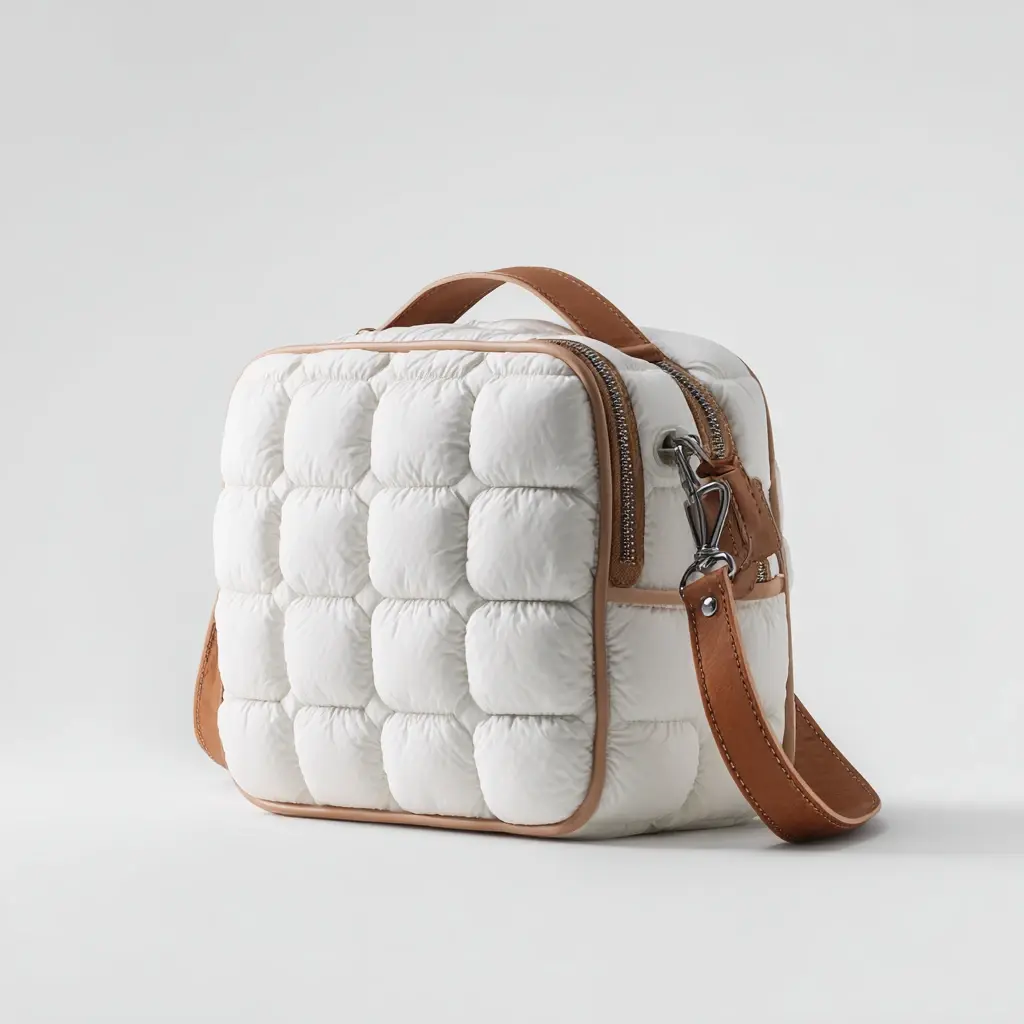
- Where Damage Claims Actually Come From
- The ISTA 3A Drop Sequence: Height Falls as Weight Rises
- Method One: Bulk-Wrapped in Tissue
- Method Two: Individually Bagged with 3 mm EPE
- Method Three: Individual Retail Box in a Master Carton
- The Nine-Row Comparison Matrix
- Reading the Carton Number: Ply, ECT and Burst
- Tarnish and Humidity Across a 30-Day Transit
- What Each Method Costs Per Piece and Per Container
- Choosing a Method in Three Questions
- Which Parts Are Actually Fragile: A Component Audit
- What a Carrier Claim Needs, Assembled in Advance
Which packing specification stops damage claims on fragile handbag hardware? None of them entirely, but the one that cuts them most is a 5-ply 32 ECT carton with each piece individually wrapped in 3 mm EPE, because the drop sequence that destroys a bulk pack does almost nothing to a separated one. Damage claims on bags are rarely about the bag; they are about metal parts rubbing metal parts for 30 days inside a moving box. The three specifications compared below were measured against the same ISTA 3A sequence of nine drops at heights from 460 mm down to 200 mm, and they differ by about USD 0.42 per piece and by roughly nine percentage points of visible abrasion. The right one depends on where the order is going rather than on what it costs.
The three methods side by side
Where Damage Claims Actually Come From
Three mechanisms produce almost every claim, and only one of them has anything to do with a defect. Knowing which mechanism is at work tells you whether the money should go into the packing specification or into the material, and getting that wrong is how buyers spend a lot on packing and still lose the claim.
- Contact abrasion inside the carton. A zip puller from one unit marks the flap edge of the unit next to it. This is the largest source and it is entirely a packing problem.
- Impact at the corners. A base corner takes the drop, and whatever is nearest the corner takes the dent — usually a magnetic closure or a set of feet.
- Stack creep in a humid container. Cartons soften at 85 % relative humidity and the bottom layer deforms over 30 days, which arrives as a crushed box and a bent frame.
Everything below is about the first two, because the third one is solved by a carton number and a desiccant rather than by a packing method. The methods are compared on the same order: 1,200 pieces of a structured tote with a magnetic closure, four metal feet and a branded zip puller, packed 12 to a carton, shipped FOB Xiamen.
The ISTA 3A Drop Sequence: Height Falls as Weight Rises
ISTA 3A is the parcel-delivery simulation most US and European buyers recognise, and it is the one to name when a packing method has to be proved rather than described. A single package up to 32 kg is dropped nine times: once flat on the base, twice on the smallest face, twice on the longest edge, twice on a corner and twice on the top. The counter-intuitive part is the height rule, which falls as the weight rises.
| Package weight | Drop height | What it means for a bag carton |
|---|---|---|
| 0-9.5 kg | 460 mm | A light carton of 12 totes is thrown the hardest; individual wrapping matters most here |
| 9.5-19 kg | 300 mm | A medium carton still needs corner protection at the base |
| 19-28 kg | 200 mm | The weight itself protects against drop but multiplies stack creep |
| Over 32 kg | Outside ISTA 3A | Move to ISTA 2A or an ASTM D4169 cycle built for the lane |
Two related standards fill in the gaps. ASTM D5276 is the bare drop test, useful as a quick screen when a full ISTA 3A sequence is not booked. ASTM D4169 lets a buyer build a cycle for a specific lane, including a humidity conditioning step under ISO 2233, which is the right tool when the complaint is deformation rather than impact.
Method One: Bulk-Wrapped in Tissue
Each bag is wrapped in 17 gsm tissue, nested in alternating directions, and 24 to 30 pieces go into a 5-ply carton with a single 1 mm corrugated divider. It is the cheapest method and the fastest to pack, and it is still the default on a great many orders because the cost difference is visible and the abrasion rate is not — until the reviews arrive.
- Wins. Lowest cost, fastest packing, best carton utilisation, and the least packing waste at the destination.
- Loses. Hardware of adjacent units is in contact across the whole transit; the abrasion rate measured on a 1,200 piece order was about 11 % of units with a visible mark.
- Where it is fine. Soft unstructured totes and hobos with no exposed metal near the panel edges.
A useful improvement costs almost nothing: put a 250 gsm paper sleeve over the strap assembly before nesting, so that the puller and the feet are behind paper rather than against the next unit. On the same order that sleeve moved the visible-abrasion rate from about 11 % to about 5 %, for a cost of USD 0.06 per piece.
Method Two: Individually Bagged with 3 mm EPE
Each bag goes into a 0.03 mm polyethylene bag, then into a 3 mm EPE foam sleeve at 20 kg per cubic metre, and 12 pieces go into a 5-ply 32 ECT carton with 12 mm corner protectors on the base. This is the method most private label programmes settle on, and on the same 1,200 piece order it measured about 2 % of units with a visible mark after the full ISTA 3A sequence.
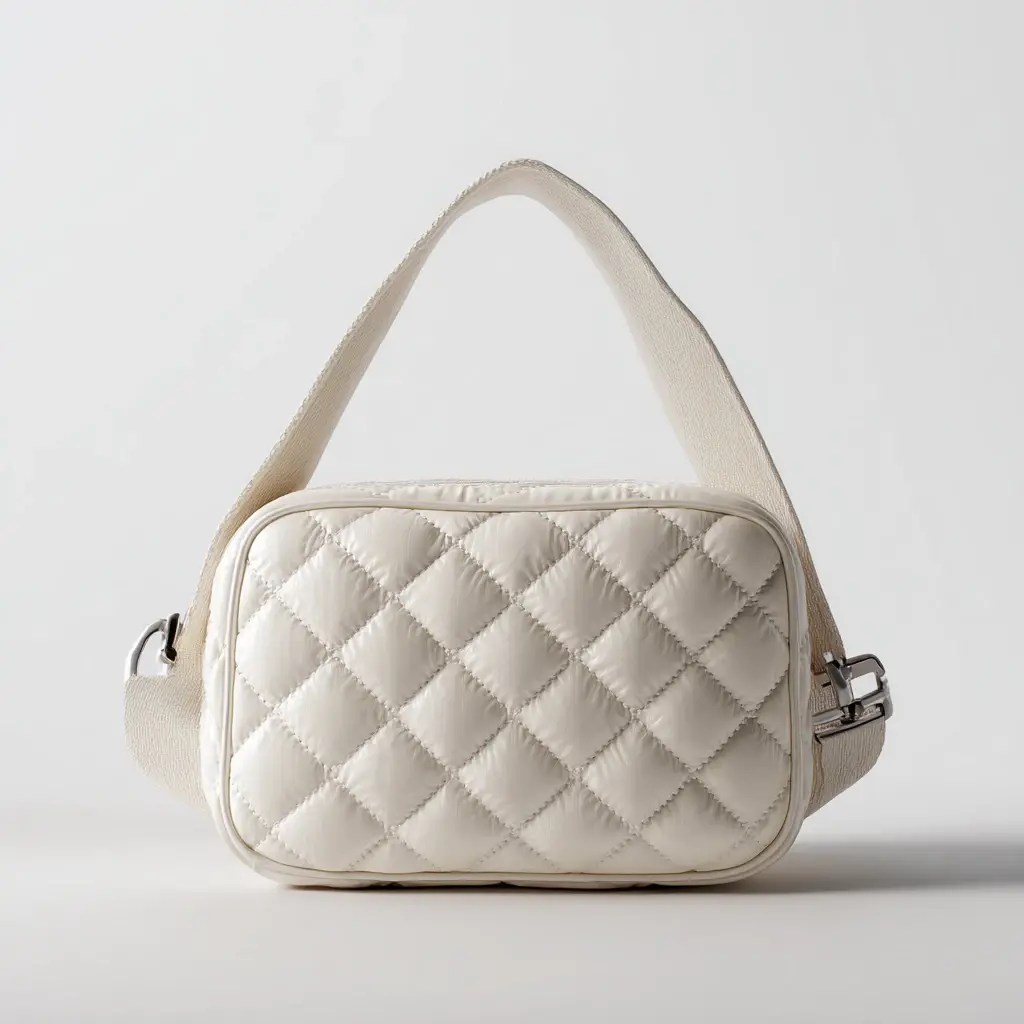
- Wins. Metal never touches metal; the drop energy goes into the foam; the carton arrives square.
- Loses. About USD 0.30 per piece more than method one, plus 8-10 % more packing volume per container.
- Watch. A PE bag sealed on a humid day traps moisture against a plated part. Vent the bag or add a 5 g silica sachet per unit.
Method Three: Individual Retail Box in a Master Carton
Each bag goes into its own 350 gsm kraft rigid or folding carton, printed or stamped, and 12 to 20 of those boxes go into a 5-ply master carton. Structurally this is the best of the three and commercially it is the most expensive by a wide margin. It is also the only one of the three that does a second job, because the box is part of the brand.
- Wins. Each unit is independently protected, the unboxing is the presentation, and it satisfies most marketplace prep rules without further work.
- Loses. Roughly USD 0.90-1.60 per piece, and a 25-30 % increase in shipped volume, which on a 40 ft high-cube container holding 67 cubic metres is a real freight line.
- Watch. The retail box itself becomes a scuff item; a 400 gsm outer with a matte lamination scuffs less than an uncoated kraft at the same grammage.
The Nine-Row Comparison Matrix
The same order, measured the same way. Rows one to three are what the buyer pays, rows four to six are what the buyer receives, and rows seven to nine are where the method starts to constrain the business.
| Row | Bulk-wrapped in tissue | Individually bagged + 3 mm EPE | Individual retail box |
|---|---|---|---|
| Packing cost per piece | USD 0.18-0.30 | USD 0.48-0.72 | USD 1.10-1.90 |
| Packing labour per 100 pcs | 12-18 minutes | 22-30 minutes | 30-40 minutes |
| Volume per 100 pcs | 0.34 m³ | 0.37 m³ | 0.45 m³ |
| Visible abrasion after ISTA 3A | About 11 % | About 2 % | Under 1 % |
| Corner dents per 100 cartons | 6-9 | 1-2 | Under 1 |
| Carton strength used | 5-ply 32 ECT | 5-ply 32 ECT + 12 mm corners | 5-ply 32 ECT master |
| Marketplace prep ready | No, needs rework | Partly, needs a label | Yes, as delivered |
| Unboxing value | None | Low | High |
| Best order size | Over 3,000 pcs of one style | 500-3,000 pcs per style / colourway | Under 1,000 pcs at a high price point |
Read the matrix by column rather than by row. The second column is the one a private label programme usually wants: it removes most of the damage, it stays under USD 0.75 per piece, and it does not commit the order to a retail box that a marketplace seller may not be allowed to use.
Reading the Carton Number: Ply, ECT and Burst
Carton specifications arrive as a shorthand that few buyers unpack. Ply is the number of sheets of paper in the board — 3-ply is a single wall, 5-ply is a double wall — and it drives puncture and crush resistance. ECT is the edge crush test, measured to TAPPI T811 in pounds per inch and in kilonewtons per metre; 32 ECT means 32 lb/in, about 5.6 kN/m. Bursting strength, still quoted on older specifications in pounds per square inch, is a different measurement and is not convertible from ECT.
- 5-ply 32 ECT is the working default for a bag carton that will be stacked 6 high in a container.
- 3-ply 32 ECT is adequate for a light carton of 20 soft units, and inadequate for a structured tote with feet.
- A stack of 8 or more needs 5-ply at 40 ECT or a 5-ply 32 ECT carton with a corrugated tray at the base and the top.
- A printed carton loses roughly 5 % of its strength to the printing pressure, which is worth asking about on a heavy load.
The rule that connects the carton to the load: the compression strength of the carton should be at least 4.5 times the load it carries in a stack. In a container at 85 % relative humidity for 30 days, use 5.5 times, because board loses a substantial part of its strength as moisture rises. That single multiplier is the reason a carton that passes a compression test in a dry room can fail the same test after a month at sea.
Tarnish and Humidity Across a 30-Day Transit
Impact is not the only thing that happens to hardware. A plated zinc alloy part also reacts, and the reaction is invisible on day one and visible on day thirty. Nickel and brass finishes tarnish fastest in a warm, humid carton that also contains the sulphur released by some papers and some rubbers, which is why the carton contents matter as much as the carton.
- Specify the plating and test it. A zinc alloy part at 8-12 µm of nickel over copper, tested 24 hours to ASTM B117 with no base metal corrosion showing.
- Wrap the metal, not just the bag. A 0.02 mm PE wrap or a VCI paper sachet inside the bag. A VCI sachet costs USD 0.02-0.04 and covers the whole carton volume.
- Use acid-free and sulphur-free paper. Some recycled tissue and some foam are the sources of the sulphur that darkens a light brass finish.
- Add desiccant by volume. One 5 g silica sachet per unit, or 20 g per cubic foot of carton, for a 30-day sea transit.
- Do not pack warm or damp. Goods packed the same day they were finished carry their own moisture into the carton.
What Each Method Costs Per Piece and Per Container
Cost is only half the comparison; the other half is freight, because packing volume consumes container space that was already paid for. The two together change the answer for anyone shipping more than a few thousand pieces.
| Line | Method 1 | Method 2 | Method 3 |
|---|---|---|---|
| Packing materials per piece | USD 0.22 | USD 0.60 | USD 1.45 |
| Packing labour per piece | USD 0.04 | USD 0.07 | USD 0.10 |
| Volume for 1,200 pcs | 4.1 m³ | 4.4 m³ | 5.4 m³ |
| Share of a 40 ft HC at 67 m³ | 6.1 % | 6.6 % | 8.1 % |
| Total packing and volume cost | USD 312 | USD 804 | USD 1,860 |
| Expected damaged units at 1,200 | About 132 | About 24 | About 8 |
The columns that decide it are the last two. Method two costs roughly USD 492 more than method one and prevents about 108 damaged units; if the true cost of a damaged unit — the replacement, the return freight and the review — is more than about USD 4.60, method two pays for itself before a single carton is opened.
Choosing a Method in Three Questions
Three questions settle it faster than any table, and they are in the order they should be asked. Each one narrows the field to one method or to none, and by the third there is usually only one answer left.
- Where will it be sold? A marketplace with its own prep rules, or a retailer with a packing specification, decides this before cost is discussed.
- Is there metal near a panel edge? A structured tote with four feet and a magnetic closure needs method two at minimum, whatever the volume.
- What does a damaged unit actually cost you? Below about USD 4.60 per damaged unit, method one is defensible; above it, method two is cheaper than the claims.
The packing specification belongs in the purchase order alongside the inspection standard, and the two are checked differently: one at the packing bench before the carton is sealed, the other at the inspection table afterwards. The handbag quality control reference sets out where packing sits in the sequence; the hardware and zipper function tests cover what to check on the parts themselves; and the common handbag defects that fail final inspection lists the marks that arrive when packing was not specified.
Which Parts Are Actually Fragile: A Component Audit
Not every metal part on a bag needs the same protection, and treating them alike wastes money. A short audit of the component list sorts the parts into three groups, which are the parts that scratch, the parts that dent, and the parts that corrode. Each group then gets the cheapest control that works rather than the most protective one available.
| Component | Dominant failure | Protection that works |
|---|---|---|
| Zip puller and slider | Scratch on an adjacent panel | Individual wrap or a paper sleeve over the strap |
| Magnetic closure | Dent at a carton corner | 12 mm corner protectors and an air gap |
| Metal feet | Print-through and scuff | Divider plus a dust bag |
| Logo plate | Scuff across the face | 0.02 mm PE wrap or a VCI sachet |
| Rings and sliders | Plating wear at contact points | Separation between units inside the carton |
The audit belongs at specification stage rather than at packing, because its result decides the packing method and the packing method decides the cost per piece. Doing it the other way round means choosing a method first and paying for protection that no component in the range actually needed.
What a Carrier Claim Needs, Assembled in Advance
Damage claims are won on documentation, and the documentation has to exist before the goods move rather than after they arrive damaged. Four items are standard across ocean and parcel carriers, and all four are produced at the packing bench or at goods receipt, which is why the routine has to be set before the first container.
- Photographs of the carton before opening. Outer condition, shipping marks and the band code, taken at the destination.
- The packing list and commercial invoice. Matched to the carton numbers, which is what ties the damage to a specific lot.
- The inspection report. AQL 2.5 under ISO 2859-1 with the accept and reject numbers, issued before shipment.
- Weight and cube records. Proving the carton was loaded within the declared stack and the declared weight limit.
- The deadline. Most carriers require notification within a stated number of days of delivery, commonly 7 to 14, so the routine has to fire before the goods are put away.
Get a packing specification before your next booking
Send your silhouettes, hardware list and destination. A private label coordinator will return a packing specification with carton strength, wrap method and drop-test standard named, sampling at 6-10 working days and bulk at 35-50 days. Get a quote.
Frequently Asked Questions
What is the ISTA 3A drop test for handbag cartons?
A parcel-delivery simulation in which one package up to 32 kg is dropped nine times: once flat on the base, twice on the smallest face, twice on the longest edge, twice on a corner and twice on the top. The height falls as weight rises, from 460 mm for packages up to 9.5 kg to 200 mm for packages up to 28 kg.
How high should a handbag carton be dropped during testing?
It depends on the weight of the carton rather than on the bag. Under ISTA 3A a carton up to 9.5 kg is dropped from 460 mm, one between 9.5 and 19 kg from 300 mm, and one between 19 and 28 kg from 200 mm, because a heavier package is handled more carefully in a real parcel network.
What does 32 ECT mean on a carton specification?
It is the edge crush test result, 32 pounds per inch or about 5.6 kilonewtons per metre, measured to TAPPI T811. It is not the same as bursting strength, which is reported in pounds per square inch, and the two cannot be converted into each other.
How many plies should a handbag shipping carton have?
Five, for a structured bag stacked six high in a container. A 3-ply single-wall carton of 32 ECT is adequate for a light carton of soft unstructured units and inadequate for a tote with feet and a magnetic closure, because the puncture resistance is what fails first.
Does individually wrapping every bag actually reduce damage claims?
Yes, and measurably. On a 1,200 piece tote order put through the same ISTA 3A sequence, bulk-wrapping in tissue produced about 11 per cent of units with a visible mark, while individually bagging with a 3 mm EPE sleeve produced about 2 per cent.
How much does better packing cost per piece?
Bulk-wrapping in tissue costs about USD 0.18-0.30 per piece, individual bagging with EPE about USD 0.48-0.72, and an individual retail box about USD 1.10-1.90 including labour. The decision point is whether a damaged unit costs more than about USD 4.60 to put right.
Why do plated bag feet tarnish in transit?
Because a warm humid carton containing sulphur-releasing paper and foam will darken a light brass or nickel finish over 30 days. The fix is to wrap the metal rather than the bag, use acid-free and sulphur-free paper, and add a VCI sachet or 5 g of silica per unit.
How is the salt spray test on bag hardware performed?
Parts are placed in a chamber sprayed continuously with a 5 per cent sodium chloride solution at 35 °C, to ASTM B117, and examined at the end of the exposure. A common specification for zinc alloy bag hardware is 24 hours with no base metal corrosion showing.
What carton strength do I need for a stack of eight cartons?
A compression strength of at least 4.5 times the load the bottom carton carries, and 5.5 times where the container will sit at 85 per cent relative humidity for 30 days. In practice that means 5-ply at 40 ECT, or a 5-ply 32 ECT carton with a corrugated tray at the base and the top.
Should I use ISTA 3A or ASTM D4169 for a handbag shipment?
ISTA 3A for a parcel-delivery lane where individual cartons are handled, and ASTM D4169 where a specific lane needs its own cycle, particularly when the complaint is deformation from humidity rather than impact damage. ASTM D5276 is the bare drop test and is a reasonable quick screen.
When should the packing method be decided?
At brief stage, before the quotation, because it changes three things at once: the unit price, the shipped volume and the freight. Deciding it after the goods are finished means the carton is bought in a hurry and the drop test is never run.
Does a retail box change the Amazon or retailer prep requirement?
It often satisfies it as delivered, which is its main commercial argument, but some marketplaces require a specific label placement and carton count, so the retail box should be drawn against the destination rule rather than against a brand mood board.
People Also Ask
Why do my bags arrive with scratched metal feet?
Because the feet of one unit were touching the panel or the hardware of the next unit for the whole transit. Separating each unit with an EPE sleeve removes most of it.
Is an expensive carton worth the money?
It is when a damaged unit costs more than about USD 4.60 to put right. Below that figure the cheaper carton is usually the better commercial choice.
What is the cheapest way to cut packing damage?
A 250 gsm paper sleeve over the strap assembly before nesting, at about USD 0.06 per piece, which roughly halves the visible abrasion rate without changing the carton.
How much desiccant does a handbag carton need?
About 5 g per unit, or 20 g per cubic foot of carton volume, for a 30-day sea transit. A VCI sachet alongside it protects the plated parts as well.
Sources and further reading
Every figure on this page is either our own programme data or attributed below. Open the originals before you write them into a specification.
- ASTM International — technical standardsASTM International Test methods for strap pull, seam strength and hardware corrosion are published here.
- Incoterms rulesICC The rules that decide where cost, risk and insurance transfer.
- International Maritime OrganizationIMO Maritime rules governing container packing and dangerous-goods declaration.