Custom Hang Tags for Handbags: Materials and Attachment Tips
Which hangtag materials hold up on a real handbag order, and which attachment detail stops tags arriving torn? A 350 gsm art card with matte laminate on both faces, a 3 mm brass eyelet set through both plies, and a 1.2 mm flat waxed cotton cord survive six weeks in transit at 65 percent relative humidity. A 250 gsm uncoated card with a punched hole and a 0.3 mm twisted polyester cord does not. Most hangtag complaints are structural, not graphic: the card curls, the hole tears, or the cord rubs a line into the handle leather. This guide opens with one 500-unit tote order that came back with all three faults, then converts that post-mortem into specification lines you can hand to a packaging partner. Every number below quotes against 500 pcs per style and colourway.
- A 500-Unit Order That Came Back Curled
- What Actually Failed: Four Root Causes
- Card Stock: 250 gsm, 350 gsm and 600 gsm Compared
- String, Cord and Pin: Choosing the Attachment
- Eyelets, Rings and Where the Tear Starts
- Printing and Finishing on a 55 x 90 mm Surface
- Attachment Points on a Real Bag Structure
- Sampling, Pull Tests and the AQL Line
- Cost Line: What Each Upgrade Adds at 500 Pieces
- Specification Fields That Prevent a Reorder Mistake
- Variable Data, Barcodes and Scanning on a 55 by 90 mm Tag
Which hangtag materials hold up on a real handbag order, and which attachment detail stops tags arriving torn? A 350 gsm art card with matte laminate on both faces, a 3 mm brass eyelet set through both plies, and a 1.2 mm flat waxed cotton cord survive six weeks in transit at 65 percent relative humidity. A 250 gsm uncoated card with a punched hole and a 0.3 mm twisted polyester cord does not. Most hangtag complaints are structural, not graphic: the card curls, the hole tears, or the cord rubs a line into the handle leather. This guide opens with one 500-unit tote order that came back with all three faults, then converts that post-mortem into specification lines you can hand to a packaging partner. Every number below quotes against 500 pcs per style and colourway.
Hangtag numbers that decide the outcome
A 500-Unit Order That Came Back Curled
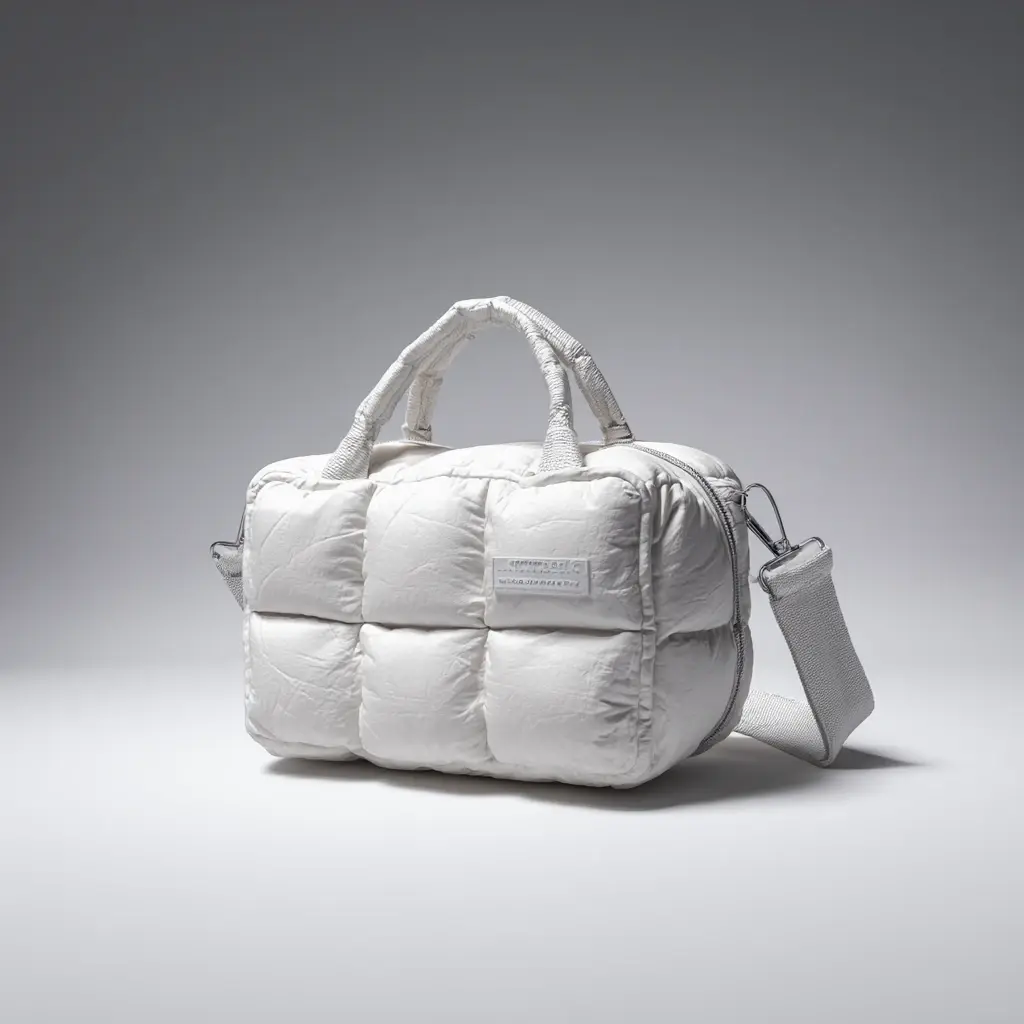
The order was 500 units of a structured tote with rolled handles, quoted FOB Xiamen to Rotterdam, booked in the second quarter on a landing date that left no room for a re-run. The hangtag was specified in a single email line: card tag, printed two sides, with string. What arrived at the line looked right for the first hour. The card was a 250 gsm uncoated art stock, the hole was punched rather than reinforced, and the cord was a 0.3 mm twisted polyester, cheap and glossy, looped through the handle and knotted by hand. Unit cost came in at USD 0.11, and nobody argued with the number because nobody had written down a test the finished tag had to pass.
Six weeks later the brand reported three distinct faults. Roughly 180 units carried tags curled badly enough that the reverse-side code panel would not sit flat under a receiving scan. Another 40 had torn clear through the hole, so the tag lay loose in the bottom of the inner sleeve. A third group showed something nobody had counted: the thin polyester cord had rubbed a shallow groove into the vegetable-tanned handle leather at the loop point on every bag that had been stacked under load for the whole voyage. The repair list was short and the arithmetic was brutal: USD 0.08 more per tag fixed all three faults, or USD 40 across the order, against a retail price of USD 189 per unit.
What Actually Failed: Four Root Causes
- Board below 300 gsm with no laminate takes up and releases moisture unevenly; a 250 gsm tag shows visible curl within 10 days at 65 percent relative humidity.
- A punched hole with no reinforcement concentrates the whole cord load on about two millimetres of paper fibre, and the tear always starts at the top edge of the hole.
- A 0.3 mm twisted polyester cord under tension behaves like wire; against a soft veg-tan handle it abrades a groove across a five-week voyage.
- Solid ink coverage over more than 70 percent of one face pulls the sheet out of plane as the ink film cures and shrinks at a different rate from the fibre below it.
- Card grain ran with the short edge, so the tag wanted to roll along its length even before it left the packing bench.
- No acceptance criterion existed, so a curl the packing line would have waved through became a complaint only after the customer had paid.
Three of those six are specification failures rather than material failures: nobody had named a grammage, nobody had named a reinforcement, and nobody had named what the finished tag had to survive. That is the useful part of the post-mortem, because those three cost nothing to fix on paper. The correction for this order took five lines: move the board to 350 gsm, laminate both faces matte, add a 3 mm brass eyelet, switch to a 1.2 mm flat cotton cord, and cap reverse-side coverage at 40 percent. A fifth line — the acceptance test — is what makes the other four enforceable, and it belongs on the purchase order rather than in an email. Every section below is written so it can be lifted directly into that document.
Card Stock: 250 gsm, 350 gsm and 600 gsm Compared
| Board | Behaviour in the field | Unit cost band | Where it belongs |
|---|---|---|---|
| 250 gsm uncoated art card | Visible curl within 10 days above 60 percent RH; hole tears under 3 kg static pull | USD 0.08 - 0.12 | Short-run inserts and swing tickets that are removed at the counter |
| 350 gsm art card, matte laminate both faces | Flat after six weeks; clears a 5 kg static pull once a 3 mm eyelet is set | USD 0.16 - 0.22 | The default season tag for totes, shoulder bags and travel pieces |
| 600 gsm greyboard with 157 gsm printed wrap | Behaves like a small card rather than a tag; raw edges need sealing or they fuzz | USD 0.35 - 0.48 | Boxed gift sets and counter display programmes |
| 100 percent recycled 350 gsm board with chain-of-custody documents | Comparable tear and curl performance to virgin board at equal grammage | USD 0.19 - 0.26 | Programmes carrying a recycled-content claim on print |
The second row carries most of the volume, and it is worth being exact about why laminate changes the outcome at unchanged grammage. Lamination bonds a film of roughly 12 microns to each face, converting two moisture-sensitive paper surfaces into one sealed sheet, so both sides expand and contract together instead of fighting each other. Two-sided application is the line brands drop to save USD 0.02, and it is also the line that does the actual work. Where a programme carries a recycled claim, a 100 percent recycled 350 gsm board documented under the Global Recycled Standard performs equivalently in the field for a 3-5 percent premium, and the documentation is what protects the claim under ISO 14021 rules on self-declared environmental statements.
String, Cord and Pin: Choosing the Attachment
The cord does two jobs at once and they pull in opposite directions. It has to carry the tag without stretching, and it has to sit against the bag without damaging it. A thin twisted synthetic wins on cost per kilogram of breaking strength and loses on contact area, which is exactly the wrong trade for a rolled leather handle. A flat cord spreads the same load across roughly four times the contact width, and a wax finish stops the weave from wicking humidity onto the leather underneath. On programmes destined for marketplace fulfilment, the choice also interacts with how the units are handled at the receiving dock, which is why the attachment decision belongs on the same sheet as the barcode and carton decisions rather than being made on the packing bench.
- 1.2 mm flat waxed cotton — the default for totes and shoulder bags; clears the 5 kg static pull and spreads load across the handle.
- 1.5 mm round braided cotton — softer read for lightweight crossbody styles; test dye transfer against pale leather first.
- 6 mm satin ribbon — right where the tag is tied at the handle base rather than looped; needs a heat-cut end or it frays inside the carton.
- Metal ball chain — highest perceived value and the heaviest option; sensible above roughly USD 120 retail because it adds both board cost and parcel weight.
- Plastic lock pin — lowest handling cost at the line and the only format some networked receivers will hang the unit from; it leaves a permanent hole in any fabric lining.
Eyelets, Rings and Where the Tear Starts
Once a tag passes about 300 gsm, the hole needs hardware. A brass eyelet with a 3 mm internal diameter and a 6 mm flange spreads the cord load over the whole flange area instead of a punched edge, and it is set cold, so the only extra charge is a setter that belongs to the programme rather than a per-unit cost. The metal choice carries a compliance dimension too: brass fittings in contact with skin sit under the nickel release restriction in REACH Annex XVII, and metal components sold into California are screened against Proposition 65. Both are covered by a documented materials declaration rather than by guesswork. The same logic governs larger metal branding components, which is why the fixing decision is treated together in the review of patches and plates.
Two details decide whether the eyelet helps or quietly hurts. The first is flange direction: the flange belongs on the face the cord pulls against, otherwise the cord rides the barrel and slowly works the metal through the board. The second is sequence. On a 600 gsm greyboard tag the eyelet has to be set before the printed wrap is folded, or the setter cracks the edge and every visible fault appears on the retail face. Both are sampling-stage decisions, and both surface inside the standard 6-10 working days of a sampling round if the specification asks for them explicitly. If the specification does not ask, a fault like this lands in the bulk run instead, where the only cure is a re-order.
Printing and Finishing on a 55 x 90 mm Surface
A season tag has about half the printable area of a postcard and gets looked at for a third of a second. That argues for one dominant element, one secondary element, and nothing else. Type below 6 pt disappears under retail lighting, hairline rules under 0.25 pt break up in print, and a reverse-out logo smaller than 12 mm across starts to fill in on uncoated stock. Ink adhesion also deserves a number: a cross-hatch tape test run to ASTM D3359 is a cheap way to catch a laminate bond that will fail later, particularly on dark solid fills where the film layer is thickest. The decision between foil and embossing has its own economics and its own die structure, covered in the finish comparison alongside labels.
| Finish | Cost index vs plain print | Durability note | Tooling |
|---|---|---|---|
| Matte lamination, both faces | 1.25 | Highest return per dollar on the whole tag; also improves ink rub resistance | None |
| Spot UV on the logo | 1.35 | Scuffs visibly on pale colourways; fine on black or deep tones | Screen, one-off |
| Hot foil, single colour | 1.60 | Survives handling better than any printed metallic; needs 0.3 mm minimum stroke | Magnesium die, charged once |
| Blind emboss | 1.45 | Reads premium under retail light but softens small type; keep above 8 pt | Brass die pair, charged once |
| Edge gilding | 1.90 | Marks in transit unless each tag is sleeved individually; highest handling cost | None, but labour intensive |
Attachment Points on a Real Bag Structure
The attachment point is a structural decision disguised as a styling one, and it is the field most often left to whoever is packing. A tag looped mid-handle swings against the panel through every movement of the carton and can rub the finish; the same tag at the handle base hangs flat and does nothing but be read. Silhouette changes the answer, so the packing photograph that accompanies the specification should show one representative unit from each of the style groups in the order rather than a favourite sample. These photographs are also what make the rest of the unboxing consistent, which is the thread running through the wider packaging documentation.
- Rolled handle on a structured tote — loop at the base where the handle meets the body, never mid-handle, so the tag rests against the panel instead of swinging.
- Webbing strap on a crossbody — use the strap keeper loop, then check the tag cannot slide down to rest on metal hardware.
- Chain strap — never hang directly from the chain; metal-on-metal marks both surfaces, so use a short cotton tie at the strap end.
- Drawcord closure — only workable if the unit ships inside its dust bag, otherwise the tag migrates during transit and arrives loose.
- Zip pull — correct for travel organizers and small leather goods, provided the tag cannot foul the slider during unpacking.
Sampling, Pull Tests and the AQL Line
Hangtag samples take 6-10 working days, and they are worth requesting mounted on the actual bag rather than shipped loose in an envelope. Sampled loose, the four faults in this case would all have looked acceptable. Condition the mounted set for 24 hours at 23 degrees Celsius and 65 percent relative humidity, then measure how far the tag lifts off a flat plane across its 90 mm length; anything over 3 mm fails. Follow that with a 5 kg static pull held for 10 seconds at the hole, checking for tear-out or distortion of the flange. Both tests are equipment-free, take minutes, and cost nothing per unit, which is why they belong in the sampling request rather than in a later dispute.
In bulk, packaging faults belong inside the same acceptance sampling plan as the bag instead of being counted separately. Under AQL 2.5 (ISO 2859-1) on a 500-unit lot the sample size lands at 50 pieces; classify a torn hole or a wrong colourway as a major defect and a curl between 3 mm and 5 mm as a minor one, then set the acceptance numbers accordingly before the run starts rather than negotiating them afterwards. Because packaging is inspected at the same time as the goods, faults are found before the 35-50 day bulk window closes, leaving room to re-cut components rather than to ship and apologise. The full programme context for how this inspection is scheduled sits in the service overview.
Cost Line: What Each Upgrade Adds at 500 Pieces
Starting from USD 0.11 for a 250 gsm tag with punched hole and polyester string, the ladder is predictable. Two-sided matte lamination takes it to about USD 0.19. Adding a brass eyelet lands near USD 0.24. A flat waxed cotton cord lands near USD 0.28, and a single-colour hot foil logo on a reusable die brings it to roughly USD 0.36. Across 500 units that is USD 55, 65, 75 and 125 of incremental spend respectively, against a unit that retails above USD 180. The pattern to notice is that the first step — lamination — buys more perceived value than any later step, so when budget is tight the cut order should run backwards: drop the foil first and never drop the laminate.
- Lamination at about +USD 0.08 per unit buys more durability than any finish above it.
- The eyelet at about +USD 0.05 costs less than a 1 percent damage rate on a USD 189 unit.
- Cord swaps are the cheapest visual upgrade and the most visible one in product photography.
- Splitting volumes at 2,000 units typically reduces the lamination premium by roughly 30 percent.
- Tooling — the foil die and the setter — is charged once and remains the property of the programme.
Specification Fields That Prevent a Reorder Mistake
The reason the original order went wrong was not ignorance of materials; it was eleven fields that nobody filled in. Writing them once means the reorder runs without a conversation, and means a change request can be quoted rather than guessed. Keep the list in the same order every season so that comparing two programmes is a matter of reading two columns side by side. Where the programme is already working through a full component set, this hangtag list is the section that plugs into the wider component checklist with the least friction.
- Board type and grammage, stated numerically — 350 gsm art card, not heavy card.
- Lamellate: type, finish and whether it covers one face or both.
- Trimmed dimensions in millimetres and corner radius, stated with a tolerance.
- Hole diameter, its position from the top edge, and the reinforcement type if any.
- Cord material, width, loop length and whether the knot sits inside or outside the handle.
- Attachment point, described per silhouette group rather than once for the whole order.
- Print: number of colours per face, maximum coverage percentage, and any registering finishes.
- Finishes, together with whose tooling is used and who holds it at the end of the run.
- Acceptance test: conditioning time, curl limit and static pull figure.
- Packing method for the tags themselves — sleeved in tens, or bulk — and label identification on each bundle.
- Drawing or artwork reference number, version date, and the date that version was approved.
Variable Data, Barcodes and Scanning on a 55 by 90 mm Tag
A tag that carries a barcode is a scannable part, and scannability has its own specification. Most tag failures at a distribution centre are print failures rather than material failures: the symbol is too small, the quiet zone has been eaten by the artwork, or the contrast is too low to grade. Five lines on the artwork prevent all three.
- Symbology. EAN-13 for a retail barcode, or the code the channel requires; state it on the artwork rather than leaving it to the printer.
- X-dimension. 0.33 mm minimum at 80 per cent magnification, which is the narrowest bar width a scanner reads reliably.
- Quiet zone. 2.5 mm clear on the left and right of the symbol, and it must not be printed over by the border artwork.
- Contrast. Print the symbol in black on a white ground; a metallic or tinted ground drops the scan grade below a pass.
- Verification. Ask for a scan grade of C or better under ISO 15416 on a sample tag before the run is printed.
- Position. Keep the symbol 8 mm from the trimmed edge and from the eyelet, so it survives punching and handling.
Put these eleven fields on your next brief
Send the silhouettes in your season, the attachment point you prefer and the finishes you are considering. Our validated partner factory Quanzhou Yingming Bags runs to 500 pcs per style and colourway, samples in 6-10 working days, completes bulk in 35-50 days and inspects at AQL 2.5 under ISO 2859-1, quoted FOB Xiamen. Get a quote.
Frequently Asked Questions
What card weight should a handbag hangtag use?
A 350 gsm art card with matte lamination on both faces is the working default for any tag meant to last a season. Below 300 gsm the board responds to humidity asymmetrically and curls, especially on the reverse side where ink coverage is heaviest. Above 600 gsm the tag stops behaving like a tag and starts behaving like a folded card, which changes how it needs to be handled at the line.
Why do hangtags curl after shipping?
Curl comes from one face expanding faster than the other as humidity moves through the sheet. Two drivers dominate: board grammage below 300 gsm and heavy solid ink coverage on one side only, which shrinks differently from the fibre underneath as it cures. Two-sided lamination removes both paths at once by sealing each face behind the same film, which is why it is the first line to specify.
Do I need an eyelet in every hangtag?
Any tag above roughly 300 gsm benefits from one, because an unreinforced punched hole concentrates the entire cord load onto two millimetres of fibre. Below that grammage the board itself tears before the hole does, so an eyelet buys less. The practical rule is simple: if the cord is expected to carry the tag for more than a few weeks of handling, specify the eyelet.
Which cord damages handle leather least?
A flat cord, ideally 1.2 mm waxed cotton, because spread matters more than strength here. A thin twisted synthetic at 0.3 mm behaves like wire under tension and will abrade a visible groove into soft vegetable-tanned leather across a five-week voyage. Wax also stops the weave from wicking moisture onto the leather at the contact point, which matters in humid transit lanes.
What size should a hangtag be for a tote?
A 55 x 90 mm portrait tag reads correctly against the scale of a structured tote without competing with the handles visually. Smaller crossbody styles take 45 x 70 mm, and anything larger than 90 mm on the long edge tends to fold inside the dust bag during transit. Corner radius of 3 mm prevents dog-eared corners on any size, particularly once the tag is sleeved.
What is the minimum order for custom hangtags?
Hangtags are quoted against the programme minimum of 500 pcs per style and colourway, which lines them up with the rest of the packaging set. Tooling such as a foil die or an eyelet setter is charged once and stays with the programme, so the unit cost on a second run falls even when volume stays flat. Sampling itself takes 6-10 working days.
Can recycled card be used for hangtags?
Yes, and a 100 percent recycled 350 gsm board performs comparably to virgin stock in both curl and tear once laminated. The meaningful difference is documentation: chain-of-custody papers under the Global Recycled Standard are what allow the claim to be printed on the tag and defended later. Budget a 3-5 percent premium over virgin board at the same grammage.
Where should the hangtag be attached on a tote?
At the base of the handle where it meets the body panel, never mid-handle. A tag looped mid-handle swings through every movement of the carton and can rub the finish or crease its own cord. At the handle base the tag hangs flat against the panel, photographs cleanly, and stays still in transit, which removes most handling damage before packing even starts.
How long does hangtag sampling take?
Sampling runs 6-10 working days for standard constructions, extending toward 12-15 days where a new die, a hand-set eyelet or a dyed-to-match cord is involved. Request samples mounted on the actual bag rather than loose in an envelope, because mounted samples are the only ones that reveal curl, fall and contact wear. That single request prevents the majority of bulk-stage surprises.
What acceptance test should be written into the hangtag spec?
Two numbers cover nearly everything: a curl limit of 3 mm lift across a 90 mm length after 24 hours conditioning at 23 degrees and 65 percent relative humidity, and a 5 kg static pull held for 10 seconds with no tear at the hole. Both are equipment-free, both take minutes, and both convert a subjective complaint into something the packing line can actually be held to.
Does lamination really matter for a hangtag?
It is the highest-value line on the specification. Two-sided matte lamination at roughly 12 microns per face costs about USD 0.08 per unit at 500 pieces and simultaneously fixes curl, improves ink rub resistance and deepens the apparent black density in print. Dropping it saves eight cents and, on this case study, cost USD 40 of repairs plus six weeks of customer frustration.
Who owns the tooling after the first hangtag run?
The programme does. A foil die, a blind emboss die pair and an eyelet setter are charged once at the sampling stage and remain the property of the brand, so they travel to any reorder without being charged again. Store the board parameters alongside the drawing reference number, because a die alone is useless if nobody recorded the grammage it was cut for.
People Also Ask
Are hangtags still worth it for direct-to-consumer bags?
Yes, but their job changed. In a retail setting the tag carries price and barcode data; in a direct-to-consumer parcel it carries the first piece of printed brand the customer touches with intent. That argues for spending less on data fields and more on board and finish, which is the opposite of how most first-time programmes allocate the budget.
What is the cheapest way to make a hangtag look expensive?
Two-sided matte lamination plus generous white space. The laminate removes the gloss that reads as cheap, and halving the amount of ink on the face reads as confidence. A single blind emboss on thick board outperforms multi-colour printing at nearly every price point, because texture is what customers actually register in a photograph.
Can a hangtag carry the barcode a marketplace requires?
It can, provided the tag stays flat enough to scan, which brings you back to grammage and lamination. A curled 250 gsm tag fails a receiving scan for the same reason a printed label on a curved panel does. Where the marketplace requires the identifier on the outer polybag instead, the hangtag should not duplicate it at all.
Should the hangtag match the dust bag and the insert?
Match the mark and one accent colour, not the whole design. A hangtag that duplicates the insert artwork exactly reads as a kit assembled from one template, while a tag that shares only the logo and typeface reads as a considered set. Stock choice should echo rather than copy, since a coated tag next to a matte insert gives useful contrast.
Sources and further reading
Every figure on this page is either our own programme data or attributed below. Open the originals before you write them into a specification.
- FashionUnited — fashion industry news and dataFashionUnited Industry news and company data for the fashion sector.
- SATRA — technical services for leather, footwear and accessoriesSATRA Independent leather, hardware and accessories testing protocols.
- Global Recycled Standard (GRS)Textile Exchange Chain-of-custody standard for recycled content and its transaction certificates.