Bag Interlining and Foam: Structure Without Weight Explained
What does interlining and foam actually do inside a bag? It does four jobs — it gives a panel enough body to stand, it stops a base from collapsing under load, it hides the seams and hardware backs showing through the face fabric, and it controls how the bag feels in the hand. Structure is bought with grams, and the working budget on a structured tote is around 90 g: 2 mm of EVA foam at 0.045 grams per cubic centimetre plus 80 gsm non-woven on the front and back panels, which is roughly 12 percent of a 750 g bag and the difference between a silhouette that photographs and one that slumps. The failure to avoid is bubbling after a year, and it comes from adhesive rather than from foam.
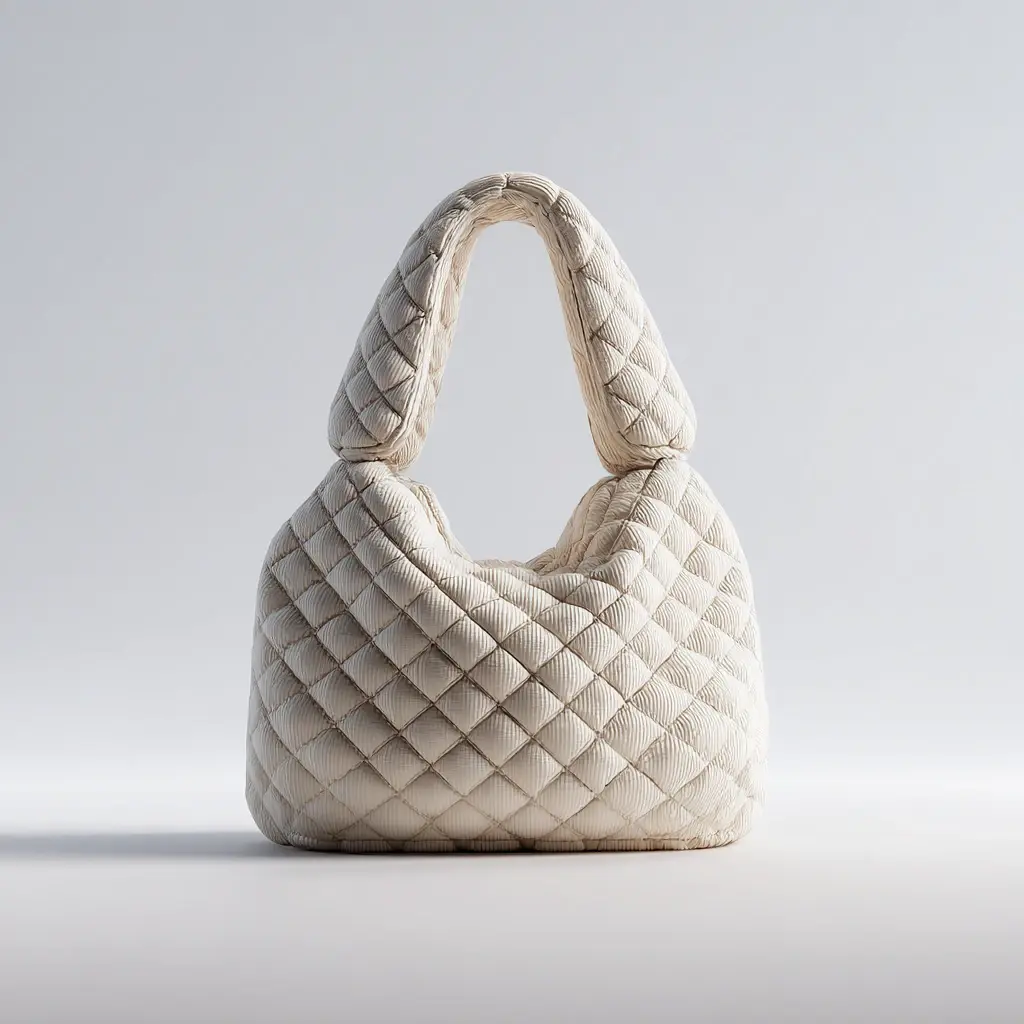
- The Tote That Stood Up in the Sample Room
- What Interlining Actually Does: Four Jobs
- The Three Families: Non-Woven, Woven and Foam
- Density Is the Number That Matters
- Where the Structure Goes: Panel, Base and Gusset
- Weight Budget: What Structure Costs in Grams
- How Interlining Changes Handle and Silhouette
- Adhesion and Durability: Why Bags Bubble
- Specifying Structure: The Seven Lines on the Sheet
- Reading the Case Backwards
- Whether the Structure Survives the Warehouse
What does interlining and foam actually do inside a bag? It does four jobs: it gives a panel enough body to stand, it stops a base from collapsing under load, it hides the seam and hardware shadows that would otherwise show through the face fabric, and it controls how the bag feels in the hand. Structure is bought with grams, and the working budget on a structured tote is around 90 g: 2 mm of EVA foam at 0.045 grams per cubic centimetre plus 80 gsm non-woven on the front and back panels, which is roughly 12 percent of a 750 g bag and the difference between a silhouette that photographs and one that slumps. The failure to avoid is bubbling after a year, and it comes from the adhesive rather than from the foam.
Interlining and foam in numbers
The Tote That Stood Up in the Sample Room
A direct-to-consumer label in Rotterdam launched a 36 cm structured tote at 129 EUR in the spring. The pre-production sample was photographed standing upright, empty, on a white sweep, and the product page carried that photograph. The first 900 units arrived and the returns ran at 14 percent against a category norm nearer 8, with the same sentence in the reviews: the bag does not look like the picture. The bag was not badly made. The seam allowance was 10 mm, the stitch count was 8 per inch and the hardware passed 24 hours of salt spray. What had changed between the sample and the run was the interlining.
The sample had been built with a 3.0 mm EVA sheet laminated to the front and back panels because that was what was on the bench that day. The production specification said interlining without a thickness, a density or a grammage, so the bulk run was built with 80 gsm non-woven alone. The difference in empty weight was 62 g and the difference in behaviour was total: the sample stood, the production run folded at the gusset and slumped forward. Nobody had specified the structure, so nobody owned it.
The fix took eleven days. Foam at 2.5 mm and 0.050 grams per cubic centimetre was laminated to both face panels and a 0.8 mm polyethylene board was added to the base, which returned 58 g and restored the silhouette. The second production run returned at 6 percent. The lesson is not that foam is better than non-woven; it is that structure is a specification with numbers, and a specification that says interlining has specified nothing at all.
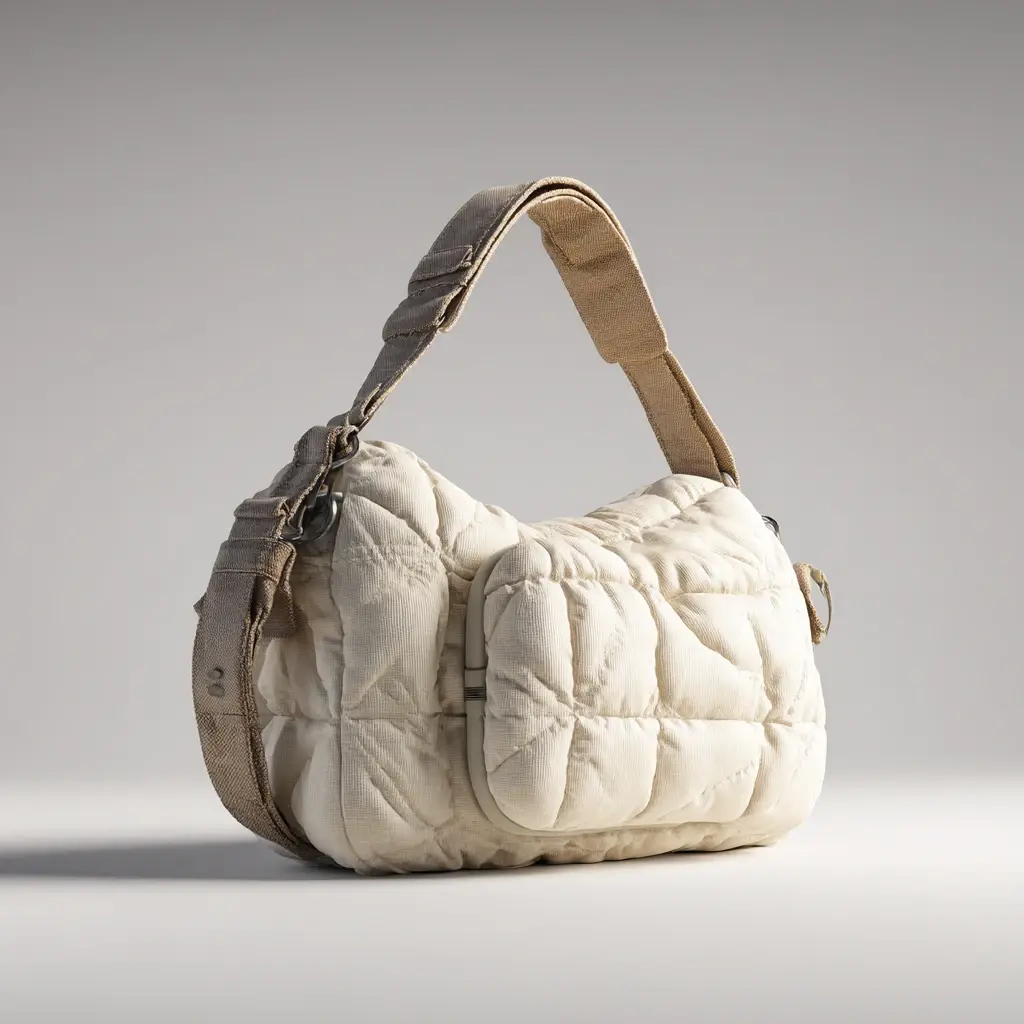
What Interlining Actually Does: Four Jobs
Interlining is the generic term for any material laminated or sewn between the outer shell and the lining, and it is doing four separate jobs at once. Understanding which job matters on a given bag is what decides the material, because a material chosen for job one often fails at job three.
- Job one, stand-up. Giving a panel enough bending stiffness to hold a shape when empty. This is what foam does, and it is a thickness-and-density question.
- Job two, load spread. Stopping a base from collapsing under the weight of the contents. This is what a stiffener board does, and it is a thickness question.
- Job three, masking. Hiding seam shadows, hardware backs, pocket outlines and the natural unevenness of a hide. This is what non-woven does, and it is a grammage question.
- Job four, handle. Controlling how the bag feels when picked up: crisp, soft, spongy or firm. This is what the combination does, and it is the job customers describe without knowing the word.
A soft hobo needs jobs three and four and almost none of one and two. A structured tote needs all four. A laptop compartment needs two and three, because the load is real and the panel has to hide the padding behind it. A packable travel bag needs none of them, which is why packable bags feel like a textile and structured bags feel like an object: the difference is not the shell material, it is the interlining.
The Three Families: Non-Woven, Woven and Foam
Three material families cover almost every bag, and each is sold and specified differently. Non-woven interlining is a bonded fibre sheet sold by grammage, from 40 gsm for a light masking layer to 120 gsm for a firm body. Woven fusible interlining is a woven cloth with a heat-activated adhesive on one face, sold by grammage and used where the drape of the shell must survive. Foam is a closed-cell sheet, usually EVA or polyethylene, sold by thickness and density, and it is the only one of the three that creates real stand-up.
| Family | Specified by | Typical value | Best at |
|---|---|---|---|
| Non-woven interlining | Grammage in gsm | 80 gsm on a body panel, 40 gsm on a flap | Masking seams and hardware backs; cheap and stable |
| Woven fusible | Grammage and adhesive weight | 45-90 gsm with 25 gsm hot-melt | Adding body without losing the drape of the shell |
| EVA foam sheet | Thickness and density | 2.0-3.0 mm at 0.045-0.060 grams per cubic centimetre | Stand-up and shape retention; the only real structure |
| PE board stiffener | Thickness | 0.6-1.0 mm, base panels and laptop sleeves | Load spreading and protecting a base from puncture |
| Craft paper or card | Grammage | 120-250 gsm, temporary or low-cost base support | Short-life shape; degrades with humidity |
The hybrid that solves most structured bags is non-woven plus foam rather than foam alone. Foam gives the stand-up and non-woven gives the smooth face, because foam laminated directly to a thin shell shows its own cell pattern as a faint orange-peel texture under raking light. Putting 80 gsm non-woven between the shell and the foam costs 14 g on a 36 cm tote and removes the texture entirely. That is the single most useful trick in this part of the specification.
Density Is the Number That Matters
Foam is specified wrongly more often than any other bag material, because people specify thickness and forget density. Two sheets of 2.0 mm EVA can behave completely differently: one at 0.030 grams per cubic centimetre is a soft sponge that compresses and stays compressed, and one at 0.060 is a firm sheet that springs back. Density, not thickness, decides whether a bag still stands after eight weeks in a warehouse under other cartons.
- Thickness
- 1.5-3.0 mm; 2.0 mm for panels, 3.0 mm for a base
- Density
- 0.045-0.060 grams per cubic centimetre for bag bodies
- Compression set
- Under 10 percent after 22 hours at 70 degrees Celsius
- Rebound
- 95 percent or better after 50 percent compression
- Tensile strength
- Above 0.4 MPa so the sheet does not tear at the needle
- Elongation at break
- Above 200 percent so it survives turning at the corners
- Cell structure
- Closed cell, so the sheet does not absorb water
- Adhesive
- 25 gsm hot-melt, activated above 110 degrees Celsius
Compression set is the number that predicts the warehouse problem. Measured as permanent deformation after a set period under heat and load, a foam above roughly 15 percent will not recover, and a bag built with it arrives at the customer already flattened at the folds where cartons pressed. Ten percent or better is the line worth writing down, and it costs very little to hit, because good EVA sheet is not expensive; cheap foam is cheap because of the density, not because of the polymer.
Where the Structure Goes: Panel, Base and Gusset
Structure is not applied uniformly, and where it goes matters as much as what it is. A structured tote typically carries foam laminated to the front and back face panels, a stiffener board in the base, and nothing at all in the gusset, because a gusset that is stiffened will not fold and a tote that will not fold does not ship flat. The gusset is the part that has to remain a textile.
- Front and back face panels. 2.0-3.0 mm foam plus 80 gsm non-woven, laminated before the panels are joined.
- Base. A 0.8-1.0 mm polyethylene board or a second layer of foam, cut 3 mm smaller than the base panel so it never reaches the seam.
- Gusset. Left unstiffened, or given 40 gsm non-woven only, so the bag can fold and lie flat in a carton.
- Flap and strap. 40-60 gsm non-woven or fusible, because stiffness here reads as cheap rather than structured.
- Laptop and pocket panels. 3.0 mm foam or a dedicated sleeve, because the job is impact protection rather than silhouette.
One dimension error causes most structural complaints, and it is the base board cut 3 mm short. A stiffener that runs to the seam line will eventually push through the seam or create a hard ridge that catches on a table edge; a stiffener cut short by 3 mm on each side sits inside the seam allowance and disappears. This is a pattern instruction rather than a material decision, and it belongs on the tech pack next to the seam allowance.
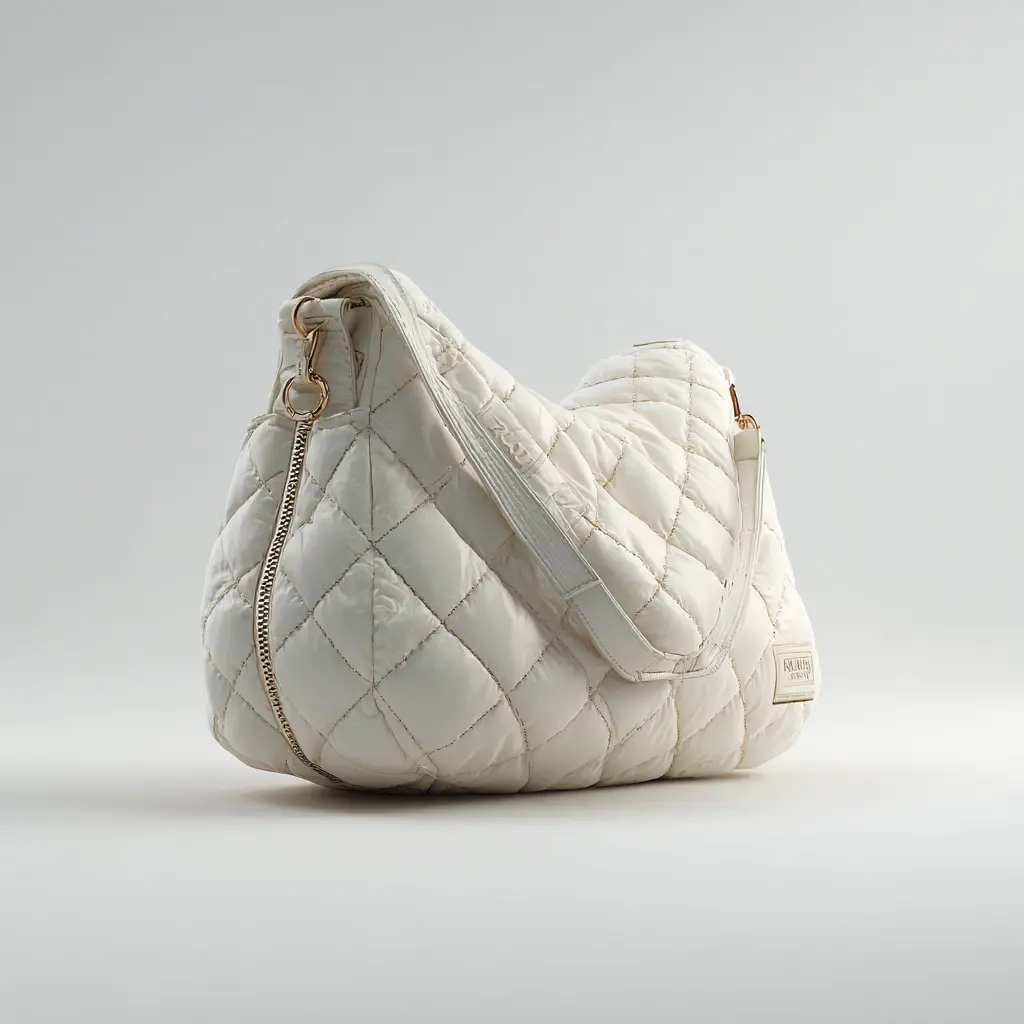
Weight Budget: What Structure Costs in Grams
Structure is bought with grams and every programme has a budget. On a 36 cm structured tote the arithmetic runs roughly like this: 2.0 mm EVA at 0.050 grams per cubic centimetre over two face panels of about 0.11 square metres each comes to roughly 55 g; 80 gsm non-woven over the same area adds about 18 g; a 0.8 mm polyethylene base board adds about 22 g. The total is around 95 g, or about 12 percent of a 780 g finished bag.
| Bag type | Structure content | Structure weight | Share of finished weight |
|---|---|---|---|
| Structured tote, 36 cm | 2 mm EVA, 80 gsm non-woven, 0.8 mm PE board | 90-110 g | 12-14 percent |
| Soft shoulder bag | 60 gsm non-woven, no foam | 25-35 g | 6-8 percent |
| Hobo, slouchy | 40 gsm non-woven on the flap only | 12-20 g | 3-5 percent |
| Laptop backpack | 3 mm foam panels plus a sleeve | 130-170 g | 15-18 percent |
| Packable travel tote | None | 0 g | 0 percent |
Those percentages are the useful part, because they transfer across sizes. Below about 8 percent a bag reads as soft and packs flat. Between 10 and 15 percent it reads as structured and stands empty. Above 18 percent it reads as heavy, and the customer says so in the review even if they cannot identify why. A brand that knows which of those three it wants has already made the structural decision.
How Interlining Changes Handle and Silhouette
Handle is the word for what a bag feels like when picked up, and it is mostly an interlining decision rather than a shell decision. A hide on its own, at 1.4 mm, is floppy; the same hide with 80 gsm non-woven is crisp; the same hide with 2.0 mm foam is firm and slightly springy; the same hide with 3.0 mm foam is rigid and begins to read as luggage. None of those is wrong, and a brand that has never specified the combination is letting the sampling bench decide its product feel.
Silhouette is the visual half of the same decision. Foam on the face panels holds a flat plane, which is what makes a tote photograph as a rectangle rather than as a soft sack. Foam omitted from the top edge lets the mouth of the bag roll slightly, which reads as relaxed. A brand brief describing a bag as architectural is asking for 3.0 mm foam and a base board; a brief describing it as slouchy is asking for 40 gsm and nothing else. Translating adjectives into grammage and millimetres is the whole job.
Adhesion and Durability: Why Bags Bubble
The complaint that follows a bad interlining decision is bubbling, and it arrives between nine and eighteen months. The face fabric separates from the foam or from the non-woven in a blister, usually near a strap attachment or across the middle of a panel. The cause is almost always adhesive rather than foam: either too little adhesive, an activation temperature that was never reached, or an adhesive that is not compatible with a coated shell.
- Adhesive weight. Around 25 gsm of hot-melt for a laminated panel. Below 18 gsm the bond is patchy and the patchiness shows as bubbling later.
- Activation temperature. Above 110 degrees Celsius for most hot-melts, held for long enough to flow. A press that runs cool produces a bond that looks fine and fails in the field.
- Compatibility. Polyurethane-coated shells need a adhesive system that will not plasticise against the coating; a mismatched pair separates in heat.
- Heat exposure in transit. A carton that reaches 60 degrees Celsius in a container will test every bond in the bag, which is why a heat-aged sample is worth requesting.
The test is cheap and should be requested at sampling: a heat-aged lamination check at 70 degrees Celsius for 24 hours, followed by a peel test. A bond that survives that will survive a container. A brand running a summer programme into a hot market should ask for it specifically, because this is one of the few failure modes that is seasonal.
Specifying Structure: The Seven Lines on the Sheet
Seven lines turn structure from an intention into a specification, and all seven can be written on one page of a tech pack. Without them the sampling bench decides, and the bench does not know what the product page promises.
- Face panel interlining
- 80 gsm non-woven, laminated, full panel coverage
- Face panel foam
- 2.0 mm EVA at 0.050 grams per cubic centimetre, closed cell
- Base stiffener
- 0.8 mm polyethylene board, cut 3 mm short of the seam
- Gusset
- Unstiffened or 40 gsm non-woven, so the bag folds flat
- Flap and strap
- 40-60 gsm fusible, preserving drape
- Adhesive
- 25 gsm hot-melt, activated above 110 degrees Celsius
- Verification
- Heat-age 24 hours at 70 degrees Celsius, then peel test
Two of those seven are the ones that get omitted: the gusset line and the verification line. Leaving the gusset unspecified means someone will stiffen it, and the bag will not lie flat in a carton, which raises the volumetric weight of the shipment and the freight bill on every order. Leaving verification unspecified means the adhesive is never tested, and the bubbling appears after the return window has closed and the reviews have been written.
Reading the Case Backwards
The Rotterdam tote failed because structure was treated as a finishing detail rather than as a specification. The three things that would have prevented it cost nothing: a grammage and thickness on the specification sheet, an approved pre-production sample that had been photographed empty and standing, and a heat-aged lamination check. None of those adds a day to the 6-10 working days of sampling window if they are asked for at the brief rather than after the sample arrives.
The rule to take away is short: structure is bought with grams, so specify the grammage, the thickness, the density and the adhesive, and hold a structure budget of 8 percent for soft, 10-15 percent for structured and above 18 percent only for luggage-like bodies. A bag specified that way stands up in the sample room and in the warehouse, and it looks like its own product photograph. The lining material comparison covers what sits on the inside of the interlining, the material specification sheet guide shows where these lines belong in a tech pack, and the material glossary defines each term. The handbag materials reference sets the full framework.
Whether the Structure Survives the Warehouse
A bag can stand up in the sample room and still arrive flat, and the difference is usually compression rather than specification. Cartons stacked four high for eight weeks put a sustained load on the face panels, and foam recovers from that only if its compression set is low enough. Worth testing before a season rather than discovering it in the first return.
| Check | Condition | Pass figure |
|---|---|---|
| Compression set | 22 hours at 70 degrees Celsius under load | under 10 percent permanent deformation |
| Rebound | 50 percent compression, then released | 95 percent or better recovery |
| Stack test | Four cartons high for eight weeks at 23 degrees Celsius | no permanent crease at the gusset fold |
| Cold flexibility | 4 hours at minus 5 degrees Celsius, then folded | no cracking of the foam or the bond |
| Bond after heat ageing | 24 hours at 70 degrees Celsius, then peel test | no delamination across the panel |
Two of those five are the ones that get skipped, and they are the two that matter most in a hot market: the cold-flexibility check and the bond check after heat ageing. Both take a day, neither needs a laboratory, and either one would have caught the failure described earlier.
Specify the structure before the sample is cut
Send your silhouette, target empty weight and how the bag should stand. A private label coordinator will return an interlining and foam specification with grammage, thickness, density and adhesive, plus a sampling window of 6-10 working days at MOQ 500 pcs per style / colourway. Get a quote.
Frequently Asked Questions
What is interlining in a bag?
Any material laminated or sewn between the outer shell and the lining. It does four jobs: giving a panel enough stiffness to stand, stopping a base collapsing under load, masking seam and hardware shadows, and controlling how the bag feels when picked up.
What grammage of non-woven interlining should a bag body use?
Eighty grams per square metre is the standard for a body panel, 40 gsm for a flap or a light masking layer and 120 gsm where a firm body is wanted on a thin shell. Below 40 gsm the interlining masks almost nothing.
What thickness and density of foam suits a structured tote?
Two millimetres of closed-cell EVA at 0.045 to 0.060 grams per cubic centimetre on the face panels, rising to 3.0 mm on a base. Density matters more than thickness: at 0.030 the sheet compresses permanently and the bag slumps.
What is compression set and why does it matter?
Compression set is the permanent deformation left after a foam is held under heat and load. Above roughly 15 percent the sheet will not recover, and a bag built with it arrives already flattened where cartons pressed it. Specify under 10 percent after 22 hours at 70 degrees Celsius.
How much weight does structure add to a bag?
Around 90 to 110 g on a 36 cm structured tote, which is 12 to 14 percent of a 780 g finished bag. A soft shoulder bag carries 25-35 g, a slouchy hobo 12-20 g and a laptop backpack 130-170 g.
Why do bags bubble after a year?
Almost always adhesive rather than foam. Too little adhesive, an activation temperature never reached, or a system incompatible with a coated shell. Around 25 gsm of hot-melt activated above 110 degrees Celsius is the working figure, and a heat-aged peel test catches the problem at sampling.
Should the gusset of a tote be stiffened?
No. Leave it unstiffened or give it 40 gsm non-woven at most, because a stiffened gusset will not fold and the bag will not lie flat in a carton, which raises volumetric weight and freight on every order.
How should a base stiffener be cut?
Three millimetres short of the seam line on every side. A stiffener that runs to the seam will eventually push through the stitch line or create a hard ridge that catches on a table edge; one cut short sits inside the seam allowance and disappears.
Can interlining be added to a soft bag to make it stand?
Yes, but it changes the product. Adding 2.0 mm foam to a soft hobo moves it from roughly 5 percent structure to 12 percent, which changes the handle, the silhouette and the way it photographs. Decide at the brief rather than after the first sample.
Does interlining affect how a bag ships?
Yes. Foam and stiffener boards prevent folding, which increases packed volume and therefore raises volumetric weight on air freight and carton count on sea freight. On 500 structured totes that difference is easily 30 percent more cartons than the same bag shipped flat, which is why a packable programme omits structure entirely.
What verification should be requested for a laminated panel?
A heat-aged lamination check at 70 degrees Celsius for 24 hours followed by a peel test. It is cheap, adds nothing to the 6-10 working days of sampling window if requested at the brief, and it is the only test that predicts bubbling in a hot container.
Is foam interlining compatible with recycled content claims?
Recycled EVA and recycled polyester non-woven are both available, but certification is lot-level. Where a claim is made, hold the Global Recycled Standard transaction certificate for the specific interlining lot rather than relying on a generic statement.
People Also Ask
Is thicker foam always better for structure?
No. Density decides whether the shape is retained; thickness only decides how far the panel stands off the shell. A 3.0 mm sheet at 0.030 density performs worse than a 2.0 mm sheet at 0.055.
Why does foam show a texture through thin shells?
Closed-cell foam has a faint cell pattern that reads as orange peel under raking light. Putting 80 gsm non-woven between the shell and the foam costs about 14 g and removes it entirely.
What percentage of bag weight should structure be?
Below 8 percent reads soft and packs flat, 10 to 15 percent reads structured and stands empty, and above 18 percent reads heavy and customers say so in reviews even if they cannot name the cause.
Should a laptop compartment use the same interlining as the body?
No. The job there is impact protection rather than silhouette, so a dedicated 3.0 mm foam panel or a sleeve is specified, usually adding 130-170 g across the bag.
Sources and further reading
Every figure on this page is either our own programme data or attributed below. Open the originals before you write them into a specification.
- Global Recycled Standard (GRS)Textile Exchange Chain-of-custody standard for recycled content and its transaction certificates.
- Fibre2Fashion textile and apparel business newsFibre2Fashion Textile and apparel business news with material pricing.
- SATRA — technical services for leather, footwear and accessoriesSATRA Independent leather, hardware and accessories testing protocols.