Handbag Manufacturers in China: What to Verify Before You Commit
What should you verify before committing to handbag manufacturers in China? Verify eight things, and verify them from documents before you verify them from a video call: business identity, the current social audit, the tannery behind the leather, sample room capability, an inspection standard with a number on it, honest capacity, tooling ownership, and commercial terms. The commercial parameters are the same whichever candidate you pick — MOQ 500 pcs per style / colourway, 6-10 working days to a first sample, 35-50 days of bulk production, FOB Xiamen — so the decision is never about price first. A Chinese bag producer is verified when it can name the tannery, quote an AQL tied to ISO 2859-1, and confirm in writing who owns your tooling; a candidate that cannot answer those three is a broker. This guide runs the eight checks in the order that costs the least, using one buyer's shortlist of three to show where the differences actually appeared.
- The Shortlist That Looked Identical on Paper
- Verification Order: Cheap Checks First
- Business Identity and the Export Record
- Audit Documents: What BSCI and Sedex Actually Cover
- Material Chain: The Tannery Question
- Sample Room Capability: What a Good One Shows
- Inspection Written in Numbers
- Capacity, Slots and Calendar Pressure
- Tooling, Moulds and Who Holds Them
- Commercial Terms Before the Deposit
- What Verification Cost in Days
- Score the First Sample Instead of Describing It
- Beyond the Licence: the Export Record Behind the Name
- A Ninety-Minute Visit Agenda, Station by Station
What should you verify before committing to handbag manufacturers in China? Verify eight things, and verify them from documents before you verify them from a video call: business identity, the current social audit, the tannery behind the leather, sample room capability, an inspection standard with a number on it, honest capacity, tooling ownership, and commercial terms. The commercial parameters are the same whichever candidate you pick — MOQ 500 pcs per style / colourway, 6-10 working days to a first sample, 35-50 days of bulk production, FOB Xiamen — so the decision is never about price first. A Chinese bag producer is verified when it can name the tannery, quote an AQL tied to ISO 2859-1, and confirm in writing who owns your tooling; a candidate that cannot answer those three is a broker. This guide runs the eight checks in the order that costs the least, using one buyer's shortlist of three to show where the differences actually appeared.
The Shortlist That Looked Identical on Paper
A distributor building a house brand shortlisted three candidates in Fujian last season. All three quoted MOQ 500 pcs per style / colourway. All three quoted 6-10 working days for sampling and 35-50 days for bulk. All three sent photographs of a tidy sample room and a container being loaded. On paper the three were the same company, and the buyer was ready to choose on unit price — which is the moment most shortlists go wrong.
The differences appeared only when the questions got specific. Asked to name the tannery supplying the top-grain, one candidate answered with a tannery and an audit reference, one answered with genuine leather, and one asked why it mattered. Asked which AQL they inspect to, one said AQL 2.5 under ISO 2859-1 and volunteered the sample size, one said strict, and one said whatever the customer requires — which means whatever the customer will accept. One question separated three identical quotations.
Verification Order: Cheap Checks First
Verification is cheap at the start and expensive at the end, so run it in cost order. Documents cost an email. A sample costs 6-10 working days. A first order costs 35-50 days and a deposit. Anything you can eliminate at document stage should be eliminated there, because a candidate that fails the tannery question will also fail the inspection question and will cost you two months to prove it twice.
- Documents (days 1-5). Business licence, export record, social audit reference, ISO 9001 certificate, material test reports. No cost, no commitment.
- Sample (days 6-20). One silhouette in the intended material, timed against the quoted 6-10 working days, measured against your tolerances.
- Counter sample (days 21-35). A unit cut from bulk material rather than sample-room leftovers. This is where material honesty shows.
- First order (days 36-85). 500 pcs in one colourway, inspected at AQL 2.5 under ISO 2859-1, report issued before the balance is paid.
Business Identity and the Export Record
Start with the least glamorous check, because it is the one that decides who you are actually contracting with. Ask for the business licence and compare the registered name with the name on the quotation, the bank account and the invoice. A mismatch is not always fraud — group companies bill through a sister entity — but it is always worth one question. Then ask how long the entity has exported, and to which markets.
Export experience matters more in bags than in most categories because the compliance load differs by destination. A partner that has shipped to the European Union will have material test reports against REACH and will know that Annex XVII restricts chromium VI in leather, azo dyes in textiles, nickel release and certain phthalates. One that has shipped to California will understand why Proposition 65 comes up on hardware and coated trim. Programmes have shipped through our validated partner factory Quanzhou Yingming Bags since 2014, and that history is exactly what a new buyer should be asking to see.
Audit Documents: What BSCI and Sedex Actually Cover
Social audits are requested constantly and read rarely. The two frameworks retail buyers ask for are amfori BSCI and Sedex SMETA, and both produce a report with a reference number, an audit date and a list of findings. Ask for the reference and the date, not the logo. A current audit is a document; an expired one is a marketing asset, and the difference is one question away.
| Document | What it proves | What it does not prove | How to check it |
|---|---|---|---|
| Business licence and export record | The legal entity and its trading history | That the entity makes anything | Compare the name with the invoice and bank account |
| amfori BSCI or Sedex SMETA report | Social compliance at a named site, on a date | Product quality or material content | Ask for the reference number and audit date |
| ISO 9001 certificate | A documented quality management system | That any particular bag is well made | Check scope covers bags, and the certificate is current |
| Material test reports | Chemical compliance of a specified material | That bulk will use that material | Match the report date and material to your order |
Which Audit Matters for Your Channel?
It depends on who sells the bag. A retailer with a house brand will usually require a current amfori BSCI or Sedex SMETA audit for the site and will ask for it annually. A marketplace seller shipping direct to consumers usually needs product compliance instead: REACH for the European Union, Proposition 65 for California, and CPSIA lead and phthalate limits plus tracking labels where an item is marketed to children. Ask your channel which document it requires before you ask the partner, otherwise you will collect a folder nobody reads.
Material Chain: The Tannery Question
Material is 40-55% of unit cost, and the tannery question is the cheapest way to find out whether a candidate is describing a supply chain or repeating a marketing phrase. Ask which tannery supplies the hide and whether it is audited under the Leather Working Group environmental protocol. Then ask for the specification in millimetres: top-grain at 1.0-1.4 mm for a shoulder bag, 1.2-1.6 mm full-grain for a tote that has to stand up, 0.6-1.0 mm PU-coated material for a lightweight crossbody.
A candidate working from a real supply chain will also volunteer what it cannot do. It will tell you that 500 pcs in one colourway is one dye lot and that splitting the run three ways means three dye-lot minimums. It will tell you that a recycled polyester lining can carry a Global Recycled Standard transaction certificate, which is what makes a percentage claim on a hangtag defensible, and that a claim without one is not defensible. That kind of volunteered limitation is the most reliable signal in the whole process.
Sample Room Capability: What a Good One Shows
The sample room is where a candidate either has patterns or does not. A room attached to real production holds graded pattern cards, cutting dies for previous runs, a rack of past samples filed by customer, and a bench with the machines used on the bulk line rather than a single domestic machine. Ask for a video walk-through timed at the bench rather than a highlight reel, and ask to see the strap attachment being sewn.
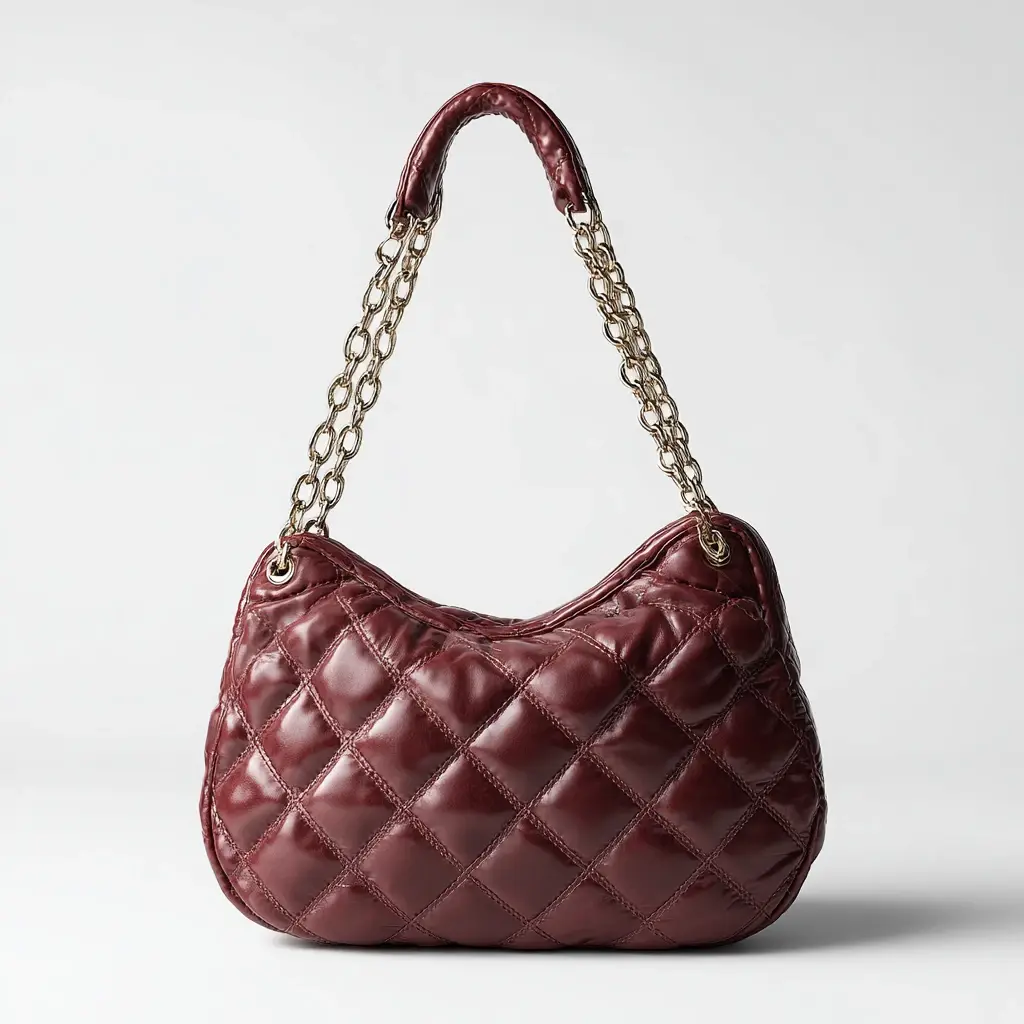
Then put numbers on the sample itself. Weigh it, measure the strap drop, count the stitches, and check the edge finish at a fold. On leather, 8-9 stitches per inch with bonded nylon is the working standard; on canvas and other coated fabrics, 9-10. A zip should be specified by chain size — a #5 metal or moulded chain on a tote mouth, a #3 on an interior pocket — and the slider should run without catching the lining. Ask for the lining denier too: 210D polyester twill is the everyday specification, and anything lighter will show wear at the corners first.
How Many Sample Rounds Should You Budget?
Budget two rounds and hope for one. A first sample arrives in 6-10 working days, or 12-15 for framed, hand-woven or stacked constructions, and a revision round costs the same again. Buyers who try to save the second round usually pay for it inside the 35-50 day bulk window, where a correction is not a correction but a re-cut. Send a written revision list with numbered items and measurements rather than a marked-up photograph.
Inspection Written in Numbers
Ask which AQL they inspect to, and wait for a number and a standard. AQL 2.5 under ISO 2859-1 is the working reference for bags: at a lot of 500 pcs the code letter is H, the inspector pulls 50 units and the lot fails on the fourth major defect; at 3,000 pcs the code letter is K, the sample is 125 units and the threshold is seven and eight. A candidate that says strict instead of 2.5 has told you that inspection is a photography session.
Then agree the defect classes in writing, because that is where disputes start. Critical is a compliance failure. Major is what a customer returns: stitch density below specification, edge paint cracked at a fold, plating rubbed through at a contact point, a strap attachment that fails a 15 kg static load held for 60 seconds. Minor is what a customer notices and keeps. Third-party inspection through SGS can be booked, and the report should be issued to you before the balance is paid — which is why payment belongs against that document rather than against a date.
Capacity, Slots and Calendar Pressure
Capacity claims are easy to make and hard to check, so ask for the two numbers behind them: monthly output and line count. About 200,000 pcs per month across 7 production lines is a figure you can test against the slot you are being offered. Then ask the question that actually matters — how much of next month is already booked — because a partner running near full utilisation that quotes 35 days is quoting the optimistic end of a 35-50 day range.
Two calendar periods distort every answer. Chinese New Year stops production and shifts slots by weeks on either side of it, and the autumn shipping rush tightens both factory capacity and vessel space. Book the slot when the deposit is paid rather than when the sample is approved. If your launch date is fixed and the window is tight, say so at brief stage: a handbag programme specialist can hold a slot, but only if the date was stated honestly at the start.
Tooling, Moulds and Who Holds Them
Branding is where private label stops being somebody else's bag, and it is where tooling money hides. Embossing needs a heated brass or magnesium die, one per mark. A woven label needs a weaving setup but no hard tool. Custom hardware — a cast logo plate, an engraved zip puller, branded feet — needs a mould, and the mould is the expensive one. Specified in numbers, a decorative zinc-alloy part is plated with a nickel under-layer at 3-5 µm and tested by salt-spray exposure to ASTM B117, with 48 hours to first corrosion the target for anything near a contact point.
Ask four things before the deposit: whether tooling is billed separately or amortised into the unit price, where it is stored, how it is identified, and whether it will be run for another brand. Tooling is the reason switching partners is expensive, and it is also the reason a cheap first quotation can become an expensive second one. If you plan to reorder, treat tooling ownership as a contract term rather than a courtesy.
Commercial Terms Before the Deposit
Trade terms default to FOB Xiamen, with CIF and DDP quoted on request. Incoterms 2020, published by the International Chamber of Commerce, defines where risk and cost transfer, so cite it in the purchase order. Payment is normally a deposit to release material with the balance against the inspection report or before loading. Ask also for a price-validity window, because hide and coated-fabric costs move and a quotation silent on validity will be re-quoted when they do.
What Verification Cost in Days
The distributor in the opening example spent eleven days on documents and twenty-two on sampling, and eliminated two of three candidates before spending anything. The winner was not the cheapest; it was the one that named the tannery and quoted a sample size. Verification is not a delay added to sourcing — it is the part that prevents a second sourcing.
If you want the checks as a reusable document, start with the shortlist of verified bag makers, then work through the 12-point production partner audit. Two questions in particular repay the effort: how to tell a sourcing and programme-management company from a producer before you sign, and vetting a sample room before bulk before you pay the deposit.
Score the First Sample Instead of Describing It
The first sample is the only artefact a buyer can evaluate without travelling, and describing it produces an argument while scoring it produces a decision. Ten weighted checks, each against a number, take about ninety minutes and give three shortlisted candidates a comparable mark. Anything scoring below 70 out of 100 on a first sample rarely improves on the second, because the failures are structural rather than accidental.
| Check | Weight | Pass mark |
|---|---|---|
| Stitch density 8-9 SPI on leather, 9-10 on coated | 15 | In band, no skipped stitch |
| Edge build and adhesion at a fold | 15 | Three coats, no lift under a thumbnail |
| Strap attachment and reinforcement | 15 | Tape present, box stitch, back-stitched |
| Dimensions against the tech pack | 10 | Plus or minus 3 mm body, 5 mm drop |
| Colour against the approved swatch | 10 | Delta E 2.0 or better under D65 |
| Hardware finish and plating | 10 | 24 hours to first corrosion, ASTM B117 |
| Lining and interior | 10 | 210D or heavier, no crocking |
| Closure cycling | 5 | 20 cycles without catching the lining |
| Branding position | 5 | Within plus or minus 2 mm of the datum |
| Packing and carton marks | 5 | As specified, legible at one metre |
Score all three candidates on the same sheet within the same week, because a mark recorded against a sample held six weeks ago is a mark recorded against a memory. The total matters less than the distribution: a candidate scoring zero on strap attachment and full marks everywhere else is describing exactly the failure that produces field returns.
Beyond the Licence: the Export Record Behind the Name
A business licence proves that an entity exists; it does not prove that it ships. Ask for the export record behind it: the markets shipped to in the last twelve months, three shipment references with dates and destinations, and the compliance files those markets required. A candidate that has shipped to the European Union will have REACH test reports already on file; one that has shipped to California will know what a Proposition 65 review covers. Both are verifiable in one email.
- Twelve months of destinations. Where the goods went, not where the website says they can go.
- Three shipment references, redacted where a client must stay confidential, with dates and volumes.
- The compliance file for your market, produced rather than promised.
- A bank account in the licensed name. If the beneficiary differs, ask which entity is contracting.
The strongest answer is an unprompted limitation. A partner that says the last twelve months included no childrens items and therefore no CPSIA tracking-label experience is describing a real record; one that claims every market and every framework is describing a brochure. The twelve-point due diligence audit runs the same checks in full.
A Ninety-Minute Visit Agenda, Station by Station
A visit is worth taking for a first programme, and it is worth scripting, because an unscripted visit becomes a showroom tour. Ninety minutes across five stations produces more evidence than a day of talking. Ask for the lines to be running when the visit happens, Monday to Friday in working hours and outside the two holiday weeks, and take photographs at each station rather than notes.
- Cutting, 15 minutes. Watch a marker being laid and a panel being cut; ask for the yield on the current style.
- Closing and skiving, 20 minutes. Count a stitch line and look at a skived fold at 0.6 mm.
- Finishing, 15 minutes. Edge paint coats, the cure rack, hardware fitting and cleaning.
- Inspection bench, 20 minutes. Ask to see the current AQL record and a defect log with photographs.
- Documents, 20 minutes. Audit references, ISO 9001 scope, material test reports and the tooling register.
One question belongs at the end of every station: what happened the last time this went wrong. A partner with a real process has an answer with a date in it, and usually a corrective note to show. A partner without one has a reassurance, and a reassurance is what a buyer is paying to replace.
Verify a candidate before the deposit
Send the silhouettes, material direction and destination market. A private label coordinator will return the specification, a sampling window of 6-10 working days, a bulk window of 35-50 days and a unit-price band at MOQ 500 pcs per style / colourway. Get a quote.
Frequently Asked Questions
What is the first thing to verify about a bag producer in China?
Business identity. Ask for the business licence and compare the registered name with the name on the quotation, the invoice and the bank account. A mismatch is not always a problem, since group companies often bill through a sister entity, but it is always worth one question. Then ask how long the entity has exported and to which markets, because the compliance load differs by destination.
Which social audit should I ask for?
The two frameworks retail buyers ask for are amfori BSCI and Sedex SMETA. Ask for the reference number and the audit date rather than the logo, because a current audit is a document and an expired one is a marketing asset. If you sell through a retailer with a house brand, the retailer will usually specify which framework it wants and require it annually.
Why does the tannery matter if I only care about the bag?
Because material is 40-55% of unit cost and the tannery determines both traceability and colour consistency. Hides from tanneries audited under the Leather Working Group environmental protocol carry an audit trail that brand compliance teams recognise. Ask for the tannery name plus the specification in millimetres, and ask whether the audit reference can be shared with your own compliance team.
What should a sample room be able to show on camera?
Graded pattern cards, cutting dies from previous runs, a rack of past samples filed by customer, and machines of the type used on the bulk line. Ask for a walk-through at the bench rather than a highlight reel, and watch a strap attachment being sewn, because that joint fails first in the field and the reinforcement tape is invisible once the bag is finished.
How many stitches per inch should a handbag have?
Eight to nine per inch on leather with bonded nylon thread, and nine to ten on canvas and other coated fabrics. Specify it as a stitch length in millimetres as well, because a machine set in stitches per inch can drift. Also specify the lining: 210D polyester twill is the everyday choice, and anything lighter tends to show wear at the corners first.
How many sample rounds should I plan and pay for?
Plan for two and hope for one. A first sample arrives in 6-10 working days, or 12-15 for framed, hand-woven or stacked constructions, and a revision round costs the same again. Skipping the second round to save a week is the most common way to convert a one-week saving into a re-cut inside the 35-50 day bulk window, where corrections are far more expensive.
What does AQL 2.5 mean in units I can picture?
Under general inspection level II of ISO 2859-1, a lot of 500 pcs takes code letter H: the inspector pulls 50 units and the lot fails on the fourth major defect. At 3,000 pcs the code letter is K, the sample rises to 125 units, and the threshold becomes seven and eight. Write the AQL and the defect classes into the purchase order, because good quality is not enforceable.
How do I check whether a capacity claim is real?
Ask for monthly output and line count, then ask how much of next month is already booked. About 200,000 pcs per month across 7 production lines is a figure you can test against the slot offered. A partner running near full utilisation that quotes 35 days is quoting the optimistic end of a 35-50 day range, and the honest answer is usually nearer the top.
Do I own the tooling I pay for?
You should, and it should be written down before the deposit. An embossing die, a woven-label setup and a hardware mould are physical assets, and they are the main reason switching partners costs money. Get four things confirmed: whether tooling is billed separately or amortised into the unit price, where it is stored, how it is identified, and that it will not run for another brand.
What plating specification should I give for custom hardware?
Give a stack and a test rather than a colour. A typical decorative specification on zinc alloy is a nickel under-layer at 3-5 µm under a gold or gunmetal flash, tested by salt-spray exposure to ASTM B117. Target 48 hours to first corrosion on parts near a strap contact point or a base foot, because those rub against clothing and shop surfaces and are the first thing a customer notices.
Which compliance documents do I need for my market?
For the European Union, material test reports against REACH, with Annex XVII covering chromium VI in leather, azo dyes in textiles, nickel release and certain phthalates. For California, a Proposition 65 review of hardware, coated trim and dyes. For items marketed to children, CPSIA lead and phthalate limits plus tracking labels. Ask your channel which document it requires before collecting a folder nobody reads.
People Also Ask
is a production partner audit the same as a product inspection?
No. An audit such as amfori BSCI or Sedex SMETA examines working conditions at a site on a specific date. A product inspection examines your goods against an AQL. You need both, and neither substitutes for the other.
How long should I allow for verification before placing an order?
Eleven days for documents and roughly three weeks for a sample and counter sample is realistic. Verification runs alongside quotation rather than after it, so it rarely delays the launch if it starts with the first email.
Should I choose the cheapest of three identical quotations?
Not until you know what changed. Identical prices usually hide different materials, lighter linings, thinner plating or a lower stitch density. Compare specifications line by line before comparing totals.
What is the strongest single signal of a genuine production partner?
Volunteered limitations. A partner that tells you unprompted that 500 pcs is one dye lot, or that a recycled claim needs a Global Recycled Standard transaction certificate, is describing a real process rather than closing a sale.
Sources and further reading
Every figure on this page is either our own programme data or attributed below. Open the originals before you write them into a specification.
- REACH — chemical substances regulationEuropean Commission Annex XVII restricts the substances that may appear in finished leather and coatings.
- Leather Working Group — environmental auditing for tanneriesLeather Working Group Environmental audit protocol for tanneries and leather traceability.
- China Briefing trade and manufacturing analysisChina Briefing Trade, tax and compliance analysis for sourcing from China.