Best Ports and Routing for Handbag Shipments to the US and EU
Which ports and routing choices move private label handbag cartons to the US and EU fastest? For programmes shipping FOB Xiamen, the reliable pairs are Xiamen to Los Angeles or Long Beach at 16-21 days port to port, and Xiamen to Rotterdam at 27-33 days. Choose the gateway on clearance behaviour, dwell time and inland distance rather than on the ocean rate alone, because a container sitting past the 4-day free time window at a US terminal can accrue USD 165 per day while a slower schedule saves only USD 200-400. This guide answers nine questions in the order a sourcing coordinator actually asks them, with the carton dimensions, transit days and fee thresholds that decide each one.

- Where Does a Xiamen Carton Actually Leave From
- Which US Gateway Clears Handbag Cartons With Less Friction
- Which European Gateway Suits a First Container
- How Long Does Each Leg Really Take
- When Does Air Stop Being the Wrong Answer
- How Much Does Carton Geometry Cost You
- Which Routing Mistakes Turn Into Fees Later
- What Does a Clean Routing Checklist Look Like
- When Should One Order Split Across Two Ports
- Where Insurance Fits on the Route
- LCL or FCL: The Break-Even on a Quarter-Full Container
- Tracking Milestones That Predict a Late Container
Which ports and routing choices move private label handbag cartons to the US and EU fastest? For programmes shipping FOB Xiamen, the reliable pairs are Xiamen to Los Angeles or Long Beach at 16-21 days port to port, and Xiamen to Rotterdam at 27-33 days. Choose the gateway on clearance behaviour, dwell time and inland distance rather than on the ocean rate alone, because a container sitting past the 4-day free time window at a US terminal can accrue USD 165 per day while a slower schedule saves only USD 200-400. This guide answers nine questions in the order a sourcing coordinator actually asks them, with the carton dimensions, transit days and fee thresholds that decide each one.
Routing baseline for FOB Xiamen handbag programmes
Where Does a Xiamen Carton Actually Leave From
Most private label handbag programmes in Fujian load at Xiamen, and the practical question is rarely which ocean carrier but which terminal and which cut-off. Bookings out of Xiamen typically secure a vessel slot 3-5 days after the cargo is ready, and export clearance at origin adds 1-2 days. With export experience since 2014 and an SGS-validated partner factory behind the programme, volume rarely delays a sailing; paperwork and carton readiness do. A programme that treats the sailing date as fixed from the first day of bulk production usually loses about a week at the front end, and that week is more expensive than any difference between carriers.
Carton standardisation decides more of the freight bill than the ocean rate does. A widely used handbag export carton measures 60 x 40 x 40 cm, which is 0.096 CBM. A 40' high-cube container holds about 68 CBM nominally, but handbag cartons are light and awkward to stack, so a realistic load is 58-62 CBM, or roughly 600-640 cartons. A launch of six styles at the 500 pcs per style and colourway minimum is 3,000 pieces; at 20 pieces per carton that is 150 cartons and about 14.4 CBM, roughly a quarter of one container. First orders rarely fill a box, and paying for unused space is a routing decision, not a production one.
- Confirm the booking-to-sailing window in writing; 3-5 days is normal at Xiamen and longer in the August-to-October peak.
- Fix carton dimensions before bulk packing; a 2 cm change in height across 600 cartons shifts roughly 4.8 CBM.
- Ask for the consolidation cut-off, usually 48 hours before vessel loading.
- Keep the commercial invoice, packing list and loaded carton count identical; mismatched counts are the most common clearance delay.
Which US Gateway Clears Handbag Cartons With Less Friction
Los Angeles and Long Beach take the largest share of Asian handbag volume because the ocean leg is short and inland rail is dense. Ocean time from Xiamen runs 16-21 days port to port. The trade-off is dwell: terminals on the US West Coast commonly allow 4 calendar days of free time before demurrage begins, and demurrage at USD 165 per day per container turns a three-day documentation delay into a USD 495 charge. Oakland usually runs 18-23 days with fewer weekly sailings but shorter queues, which suits programmes that can accept one sailing per fortnight. Savannah and New York serve East Coast demand on 28-36 day schedules, and the extra ocean time is often recovered by avoiding a 4-5 day rail leg inland from California.

Compliance also shapes the gateway choice. Handbags destined for California shelves need California Prop 65 warning obligations assessed before the cartons are sealed, and anything marketed to children falls under CPSIA tracking and testing rules. Leather and coated fabrics are routinely checked against REACH Annex XVII when the final destination is in the EU. None of these regimes changes the ocean rate, but each one changes how long a container sits when paperwork is wrong, and dwell is where routing budgets break.
| Gateway | Ocean days from Xiamen | Typical free time | Inland note |
|---|---|---|---|
| Los Angeles / Long Beach | 16-21 | 4 days | Rail to Chicago in 4-5 days |
| Oakland | 18-23 | 4 days | Fewer sailings, shorter queues |
| Savannah | 28-34 via Panama | 5 days | Best for East Coast demand |
| New York / New Jersey | 29-36 | 5 days | Densest inland network |
Which European Gateway Suits a First Container
Rotterdam is the default for a first European container because the 27-33 day ocean leg from Xiamen is short for North Europe and the onward barge and rail connections are dense. Hamburg is typically 2-3 days longer on the water but has stronger rail into Central Europe. Antwerp sits between the two on transit and is usually competitive on handling charges. Whichever you pick, ask the forwarder for the total door figure rather than the ocean rate: a EUR 60-90 per container difference in terminal handling is trivial next to a week of customs queries.
- Rotterdam: 27-33 days from Xiamen, 7 days of free time is common, dense onward barge and rail.
- Hamburg: 30-36 days, strong Central European rail, higher handling charges.
- Antwerp: 28-34 days, competitive handling, good for Benelux and northern France.
- Confirm whether the quote includes discharge, or a separate terminal handling line will appear later.
How Long Does Each Leg Really Take
Routing is only the middle of the calendar. A realistic first order runs 6-10 working days for sampling, 35-50 days for production 35-50 days for inspection, 3-5 days for booking and export clearance, 16-21 days on the water to the US West Coast, 2-4 days for import clearance, and 3-5 days inland. That is roughly 67-98 days from approved sample to warehouse, and the ocean leg is only about a quarter of it. Programmes that compress the front end gain far more than programmes that chase a faster vessel, because sampling and bulk production are where calendar risk actually lives.
- Day 0: approved sample and signed specification sheet.
- Days 6-10: sampling closes and bulk materials are released.
- Days 35-50: bulk production on the confirmed line allocation.
- Days 51-53: AQL 2.5 (ISO 2859-1) inspection and packing list finalisation.
- Days 54-58: booking, export clearance and loading at Xiamen.
- Days 70-79: arrival, import clearance and inland delivery.
When Does Air Stop Being the Wrong Answer
Air is expensive per carton and cheap per day saved. Consolidated air out of Xiamen is typically quoted at USD 4.5-6.5 per chargeable kilogram, and a 60 x 40 x 40 cm carton bills on 16 kg of volumetric weight under the 6,000 divisor even when it physically weighs 12 kg. That is roughly USD 80-104 per carton against USD 16-22 by sea. Spread over 20 tote bodies, air adds about USD 4-5 per piece to landed cost, which is why air is a launch tool rather than a replenishment tool.
The decision is a ratio, not a feeling. Air becomes defensible when the cost of missing the launch window exceeds 6% of the order's wholesale value, or when the style retails above roughly USD 150 and the margin per piece absorbs USD 5 without repricing. Below that, ship by sea and pull the launch date forward instead. A split is often the best answer: a 60-piece air top-up covers photography, press samples and first reviews while the 500-piece sea shipment arrives about three weeks later.
| Mode | Chargeable basis | Cost per carton | Landed cost per piece |
|---|---|---|---|
| Sea, 40' high-cube | 58 CBM used | USD 16-22 | USD 0.85-1.15 |
| Air, consolidated | 16 kg volumetric | USD 80-104 | USD 4.00-5.20 |
| Air, express | 16 kg actual | USD 120-160 | USD 6.00-8.00 |
How Much Does Carton Geometry Cost You
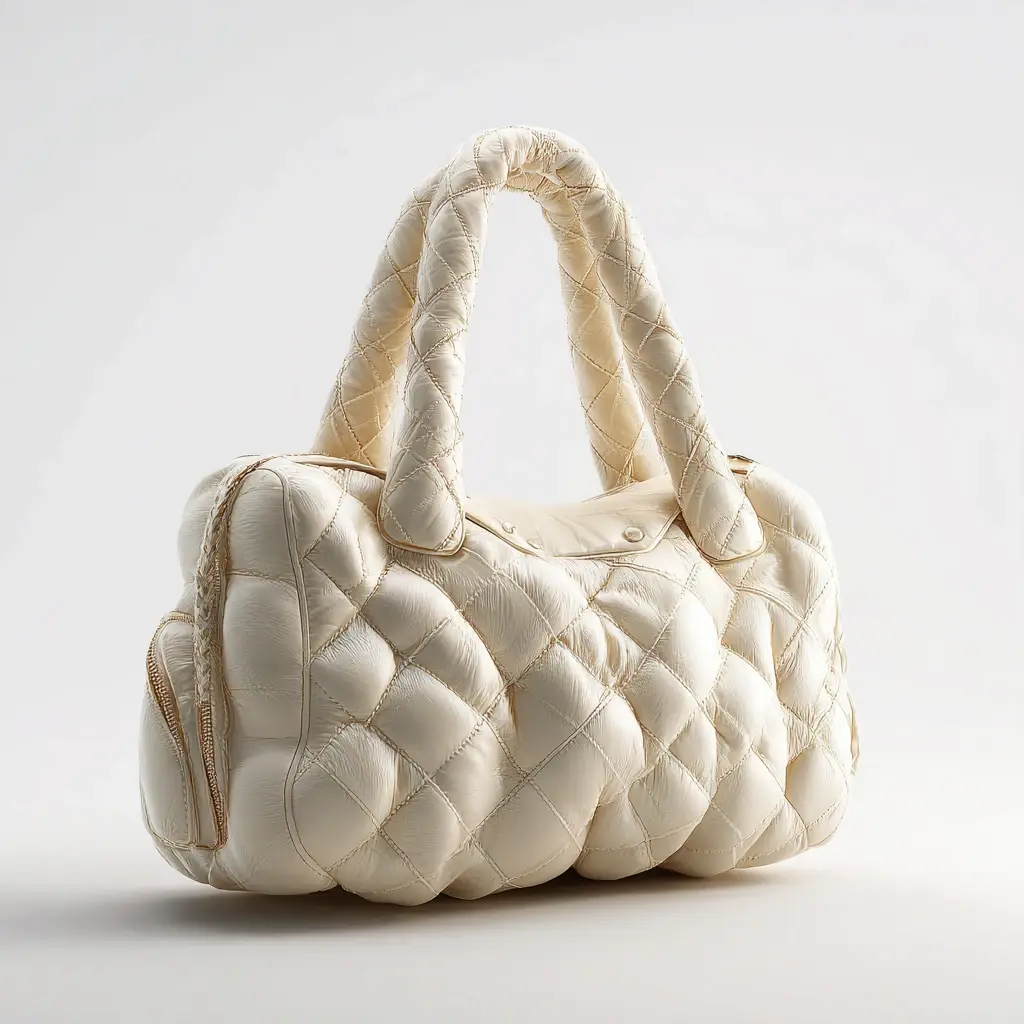
Volumetric weight is the quietest cost in a handbag programme because it is set by the carton rather than the product. Under the 6,000 divisor most carriers use, a 60 x 40 x 40 cm carton bills as 16 kg; reduce the height to 35 cm and the same carton bills as 14 kg, a 12.5% cut in the air charge. On ocean freight the same change is worth 0.012 CBM per carton, or 7.2 CBM across 600 cartons, which is close to 12% of a container's usable space. Geometry is therefore a specification question that belongs in the sampling stage, not a packing-day improvisation.
- Nest tote and shoulder bodies flat instead of stuffing them; stuffing adds volume without protecting shape.
- Specify 5-ply carton board for stack heights above 1.6 m so bottom cartons are not crushed on arrival.
- Cap carton gross weight at 15 kg so one handler can move it in the destination warehouse.
- Reduce height before width; loose folds waste height more often than they waste footprint.
Which Routing Mistakes Turn Into Fees Later
Most routing complaints are not about the vessel. They are about deadlines nobody wrote down. The Importer Security Filing for US ocean cargo must be lodged 24 hours before loading, and a late filing means penalty exposure plus a held container. Peak season surcharges appear between August and October with short notice, and reporting in Sourcing Journal and FashionUnited has made those windows predictable while first-time importers still get caught by them. Chassis shortages and appointment systems at individual terminals add a further day or two that no ocean schedule shows.
One line deserves its own check: the items missing from a first quotation are usually the ones that decide whether a routing is genuinely cheap. A carrier quote that excludes terminal handling, documentation, ISF and chassis looks USD 300-500 lower than an all-in one while costing more at the end. The carton-level freight estimate in the logistics set breaks these into a single sheet, and the walkthrough of fee lines that never appear in a first quotation lists them one by one.
- ISF lodged 24 hours before vessel loading at origin.
- Free time counted from gate-in, not from arrival at the consignee.
- Peak season surcharge confirmed in writing for August to October sailings.
- Detention clock starts when the container leaves the terminal, not when it is unpacked.
- Packing list carton count matched to the count actually loaded.
What Does a Clean Routing Checklist Look Like
A routing decision is only finished when it exists as a dated checklist with a named owner for each line. Six lines cover almost every failure seen on a first container, and each one can be confirmed by email before the vessel sails. If a forwarder cannot answer one of them in writing, treat that as information about the forwarder as much as about the route.
- Confirm the origin cut-off and the booking-to-sailing window in days.
- Lock carton dimensions and the total carton count for the whole order.
- File the ISF 24 hours before loading for US cargo.
- Confirm free time in days and the daily demurrage and detention rates.
- Agree the inland leg and its transit days before the vessel sails.
- Hold one named contact at destination for exceptions and appointment changes.
When Should One Order Split Across Two Ports
Splitting makes sense in two situations. The first is when a programme serves both the US and the EU and the delivery windows differ by more than 21 days; sending one 40' high-cube to Rotterdam and one to Los Angeles from the same Xiamen sailing costs slightly more per container but removes a transshipment and a second clearance event. The second is when inland distance makes one gateway expensive: shipping to Savannah instead of Los Angeles for East Coast demand saves 4-5 rail days, worth roughly USD 350-500 per container in avoided dwell and inland charges.
If a programme serves only one market, do not split. Two partial containers double the documentation, double the clearance risk and rarely recover the cost. Where a split does help, keep both legs on the same specification sheet and the same inspection batch so a single AQL 2.5 (ISO 2859-1) record covers both. For the full sequence from brief to first purchase order, work through the handbag sourcing guide; for customs values and duty assessment, see how duty is assessed on the declared value.
Where Insurance Fits on the Route
Under FOB Xiamen, risk passes to you when the goods are loaded, and everything after that is your exposure. Marine cargo insurance on handbag cartons typically runs 0.2-0.5 percent of the declared value, so a USD 57,000 order insures for roughly USD 115-285 for the transit. The decision is not about the safety of the vessel; it is that a general average event or a container washed over in heavy weather makes every uninsured carton a total loss while insured ones are claimed and replaced. The question of whether you need it is worked through in the guide to insurance for imported handbag shipments.
- Cost. 0.2-0.5 percent of declared value; roughly USD 115-285 on a USD 57,000 FOB order.
- Cover point. From loading at Xiamen under FOB; check which perils the policy covers, not only that a policy exists.
- Claims evidence. Loading photographs, the packing list and the inspection report are what a claim is paid against.
- Air freight. Carrier liability on air waybills is capped per kilogram at a fraction of cargo value; insure the difference.
LCL or FCL: The Break-Even on a Quarter-Full Container
A first order of 3,000 pieces is about 14.4 CBM, roughly a quarter of a 40' high-cube, and that raises a question the ocean rate cannot answer: consolidate or take the whole box. LCL is priced per cubic metre with a consolidation charge at the origin warehouse and a destination handling charge per CBM, so at 14 CBM the all-in per-carton figure often lands close to a full container's, without the container's fixed costs. The break-even on handbag cartons sits near 25-30 CBM: below it, LCL; above it, the box. The complication is handling, because LCL cartons are touched at two consolidation warehouses, which is why 5-ply board is not optional on a consolidated shipment.
| Option | Suits | Watch |
|---|---|---|
| LCL at 14.4 CBM | First orders under about 25 CBM | Per-CBM destination fees and extra handling |
| 40' high-cube FCL | Above roughly 25-30 CBM | Paying for unused space; demurrage if clearance slips |
| Consolidated with a second order | Programmes with two SKUs ready weeks apart | One packing list per shipment, not per order |
Tracking Milestones That Predict a Late Container
A container is rarely late without warning; the warnings sit in four milestones. The first is the origin cut-off confirmation — if the booking was not confirmed 48 hours before the consolidation cut-off, the cartons missed the vessel and the tracker has simply not caught up. The second is actual departure against the bill of lading date. The third is transshipment status, where a missed connection at a hub adds days that no port-to-port schedule shows. The fourth is the arrival notice and the free-time clock, which starts at gate-in rather than when the forwarder's email arrives.
- Origin cut-off. Confirmed 48 hours before consolidation; silence means a rolled booking.
- Departure against the B/L date. One day late out of Xiamen can mean a week late at the destination on weekly sailings.
- Transshipment. A missed hub connection adds 6-10 working days; ask which leg connects and where.
- Free time. Starts at gate-in; book the inland leg before the vessel docks, not after.
Send the destination city, carton count and target delivery week and you will get back a routing with transit days, free time and an all-in cost per carton. Get a Quote → /contact-quote/
Frequently Asked Questions
Which port is best for shipping handbags from China to the US?
For FOB Xiamen programmes, Los Angeles and Long Beach give the shortest ocean leg at 16-21 days port to port, with Oakland at 18-23 days for programmes that can accept fewer weekly sailings. Choose on dwell and inland distance, not on the ocean rate alone, because free time of only 4 days makes paperwork delays expensive.
How long does sea freight take from Xiamen to Rotterdam?
Expect 27-33 days port to port from Xiamen to Rotterdam, with Hamburg at 30-36 days and Antwerp at 28-34 days. Add 2-4 days for import clearance and another 2-4 days for inland delivery, so a realistic door-to-door figure for North Europe is 31-41 days after the vessel departs.
What is the cheapest way to ship a first handbag order?
A consolidated sea shipment out of Xiamen is cheapest per piece, at roughly USD 16-22 per carton on a 40' high-cube. The saving only holds if you avoid dwell: confirm free time, file the ISF 24 hours before loading and match the packing list count to the loaded count.
How many cartons fit in a 40' high-cube container of handbags?
A 40' high-cube holds about 68 CBM nominally, but handbag cartons load at 58-62 CBM in practice. With a standard 60 x 40 x 40 cm export carton at 0.096 CBM, that is roughly 600-640 cartons, or 12,000-12,800 pieces at 20 pieces per carton.
When is air freight worth it for handbags?
Air is defensible when missing the launch window costs more than 6% of the order's wholesale value, or when a style retails above about USD 150 and absorbs USD 5 per piece. Below that, ship by sea and move the launch date forward instead of paying 4-5 times more per piece.
What is demurrage and how much does it cost per day?
Demurrage is the charge for leaving a container inside the terminal past the free time allowed, commonly 4 calendar days on the US West Coast and about 7 days at Rotterdam. At USD 165 per day per container, a three-day documentation delay costs roughly USD 495, more than most ocean rate differences.
Do I need a customs broker for a handbag shipment?
Yes for US imports, where an Importer Security Filing must be lodged 24 hours before loading and entry filed on arrival. A broker also handles classification and duty payment. For EU imports a fiscal representative or broker performs the equivalent role and manages REACH Annex XVII documentation on leather and coated fabrics.
Should I ship FOB Xiamen or DDP to my warehouse?
FOB Xiamen gives control over the carrier, the routing and the cost lines, and it is the better choice once you have a forwarder you trust. DDP is simpler for a first container because one party owns clearance and delivery, but compare the all-in figure before deciding, since DDP quotes often bundle a margin into each line.
How do I reduce volumetric weight on handbag cartons?
Reduce carton height first, because loose folds waste height more than footprint. A 60 x 40 x 40 cm carton bills as 16 kg under the 6,000 divisor; cutting height to 35 cm brings it to 14 kg, a 12.5% reduction. Nest tote and shoulder bodies flat rather than stuffing them.
What documents are needed for a handbag shipment to the EU?
A commercial invoice, packing list, bill of lading and, where preferential origin is claimed, a certificate of origin. Leather and coated fabrics should carry REACH Annex XVII compliance evidence, and programmes using tanned leather should keep Leather Working Group documentation from the tannery available for inspection on request.
Can one container serve both the US and EU markets?
Not directly. A single container discharges at one port, so serving both markets means either a transshipment or two containers from the same Xiamen sailing. Split only when delivery windows differ by more than 21 days or when inland distance makes one gateway clearly expensive.
People Also Ask
What is the fastest shipping route from China to the US for bags?
Xiamen to Los Angeles or Long Beach at 16-21 days port to port is the fastest sea option, with consolidated air at 3-5 days door to door when the launch date cannot move.
How much does it cost to ship a container of handbags?
On a 40' high-cube from Xiamen, budget USD 16-22 per carton for the ocean leg plus terminal handling, documentation and inland delivery, which together often add USD 300-500 per container.
Which European port is best for first-time importers?
Rotterdam, because the 27-33 day leg from Xiamen is short for North Europe, free time of about 7 days is common, and onward barge and rail connections are dense.
How do I avoid demurrage charges on a handbag container?
Confirm free time in days before booking, file the ISF 24 hours before loading, match the packing list count to the loaded count, and pre-book the inland truck or rail slot so the container leaves the terminal inside the window.
Sources and further reading
Every figure on this page is either our own programme data or attributed below. Open the originals before you write them into a specification.
- Incoterms rulesICC The rules that decide where cost, risk and insurance transfer.
- REACH — chemical substances regulationEuropean Commission Annex XVII restricts the substances that may appear in finished leather and coatings.
- International Maritime OrganizationIMO Maritime rules governing container packing and dangerous-goods declaration.